Story ideas
What elf on the shelf classroom ideas work for teachers, including families who do not celebrate?
Elf on the shelf classroom ideas that stay optional: a paper visitor, a parallel activity for families who do not celebrate, and props to keep out of school.
The short answer
Elf on the shelf classroom ideas should be optional, short, and easy to skip. NAEYC says celebrating a holiday assumes every family shares it, while learning about a holiday does not. A paper figure on a bulletin board can stay at school. Do not send a doll home, and do not use loose high-powered magnets or button batteries as props.
Elf on the shelf classroom ideas have to work for a whole group, including children whose families do not celebrate Christmas and children who will never take a doll home. Keep any visitor optional, paper-based, and done in a single day or a single afternoon. Home pranks do not transfer to a classroom.
Key takeaways
- NAEYC says celebrating a holiday treats children as believers. Learning about a holiday does not. Santa-themed props are not culturally neutral.
- Penn State Extension says children under eight have a limited sense of time, and it suggests limiting a holiday to an afternoon or one day.
- Do not send a doll to students' homes. Do not require a take-home craft.
- Keep loose high-powered magnets and button batteries out of the room. The CPSC writes swallowed magnets can attract inside the body and that many cases have needed surgery.
What elf on the shelf classroom ideas are school-safe?
Use a paper figure you drew, or a flat laminated shape, pinned to a bulletin board at child height. It does not perch on a cabinet. It does not move to the bathroom, the lunchroom, or a heating unit.
A one-day sequence:
- Morning meeting, five minutes. Say: "Some families have a visitor like this at home. Some do not. Today the paper visitor will sit by our read-aloud. You can look, or you can draw at the other table."
- Read-aloud. Read a book the class already owns about winter, kindness, or families. Do not require a Christmas book. If a child mentions their own holiday, thank them and do not turn it into a presentation they did not ask for.
- Parallel table. Paper, crayons, and a prompt that is not religious and not commercial: "Draw a window in cold weather" or "Draw someone who helps our school." Penn State writes that rather than assigning a teacher-directed holiday craft to take home, children can make with open materials. It also writes a take-home display is not required.
- End of the day. The paper figure stays at school. Tell the class it does not visit houses. Parents are not asked to continue a scene tonight.
That is the whole idea. Home setups a family already chose are not homework.
How do you include families who do not celebrate?
NAEYC's anti-bias guidance on holidays, accessed October 30, 2026, draws a line teachers can use. Celebrating a holiday engages children as full participants, on the assumption that their families believe in that holiday's purpose. That fits a faith-based program, or a program where every family truly lives that holiday. Learning about a holiday means teaching what it means to the people who honor it, while being clear that children may keep their own family beliefs.
NAEYC also states that it is hurtful to impose one group's holiday on every child and every staff member, or to make some traditions visible and others invisible. You do not have to teach every holiday your families practice. You do have to avoid choices that leave a family out.
A second NAEYC piece, also accessed October 30, 2026, writes there are no cultural or religious holidays that are universal, and that secular or commercial parts of holidays are not culturally or religiously neutral. It names Santa Claus at Christmas as an example. A doll whose whole job is Santa's scout is not a neutral decoration. Treat it as optional, or skip it.
Practical moves:
- Send a short family note in October or November: "We will not send a doll home. If you want no visitor talk at all, tell me and I will offer the drawing table for the whole day."
- Do not ask "What do you want for Christmas?" Penn State suggests asking how a family will mark a season, or whether they will do anything special, and it writes to de-emphasize the commercial side.
- Do not make a child explain their religion to the class.
- If your program is faith-based and every family shares the celebration, you can go further, and NAEYC still writes families inside one belief system celebrate in different ways. Ask before you assume.
Home customs are not a curriculum, and they are not a class assignment.
Which props should stay out of the classroom?
Penn State notes that children under age eight have a limited sense of time. A visitor that "returns every night until the 24th" is a long, fuzzy promise. One afternoon is easier to understand, and easier to staff.
Unsafe props:
- Loose high-powered magnets, including magnetic balls sold as puzzles or desk toys. The CPSC writes these are a risk from the toddler years through the teen years. When two or more are swallowed, they can attract internally. Many incidents have led to surgery to remove the magnets and to repair stomach or intestinal injury. If you suspect magnets were swallowed, seek medical care immediately. Symptoms include abdominal pain, nausea, vomiting, and diarrhea. On an X-ray, several pieces can look like one object. The CPSC also writes these magnets can be up to eight times stronger than magnets used in toys.
- Button batteries and coin batteries. The AAP writes to keep children away from them because they can cause life-threatening injuries if swallowed, and to secure compartments in light-up toys and musical ornaments. A blinking classroom prop is not worth that risk. If you think a battery was swallowed, the AAP writes to go to an emergency room.
- Real candles, candy-shaped beads, and artificial snow spray. The AAP writes never to leave a burning candle unattended, to keep small removable parts out of reach, to avoid trimmings that look like food, and to follow directions on snow sprays so lungs are not irritated.
- Food "messes." Flour, cereal trails, and candy on a rug are allergen and choking problems in a group. Do not assign families a cleanup.
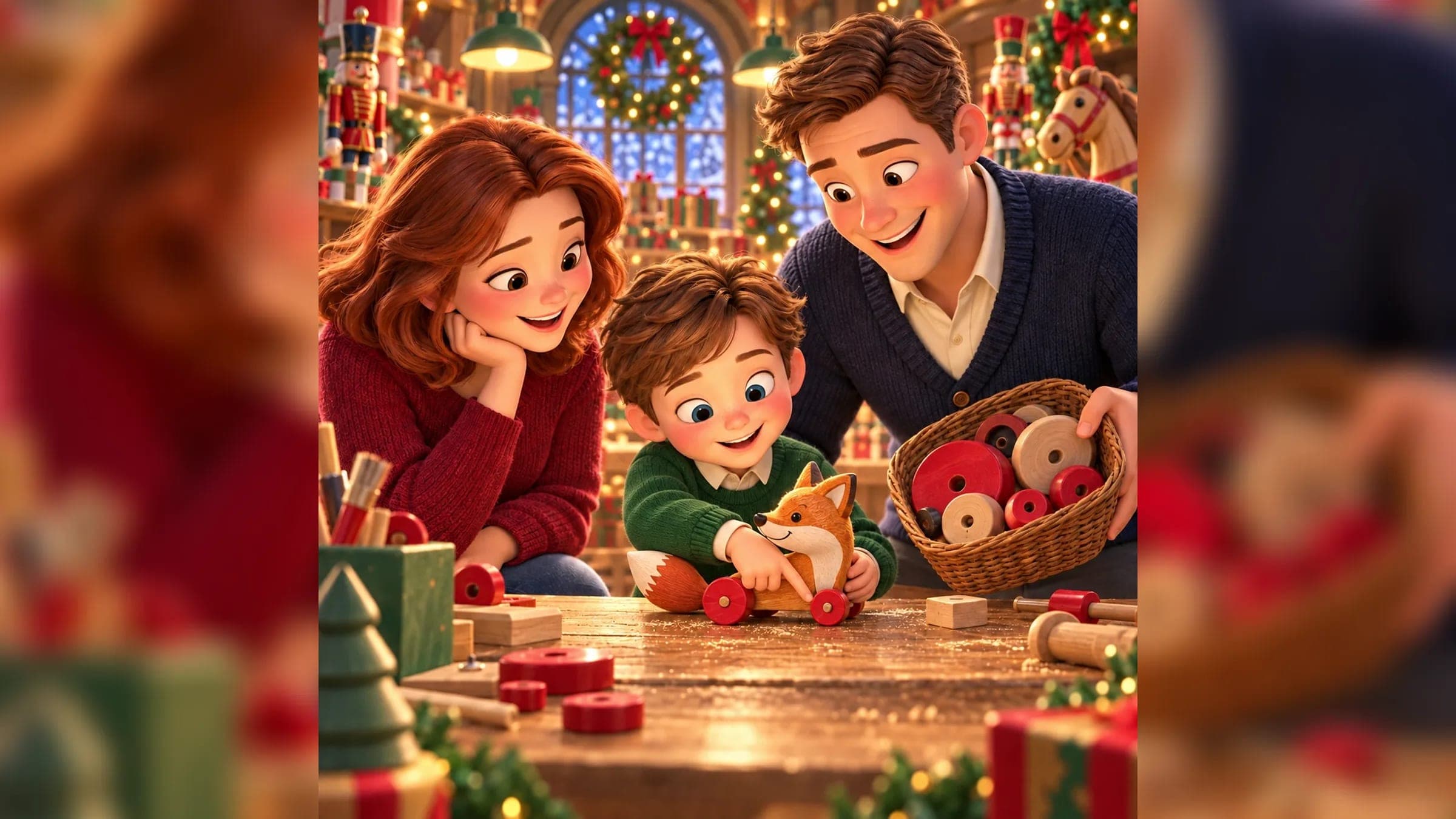
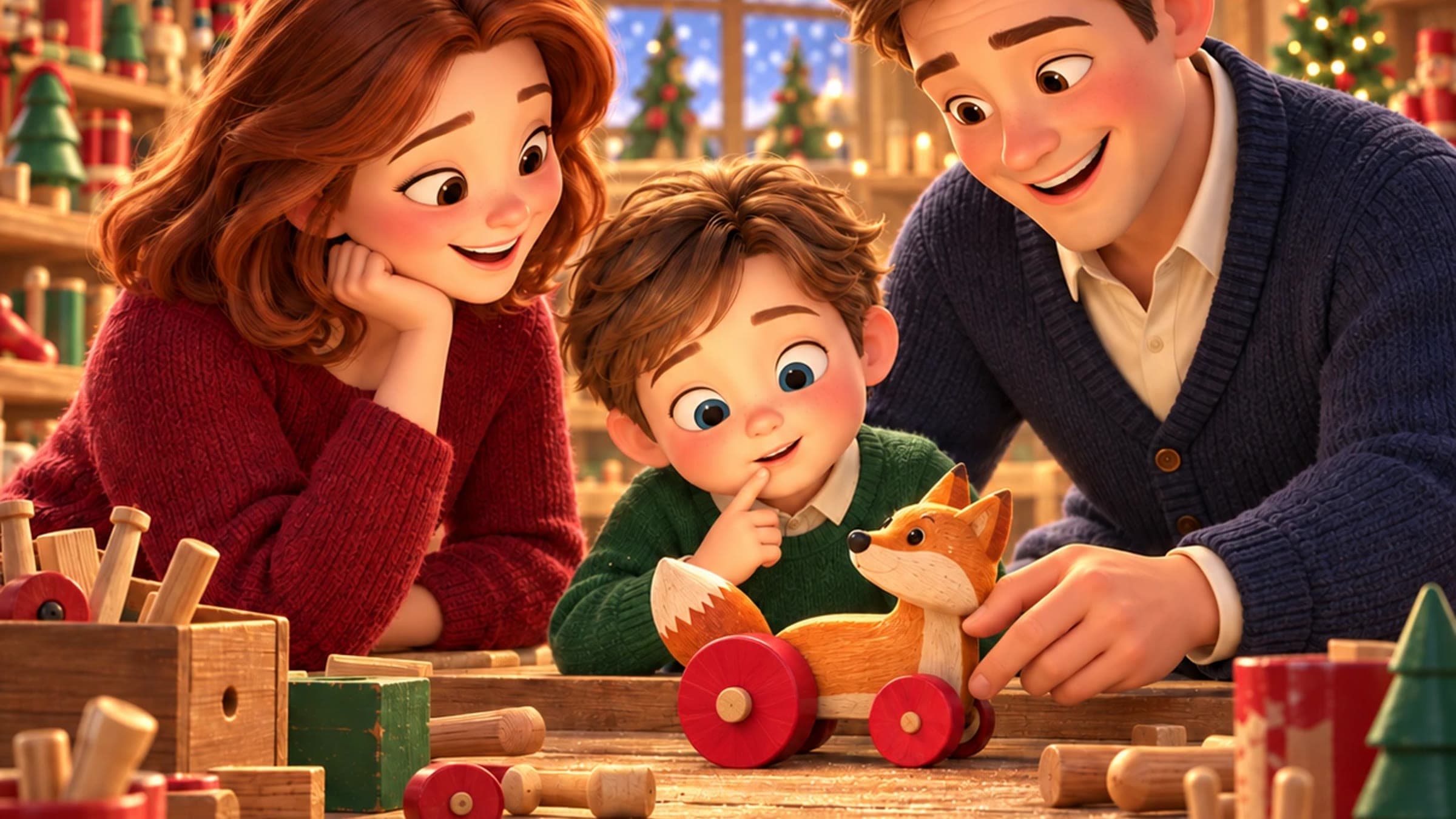
The sample Christmas book shows a child and two adults at a low workbench with a wooden fox toy. That scene is a home story, not a class mascot. It is a picture of people working side by side, which is the part worth borrowing: a shared table, blunt materials, nobody on a ladder. Do not tell students the fictional child in that book is a classmate.
What should you tell families?
A note you can send:
This week we may have a paper visitor on the bulletin board for one afternoon, next to a read-aloud. It will not come to your home. Children can draw at another table instead. Please tell me if you want your child in the drawing group for the day. We will not ask children what they want as presents.
If a family wants a home version, a scrap that stays at home is their choice. A Christmas Eve letter is a home event, not a class performance.
A holiday story made from a family's own photo is a home project, not a class assignment. Parents who want one can use the holiday story. One clear photo and a first name, customs they choose, and anything they want left out, including Santa. Prices are on Pricing. Teachers should not collect photos for this.
Frequently asked questions
What is a school-safe elf on the shelf classroom idea?
A paper figure that stays on a bulletin board for one afternoon, beside a book you already own, with a drawing table for anyone who opts out. No home delivery, no food mess, no magnets, no button batteries.
Do I have to include this if one family loves it?
No. NAEYC writes imposing one group's holiday on everyone is hurtful. A family can enjoy the custom at home without the class adopting it.
Can the doll visit a different student's house each night?
No. That pressures families who do not celebrate, and it sends a loose object into homes you do not control. Keep the paper at school.
How long should the classroom bit last?
Penn State suggests an afternoon or one day when possible, and notes that children under eight have a limited sense of time. A month-long perch is a home hobby, not a lesson plan.
What if a child is upset that their family does not do this?
Thank them, offer the drawing table, and do not negotiate their family's practice in front of the group. If the upset continues most days for more than two weeks, suggest the family talk with the child's doctor. A class activity is not medical care.
Sources
- Anti-Bias Education and Holidays: Making Thoughtful Decisions, National Association for the Education of Young Children, accessed October 30, 2026
- Holidays in a Diverse World: Applying Anti-Bias Thinking to Curriculum, National Association for the Education of Young Children, accessed October 30, 2026
- Holiday Celebrations, Penn State Extension Better Kid Care, accessed October 30, 2026
- Magnets, U.S. Consumer Product Safety Commission, accessed October 30, 2026
- Holiday Decoration Safety: 12 Tips for Families, American Academy of Pediatrics, accessed October 30, 2026