Story ideas
What are elf on the shelf goodbye ideas for the last day and Christmas Eve?
Elf on the shelf goodbye ideas for the last day and Christmas Eve: a farewell letter, words for a sad morning, and when ongoing sadness needs a doctor.
The short answer
Elf on the shelf goodbye ideas, last day ideas, and Christmas Eve elf on the shelf plans are one evening. The doll leaves, you read one farewell, and a weepy morning can be ordinary sadness. Depression guidance from the American Academy of Pediatrics separates that sadness from depression. If a low mood is present most days for more than two weeks, call the doctor.
The last evening is one job. The doll leaves, you read one farewell after dinner, and you store the doll where morning will not rediscover it. A child may be weepy, angry, or completely fine. The farewell gives the feeling a place to sit. It does not cancel the feeling.
Key takeaways
- Keep the departure to one evening. Do not invent a second exit on the 26th.
- Penn State Extension, accessed October 30, 2026, records that children under age eight have a limited sense of time, so "next winter" is a long blank. Offer a nearer marker, such as a folded page in a drawer.
- Depression guidance separates ordinary sadness from depression. If sadness is present most days for more than two weeks, call the child's doctor.
What are Christmas Eve elf on the shelf ideas for the last day?
Keep the scene smaller than the rest of the month. Three moves are enough.
- After dinner, and while the evening is still calm, read the farewell once.
- Let the child put the paper in a drawer, inside a picture book, or in an envelope they can open later. The doll goes into a closet or a bin the child does not search.
- In the morning, the doll is gone. Do not re-hide it as a joke. The joke undoes the departure.
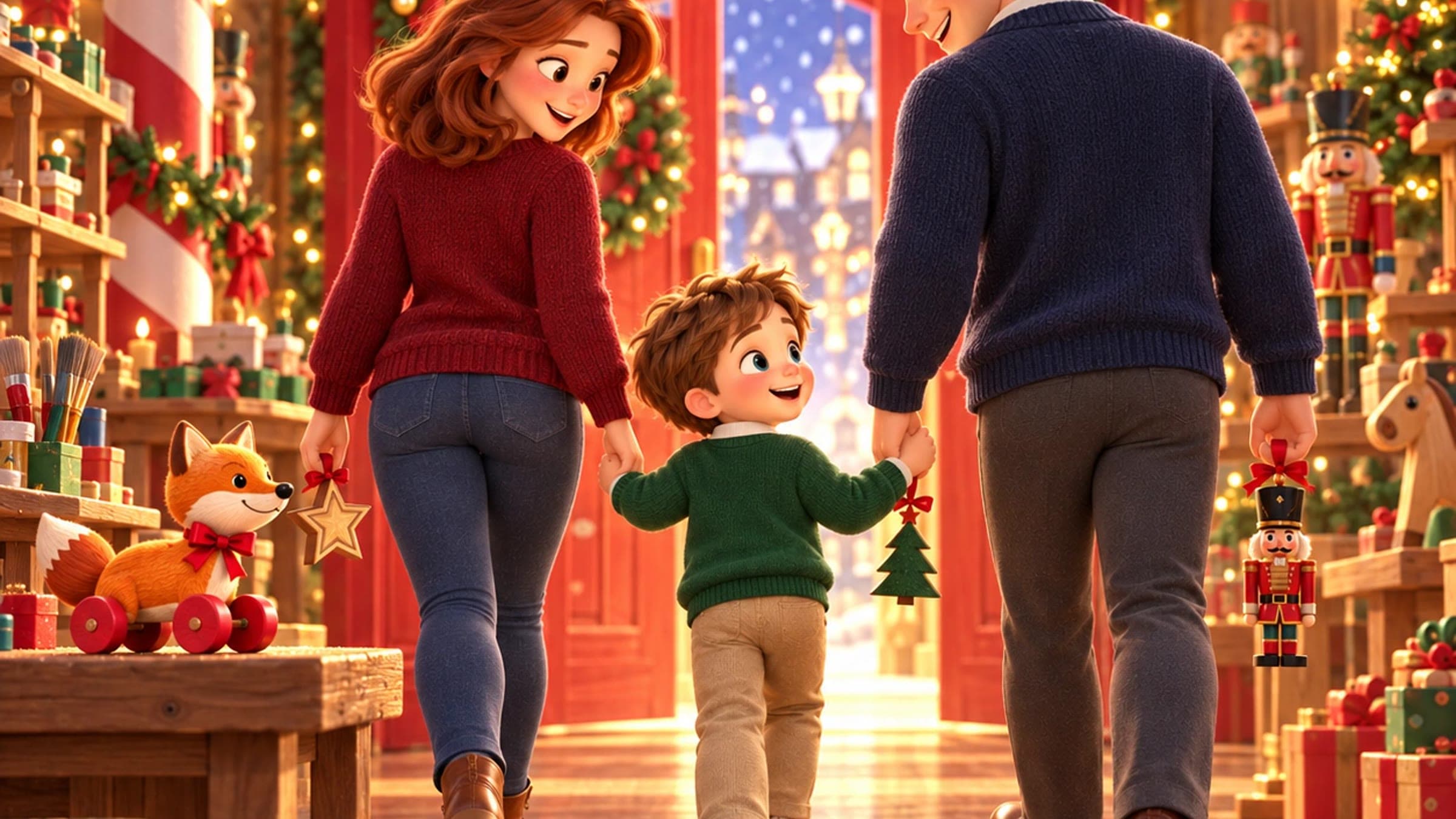
In the sample Christmas book, a child holds hands with two adults and walks toward open red doors, each person carrying a wooden ornament. That is a leaving picture: people going, objects staying small. Treat it as a mood, not a script you must copy. The people in the sample are fictional.
Other plans that are not a doll: a walk to see lights, or cocoa. If you want to retire the doll after this year, pick a custom you will actually repeat.
What can the farewell say?
This farewell is only for leaving. It is not a stack of daily scraps, and it is not a message from Santa.
Read this as the doll, then stop.
Tonight is my last night in your house. I am going back with the other travelers. I am not taking your toys, your bed, or your people. I saw ordinary days, and ordinary days were enough. If you feel mad or weepy in the morning, that feeling can stay. Your adults stay. I left this paper so you can put it somewhere you choose. When you want to remember the visit, read it. You do not have to be cheerful about me leaving.
Do not add a list of mistakes. Do not add a threat about next year's presents. The visit ends because the calendar ends, not because the child earned an exit.
What do you say when a child is weepy that the doll left?
Try this, in your own voice, sitting down:
You wanted another morning. The doll is gone, and your body is upset. I will sit here. We can be quiet, or we can put the paper in the drawer. Both are allowed.
Then wait. Do not rush a joke. Do not replace the doll with a bigger toy to shut the feeling down. ZERO TO THREE, accessed October 30, 2026, records that rituals help children manage strong feelings during a stressful change, by offering a repeated action and a reliable tone. The drawer can be that action: the same drawer, the same paper, the sentence "We can read it when you wish."
Penn State Extension's holiday guidance for early learning records that children under age eight have a limited sense of time. Adults may plan for weeks. A long wait can overwhelm a young child. "See you next winter" is a far-off sentence. Pair it with something closer: "When the snow melts, we will take this paper from the drawer once." If you do not get snow, use a nearer event you actually have, such as the first warm weekend or a grandparent's visit.
A single weepy breakfast is ordinary sadness. Depression guidance from the American Academy of Pediatrics, accessed October 30, 2026, records that it is normal for children to feel down sometimes, and that depression is not sadness or grief. Grief and sadness can be intense and still ease. Depression is when sadness and related symptoms are more intense or last longer than usual. Children may have depression if symptoms, which may include sadness, occur every day for more than two weeks. The two most common signs named there are seeming more sad and irritable than usual, in a low mood for most of the day, and no longer enjoying activities that used to feel good.
The doll leaving is not a diagnosis. If those signs show up most days for more than two weeks, or sleep and eating change in a way that worries you, talk with the child's doctor. The guidance tells caregivers to do that even if the child has not brought it up. A farewell is not treatment.
That guidance also estimates that between 2% and 3% of children ages 3 to 11 have depression, and that although it is not common, children as young as 3 have been diagnosed. That figure is about depression in general. It is not a claim that a December custom causes it, and it is not a claim that this doll is suitable for babies. It is why a long low mood deserves a doctor rather than another scrap of paper.
How does a kept story fit the last night?
Some households want the departure to point at an object they will still have in January. The holiday story can be that object. You add one clear photograph and a given name, describe the evening you want remembered, and you may omit the doll entirely. Prices are on Pricing. A printed copy starts after you approve the proof. Arrival by the 24th is not guaranteed. Printed copies take about 4–6 business days; mid-Nov through Dec allow 7–10+.
Frequently asked questions
What are elf on the shelf goodbye ideas?
Read the farewell on the 24th, let the child put the paper away, and do not re-hide the doll the next morning.
Are last-day plans different from Christmas Eve plans?
Not here. The doll leaves on Christmas Eve, so the goodbye and that evening are one event. A separate message from Santa is different paper.
What if my child does not care that it left?
That is a fine outcome. Do not perform extra sadness to make the custom feel important. Say goodbye once and move to breakfast.
When is sadness more than a doll leaving?
When a low mood is present most of the day, nearly every day, for more than two weeks, or the child stops enjoying things they usually like. Call the child's doctor. The academy's depression page is the source for that boundary, accessed October 30, 2026.
Should I promise the doll will return next year?
Only if you intend to do it. If you might stop, say "We will decide next winter." Penn State records that a long stretch of time is hard for children under eight to picture, so give a nearer moment to reread the farewell.
Sources
- Depression in Children and Teens, American Academy of Pediatrics, accessed October 30, 2026
- Holiday Celebrations, Penn State Extension Better Kid Care, accessed October 30, 2026
- Rituals and Routines: Supporting Infants and Toddlers and Their Families, ZERO TO THREE, accessed October 30, 2026