Story ideas
Should I wean my child off the pacifier now, and how do I run the goodbye?
Sort first-year sleep benefit from the wean window, then run a chosen goodbye with a named replacement — and when to involve a pediatric dentist.
The short answer
In the first year, keep offering a pacifier at naps and bedtime. AAP associates that sleep use with lower SIDS risk, so do not wean an infant for dental reasons. After year one, run a chosen goodbye: name a replacement comfort, keep one pacifier as a keepsake, and praise stretches without it. AAPD discusses stopping by 36 months; AAP flags strong sucking beyond two to four years. A story can rehearse the goodbye. It cannot replace a clinician.
Key takeaways
- In the first year, a pacifier at naps and bedtime is associated with lower SIDS risk. Do not wean a young infant for dental reasons.
- After the first year, decide whether this child is ready for a chosen goodbye — not a surprise disappearance.
- Name a specific replacement comfort before the goodbye, and praise the stretches without the pacifier.
- A story can rehearse that plan. It cannot straighten teeth, prevent ear infections, or replace a clinician.
Should I wean my child off the pacifier now, and how do I run the goodbye?
Do not start with a mail-the-pacifiers plan. Start by placing this child on a timeline.
If they are still in the first year, a pacifier at nap time and bedtime is doing a job the American Academy of Pediatrics ties to lower sudden infant death syndrome (SIDS) risk. That is the infant-benefit window. Do not take it away to protect baby teeth.
If they are past the first year — and especially as they move toward two, three, and four — you are in the wean window. The job then is a chosen goodbye: name a replacement comfort they can actually hold, keep one pacifier as a keepsake, and treat leftover sucking as a habit to ignore and praise around, not a character flaw. Harsh words, teasing, and overnight disappearance are the methods the AAP says backfire (Baby Pacifiers & Thumb Sucking).
A story can rehearse that goodbye. It cannot straighten teeth, prevent ear infections, or stand in for a pediatrician or pediatric dentist.
Is a pacifier still helpful in the first year?
Yes — at sleep, and only if the baby wants it.
HealthyChildren, the AAP's parent site, tells families to offer a pacifier at nap time and bedtime because that helps reduce the risk of SIDS. If you are breastfeeding, wait until breastfeeding is going well before offering one, usually about three to four weeks. Do not force a baby who refuses it. Never tie a pacifier to a crib, or around a child's neck or hand (Baby Pacifiers & Thumb Sucking).
The AAP's safe-sleep explainer says the same thing in the first-year recommendations: try a pacifier at nap time and bedtime; it helps reduce SIDS risk even if it falls out after the baby is asleep, and you do not have to put it back in. Do not hang it around the baby's neck or attach it to clothing while they sleep (How to Keep Your Sleeping Baby Safe).
The American Academy of Pediatric Dentistry's current pacifier policy also lists decreasing the incidence of SIDS among the reasons a pacifier may be beneficial in the first few months of life, alongside comfort, soothing, and helping some premature infants with the sucking reflex (Policy on Pacifiers).
That is why this page does not tell parents of young infants to wean for dental reasons. Teeth are not the first-year job.
How do I tell the infant-benefit window from the wean window?
Use the child's age, where the pacifier actually shows up, and whether a clinician has already raised the habit. The two professional bodies do not give one shared deadline. Keep their windows separate.
The AAP says that if a child sucks strongly on a pacifier, thumb, or fingers beyond two to four years of age, the habit may affect the shape of the mouth or how the teeth are lining up, and that if sucking stops before the permanent front teeth come in, the bite often has a good chance of correcting itself (Baby Pacifiers & Thumb Sucking).
The AAPD policy encourages a dental home by 12 months so families can get anticipatory guidance that includes discontinuing nonnutritive sucking habits by 36 months. In the same statement it notes that usage after 12 months of age can increase the risk of acute otitis media, and that use beyond 18 months can influence the developing orofacial complex, including anterior open bite, posterior crossbite, and Class II malocclusion (Policy on Pacifiers). Those are counseling points for a medical or dental visit — not a reason to wean a baby still inside the first-year sleep-benefit window.
| What you are seeing | Window | What to do next |
|---|---|---|
| Under 12 months; pacifier is mainly for naps and bedtime | Infant-benefit | Keep offering it at sleep. Follow the safe-sleep rules. Do not wean for teeth. |
| Past the first birthday; pacifier is still mostly for sleep; no clinician has flagged the bite | Early watch | Start naming a replacement comfort. Ask about the habit at the 12-month dental-home visit. Do not jump to a cold-turkey goodbye. |
| Closer to 2–4, sucking is strong and frequent, or a pediatrician or pediatric dentist has raised the habit | Wean window | Run a chosen goodbye with a named replacement. Praise the stretches without it. Book the mouth check if the palate or bite looks different. |
If the harder object is the bottle, not the pacifier, that is a different job — see weaning off the bottle.
How do I run a chosen goodbye with a replacement comfort?
Skip this section if the child is still in the infant-benefit window. The script below is only for a family that has already decided this child is in the wean window.
The AAP's first step is to ignore the habit. Most children stop on their own. Harsh words, teasing, or punishment can upset the child and are not an effective way to end sucking. What the AAP does recommend: praise and reward the times they do not use the pacifier; use star charts, daily rewards, and gentle daytime reminders; and if sucking is filling boredom, keep their hands busy with something they find fun. Explain whatever method you try. If it makes the child afraid or tense, stop (Baby Pacifiers & Thumb Sucking).
Turn that into a short plan you can actually run.
- Name the job the pacifier is doing. Bedtime, the car, a loud room — say it in one sentence so the goodbye has a reason, not a scolding.
- Name the replacement before the goodbye. A specific stuffed animal plus one calming move they can do anywhere. "Hold Moss and take three slow breaths" is a plan. "Be a big kid" is not.
- Choose a goodbye they can see. Keep one pacifier in a small keepsake tin. A memento is easier than a total disappearance. Do not snip it in secret or make it vanish overnight.
- Practice the sequence for several days. Read the plan at the calm part of the evening, not on the night you collect the pacifiers.
- Stay warm and matter-of-fact on the wobbly nights. Consistency shortens the transition. A lecture at 2 a.m. lengthens it.
- Praise the stretches without it. Point to the nap or the car ride that did not need the pacifier. Do not narrate every reach for the old one.
The names below are invented for illustration. In a real personalized book the hero is your own child.
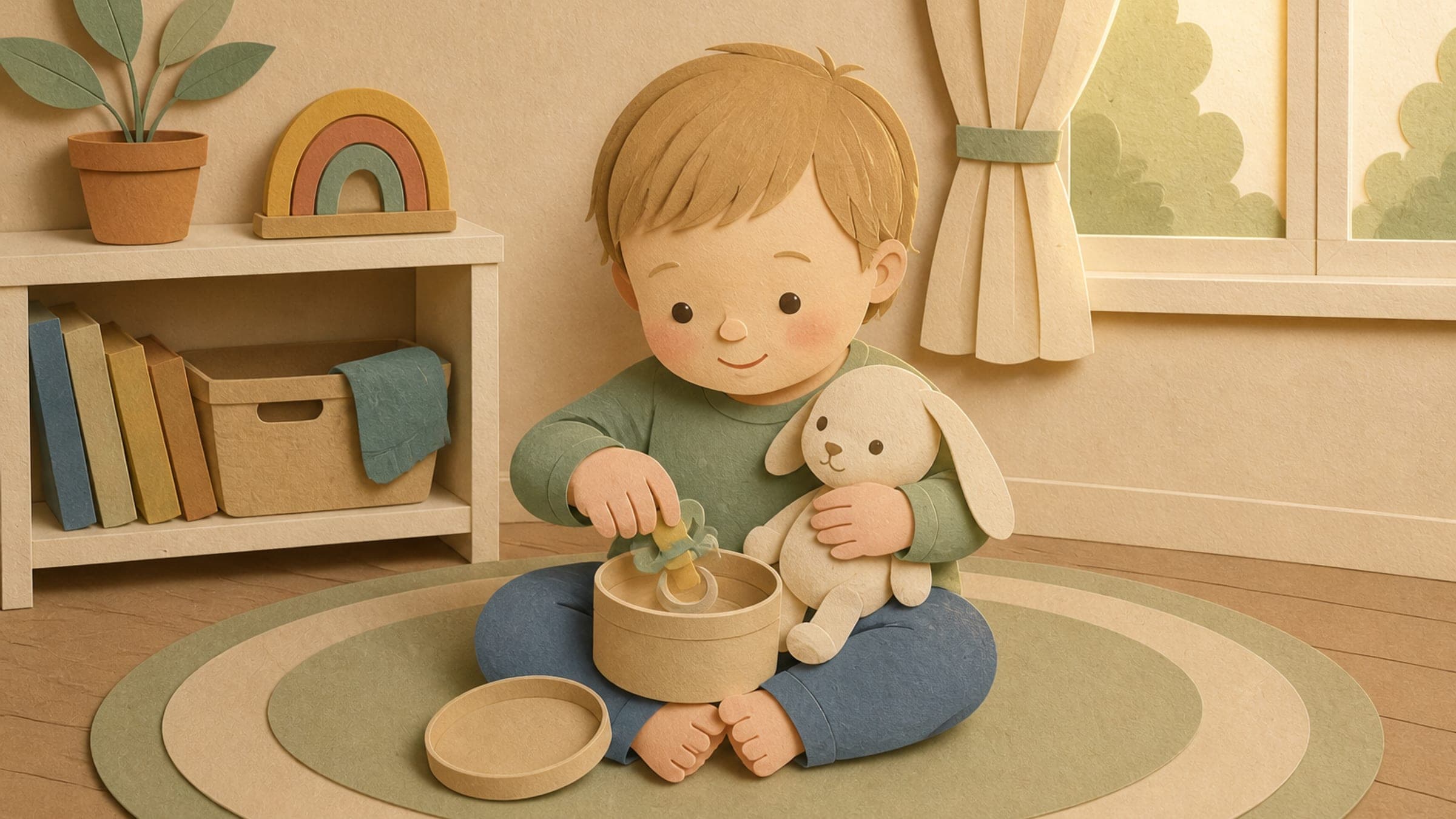
Nora is two and a half. Her pacifier still comes out the moment the day gets loud. In the story she puts the extras in a box, keeps one in a small tin on the dresser, and holds her stuffed bunny Moss for the hard minutes. Real Nora hears that plan for a few nights, then does the same thing on a Saturday morning — not as a surprise, and not because a book promised her teeth would line up.
If the replacement comfort is doing the work at bedtime, build it into the nightly wind-down — see how to build a bedtime storytelling routine. If the whole sleep place is changing at the same time, do not stack both goodbyes in one week; the crib-to-big-kid-bed transition is a separate job.
When should I involve a pediatrician or pediatric dentist?
Sooner than a crisis, later than a single wobbly night.
The AAP says to talk with your pediatrician or pediatric dentist if you see changes in the roof of the mouth or in the way the teeth are lining up. There are devices that can make finger or thumb sucking uncomfortable; those belong in a clinician's office, not in a parent experiment (Baby Pacifiers & Thumb Sucking).
The AAPD wants that conversation on a calendar: establish a dental home by 12 months so there is time for guidance on stopping nonnutritive sucking by 36 months, and so medical and dental clinicians can give consistent messages about a prolonged habit (Policy on Pacifiers). If ear infections are part of what you are seeing, take that to the pediatrician — the AAPD notes an increased acute-otitis-media risk with pacifier use after 12 months, and a story cannot prevent it.
If the appointment itself is the hard part, use the child-afraid-of-the-dentist preview-and-practice plan. Do not treat the read-aloud as the dental visit.
How is giving up a pacifier different from thumb sucking?
A pacifier is an object. You can retire it, keep one in a tin, and give the goodbye a finish line. A thumb goes everywhere the child goes, so there is nothing to put away.
That is why this page is a decision-and-goodbye guide, and the thumb-sucking guide is a habit-reduction script: ignore first, catch the trigger, praise the thumb-free stretches, and loop in a dentist if strong sucking continues past age three. Do not merge the two jobs. If the child uses both, pick the object goodbye first only when they are already in the wean window — the thumb still needs the longer routine.
What can a personalized story actually do?
It lets a child watch a character who looks like them put the pacifier in the tin and reach for the named replacement, before the real Saturday morning. That is rehearsal. It is not a treatment.
The useful book names the real stuffed animal, the real tin, and the real wobbly-night line you will use. A book that ends on "and then they never needed it again" is a promise this page will not make.
Keep reading: if the habit is a thumb rather than an object, start with when to worry about thumb sucking.
More related guidance:
- How to Build a Bedtime Storytelling Routine
- Weaning Off the Bottle: A Story That Makes the Big-Kid Cup Exciting
- Moving From a Crib to a Big-Kid Bed: A Transition Story
- Child Afraid of the Dentist? A Parent Script That Helps
- Personalized Story Ideas Hidden in Everyday Family Moments