Reading together
What belongs in a preschool bedtime routine?
A preschool bedtime routine is a short, repeatable order: brush, a book, then bed, plus the wash and pajama steps your house already uses.
The short answer
A preschool bedtime routine is a short sequence the child can predict. The American Academy of Pediatrics teaches brush, then a book, then bed. The CDC uses that same trio as an example and says routines help children know what will happen next. Many families add a wash, pajamas, one comfort object, and a goodnight line before the light goes down. Keep one hard moment in the practice, and do not treat the routine as a sleep cure.
Key takeaways
- Brush, a book, and bed are the core the American Academy of Pediatrics teaches. Add only the wash, pajama, and goodnight steps your house already uses.
- Predictability is the point. The CDC says children feel safer when they know what happens next, and when adults follow through.
- Rehearse one hard moment, such as stopping play or one extra request. A picture book can make that path familiar. It cannot treat a sleep problem.
A preschool bedtime routine is a short, repeatable order, not a long performance. Put toothbrushing first, then sit down with a book, then get into bed at a regular time. That is the Brush, Book, Bed sequence from the American Academy of Pediatrics. The CDC uses the same trio as its example of a nighttime routine and says consistent routines help children know what to expect. Families often tuck a face wash, pajamas, a comfort object, and one goodnight line around that core. Write the order down the way it already happens in your house, and keep one ordinary snag in view instead of trying to fix the whole night.
What belongs in the routine
Start with the three steps that outside guidance already names.
Brush. The AAP says every night should include help with brushing, and that the toothbrush should be the last thing to touch the teeth before bed. Young children still need an adult turn with the brush. Toothpaste amount, fluoride, and flossing belong with the child's dentist and with the AAP's current oral-health notes, not with a story you invent. If brushing is the nightly standoff, the brushing guide covers how to make the two minutes a job the child can help with.
Book. After brushing, the AAP says to find a comfortable spot and read. It describes even 15 minutes of reading aloud as time that supports language and social-emotional skills, and it invites silly voices, songs, and books the child helps choose. That read is a lap activity. It is not a test of letters.
Bed. The AAP says a predictable series of steps helps a child wind down, and that a regular bedtime works better than waiting until eyes are already rubbing. The CDC's sample evening ends with pajamas, cuddles, and lights out after the story. Pick a time you can keep on ordinary nights. Say it out loud so the child hears the same plan.
Around that core, add only steps that already exist:
- A wash or a bath, if that is truly before pajamas in your house.
- Pajamas and the same comfort object, named the way the child names it.
- One goodnight line. "We are nearby" is enough if that is what you say.
- A door or a lamp set the way the child is allowed to choose it: a little open, a little low.
Leave out new rituals you hope will be impressive. A routine that changes props every night is a show, and the child cannot predict a show.
The CDC also says to match tasks to what a toddler or preschooler can actually do, and to explain a change while everyone is calm. If Saturday means a later book because cousins are visiting, say so before the snag, not in the middle of tears.
Storytelling at bedtime
For the reading step itself, start with one fixed cue, let your child finish lines they know, and close on the same last sentence every night.
Keep the order, and keep it short
Order is the part children use. If the book sometimes comes before the brush and sometimes after a snack in bed, the sequence is not a sequence. The AAP's order is deliberate: brush, then book, then bed, so the toothbrush stays last on the teeth.
Length matters because preschool attention is short. The CDC notes that longer routines are harder to stay with. A workable preschool version is often:
- Finish the last game and name that play is ending.
- Wash face or take the bath you already do.
- Pajamas.
- Brush, with an adult helping.
- One book, chosen from two options, not from the whole shelf.
- A short song or the goodnight line, then the lamp and the door.
If the list needs a second page of instructions, cut it. The child should be able to point at the next step.
A Christmas Eve box or any other special night can still use this order. Open the box early, then return to brush, book, and bed. Christmas Eve box ideas shows how a small kit can sit inside the same routine instead of replacing it.
Rehearse one hard moment
Most evenings have one place they bend. Common ones:
- Play that will not stop.
- One more water, one more snack, one more everything.
- The room feeling too dark.
- A bed that is not the one at home.
Pick one. Practice that beat in words you can repeat: "It is hard to stop when you are having fun," then the next real step. Do not stack every fear into one night. A story that solves darkness, separation, and a new house in eight pages is asking the child to hold too much.
The picture book is a rehearsal, not a result. It can show the child choosing the first step, pausing when a feeling shows up, and still finishing the path. It should not promise sleep, fewer wakings, or a morning that goes perfectly. If snoring, breathing, or daytime exhaustion is the concern, that belongs with a pediatrician. The guide to sleeping in their own room is a separate question about where the night happens. This routine can travel to that room, but it does not decide the room.
Inside the personalized bedtime book
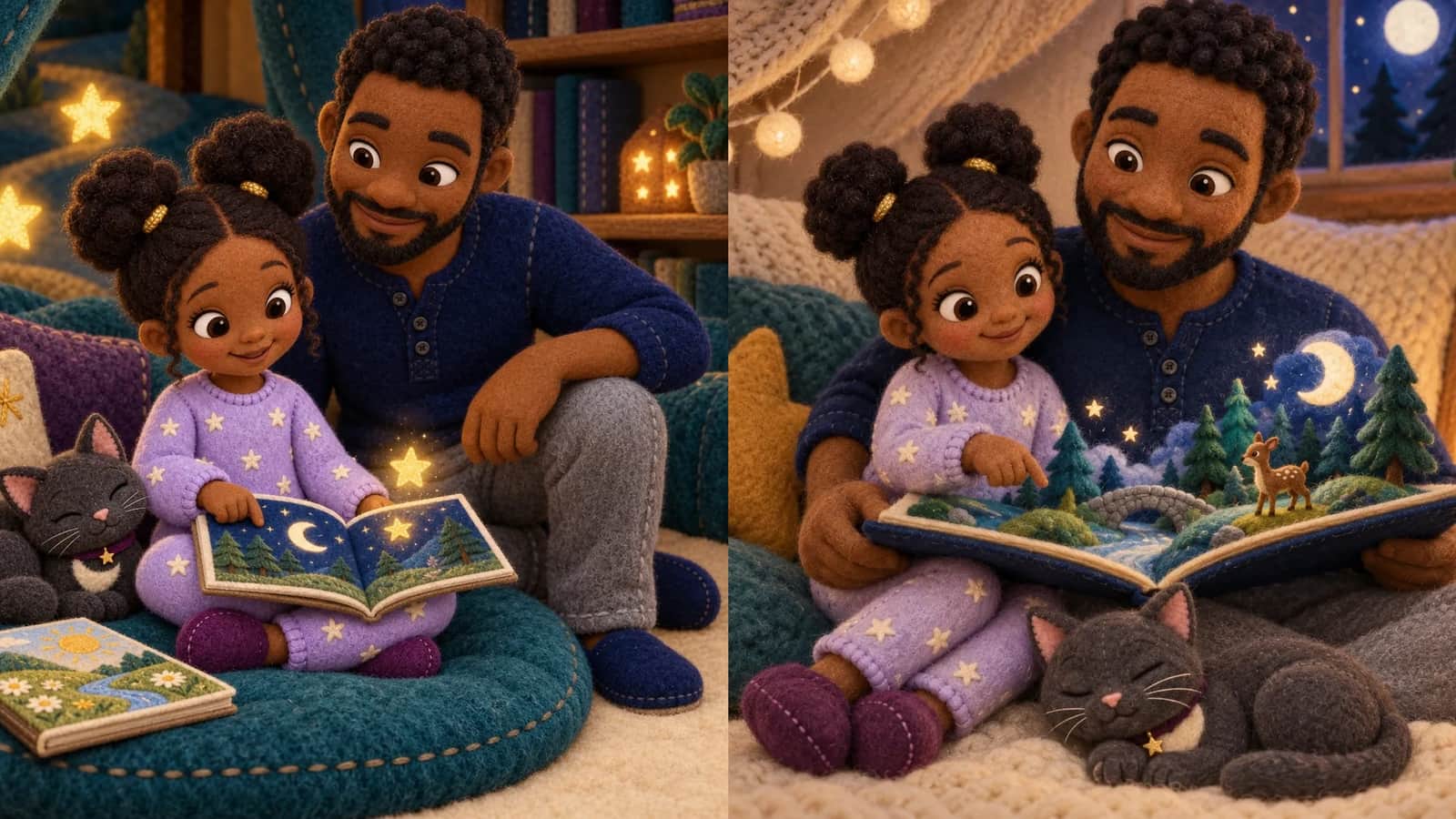
The sample personalized bedtime book runs 20 illustrated story pages, with a cast of a child, two caregivers, and a cat. The spread at the top of this page is the middle of that fictional evening. Read the full personalized bedtime book.
The sample follows a made-up path: play ends, a face is washed, pajamas go on, teeth are brushed with an adult close by, one book is chosen, a last request shows up, and the door stays a little open. Those beats are an example of brush, book, and bed with a wash in front. They are not your child's night, and the names in the sample are not people you know.
What a finished bedtime book looks like
On the Storybook Studio bedtime form, you type the order, a goodnight phrase, and one comfort object or night-light. You choose one hard part from the four the form offers: stopping play, extra requests, a dark-room worry, or sleeping somewhere unfamiliar. The cast is the child plus at least one caregiver, up to four characters, and a pet can be one of them. Each person or pet needs a separate clear photo. You approve the drawn likeness before the story pages are illustrated.
The form does not ask for a numeric age. It is a picture book for a shared read, which the age guide helps you judge. It does not include infant sleep, crib, medicine, or lock-the-door advice. A PDF is part of the order. A printed copy starts only after you approve the proof. Prices and production time are on Pricing.
If the gift is the book itself, the bedtime book gift guide walks through who it is for. For more story ideas that start from ordinary family life, see personalized story ideas for everyday family moments.
Frequently asked questions
What belongs in a preschool bedtime routine?
Brushing with an adult's help, a short read-aloud, and bed at a regular time. Add a wash, pajamas, a comfort object, and a goodnight line only when those are already part of your evening.
Does the book have to come after the toothbrush?
That is the AAP order, so the toothbrush stays the last thing on the teeth. If your dentist has given you a different plan, follow the dentist. Do not invent a third order in the story.
How long should the routine take?
Short enough that a preschooler can stay with it. The AAP describes about 15 minutes of reading as a useful book step. The CDC notes that long routines are harder. Cut steps that you do not actually do.
Can this replace a conversation with a pediatrician?
No. A predictable story can make a known path familiar. Snoring, breathing trouble, or a sleep problem that is wearing the household down needs a clinician, not another picture book.
Related reading:
- See a finished personalized bedtime book
- Start a bedtime book
- A bedtime book gift
- Personalized story ideas for everyday family moments
- Brushing teeth without a fight
- What to write in a children's book dedication
Sources
- Brush, Book, Bed: How to Structure Your Child's Nighttime Routine, American Academy of Pediatrics, accessed October 29, 2026
- Tips for Relying on Routines and Rules, Centers for Disease Control and Prevention, accessed October 29, 2026