Story ideas
How do you help a child learn what to do with anger?
Name the anger, block the hit, and practice one safe choice when calm: a stomp, a breath or a walk away. What to say in the moment and when to call the doctor.
The short answer
Anger is allowed. Hitting, breaking things, and hurtful words are not. When everyone is calm, pick one safe choice and practice it — for a toddler that may be stomping feet; for an older child, a slow breath, a count to 10, or walking away. In the hot moment, keep people safe and wait until they can hear you. A story can rehearse the choice. It cannot stop aggression or replace a pediatrician.
Key takeaways
- Anger is a strong feeling. Hitting, breaking things, and words that hurt are not the way through it.
- Practice one safe choice when everyone is calm. Do not teach a new tool in the middle of the heat.
- In the hot moment, keep people safe, say the limit in one sentence, and wait until your child can hear you.
- Call the pediatrician when hurting is frequent, someone is injured, or you are afraid for people's safety. A story can rehearse the choice. It cannot treat aggression.
How do you help a child learn what to do with anger?
Name the anger. Block the hit. Practice one safe choice when everyone is calm.
The American Academy of Pediatrics says anger does not usually last a long time, but it is a very strong feeling when it happens. Children get mad when their feelings are hurt, they cannot do what they want, others do not understand them, they feel left out, or other people do not act the way they hoped. Their hearts beat faster. Their faces feel hot and sweaty. It can be hard to breathe, hard to think clearly, and hard to stay still. While they are mad, it is good to put the feeling into words. It is not good to hit someone, break things, or say things that hurt (Everybody Gets Mad: Helping Your Child Cope with Conflict).
That is the whole job on this page. Not "stop feeling angry." Not "be sweet." One true sentence about the feeling, one hard line about hurting, and one choice they have already practiced.
A story can walk through that sentence and that choice on a quiet afternoon. It cannot make the feeling smaller on command, and it cannot replace a pediatrician.
Is this anger, a tantrum, or the repair after someone got hurt?
Stay on this page when the hard part is a hot feeling that needs a safe place to go.
A full tantrum, with thinking offline, is a different job. So is the morning after they hurt someone and need to repair it. So is falling apart because they lost a game. Mixing those jobs turns one choice into a pile of lectures.
| What you are seeing | What it usually means | Which page |
|---|---|---|
| Their face is hot, their body wants to move, and they need something to do instead of hitting | Anger that needs one safe choice | This page |
| The wave is already a scream, a floor, and a child who cannot hear a lesson | A tantrum | Big feelings and tantrums |
| The heat already came out as hurting, and the next job is a real apology | Repair after they were unkind | When your child was the mean one |
| The heat is a lost game, a last place, or a turn that ended | Disappointment | Losing a game |
| They lied because they were scared of what the anger would cost | Coming clean | Telling the truth after a lie |
| The same fight starts every time the screen has to stop | A tablet transition | Giving up the tablet |
The table is editorial sorting. The AAP, CDC, and ZERO TO THREE pages do not publish this chart. Use it to pick one job. Do not run four scripts at once.
What can a child do with anger instead of hitting?
Pick one choice from the list that matches their age. Practice it when nobody is mad.
For children in a peer conflict, the AAP's "ACT" steps are specific. Acknowledge the angry feeling and the body changes. Calm down by breathing deeply, counting to 10, or walking away — or by punching a pillow, running, or playing music. Then think about the problem and talk about a fix that is not a fight. If there is nobody to talk to right away, the page's line is to stop and think, "This is why I'm mad and what I need to do is ..." If another child is trying to start a fight, the same page says to keep a safe distance, take slow deep breaths, skip the name-calling, listen, and walk away if nothing else works (Everybody Gets Mad).
You do not need all six calm-down options. One is enough. A family that does not want a pillow punch — because it still looks like hitting — can use the breath, the count, or the walk. Those are on the same list.
For toddlers, ZERO TO THREE is the page that names the body choices in plain language. When a toddler is really angry, it suggests jumping up and down, hitting the sofa cushions, ripping paper, curling up in a cozy corner, painting an angry picture, "or some other strategy that you feel is appropriate." It also names the praise that fits: "You stomped your feet when you were mad rather than hitting." The point it states is to teach that there are non-hurtful ways to show the feeling, and to practice them regularly — not to invent a new trick during the hit (Aggressive Behavior in Toddlers). That stomping line is toddler guidance. Do not treat it as a school-age prescription. An older child can use the AAP conflict list above.
For toddlers and preschoolers who are angry but still able to talk with you, CDC's emotion-coaching page is the naming script. Notice the feeling. Connect. Listen without judging the emotion. Name it in simple words — its example is, "I see that your blocks fell. Are you feeling angry?" Then find a solution only after you have accepted the feeling. The sentence it gives is, "It's ok to feel angry, but it's not ok to throw our blocks," followed by a small choice such as stacking again or starting a puzzle. It says rushing into the solution too soon can dismiss the feeling and make things hotter (Tips for Noticing and Naming Emotions).
- Choose one safe outlet before the next hard afternoon. Toddler: a stomp, a jump, or the sofa cushions, from the ZERO TO THREE list. Older child: one item from the AAP list — a slow breath, a count to 10, a walk away, a pillow, a run, or music (Everybody Gets Mad; Aggressive Behavior in Toddlers).
- Practice it while everyone is calm. CDC says to notice feelings when they are still low, before distress, and to model a pause and deep breaths yourself while your child is watching (Tips for Noticing and Naming Emotions). A Saturday living-room practice is the lesson. The moment of the hit is not.
- Pair it with one sentence. "You are angry. Hitting is not allowed." That matches the CDC line that all emotions are acceptable and not all behaviors are, and the AAP line that words are good and hurting is not (Tips for Noticing and Naming Emotions; Everybody Gets Mad).
- Praise the safe choice, not a performance of never being angry. The AAP says to tell a young child how grown-up they are acting when they are kind and gentle instead of hitting, kicking, or biting (10 Tips to Prevent Aggressive Behavior in Young Children). ZERO TO THREE's example of useful praise is the stomp that replaced the hit (Aggressive Behavior in Toddlers).
- Show the same choice yourself. The AAP says children do what they see, and that one of the best ways to teach is to express your own anger in quiet, peaceful ways (Everybody Gets Mad; 10 Tips to Prevent Aggressive Behavior). CDC says if you want a child to pause and breathe, do it where they can see you (Tips for Noticing and Naming Emotions).
What do you say while they are still hot?
Keep bodies safe. Say the limit once. Save the lesson for when they can hear you.
CDC draws the line by whether they can still engage. Emotion coaching is for an intense feeling, including anger, when they are not in distress. If they are distressed or in a tantrum, the order is different: make sure your child and other people are safe, stay close, offer time and space to calm down, and wait until both of you are calm before coaching. It also tells you to pause and take a breath yourself first. If you need a longer pause, another trusted adult has to be with the child. As long as nobody is in immediate danger, sitting quietly together is allowed (Tips for Noticing and Naming Emotions).
For toddlers and preschoolers, the AAP is blunt about self-control. Young children have little of it. They need you to teach them not to kick, hit, or bite, and to use words instead. Occasional outbursts are normal, especially during tantrums. If a physical fight continues after they are told to stop, or one child is in a rage and is hitting or biting, pull them apart and keep them separate until they have calmed down. If the fight is very violent, end the play. It does not matter who started it. There is no excuse for trying to hurt each other. Until age 3, and sometimes later, children often do not understand punishment. Clear, calm, sure limits work better. Threats ("stop it or else") are weaker than teaching a different behavior. A time-out is a last resort, not the first move (10 Tips to Prevent Aggressive Behavior in Young Children).
ZERO TO THREE, writing about toddlers, says the same sequence in different words. Aggressive behavior is a sign they are out of control and need help calming down before any teaching can happen. Stay calm yourself — a few deep breaths, or your own minute away if another adult is there — because your agitation often makes their distress bigger. Name the feeling and the limit together: "You are really angry. It is not okay to hit. Hitting hurts." If you stop the behavior and offer no alternative, the behavior is more likely to continue (Aggressive Behavior in Toddlers).
- Stop the hurt before you explain it. Separate bodies if someone is being hit or bitten. The AAP says to pull children apart when a fight continues, and to keep them apart until they are calm (10 Tips to Prevent Aggressive Behavior). CDC's first step in a tantrum is safety (Tips for Noticing and Naming Emotions).
- Use one sentence, not a speech. "You are angry. I will not let you hit." Then stop talking. CDC says problem-solving too early can dismiss the feeling and escalate things (Tips for Noticing and Naming Emotions).
- Offer the one choice they already know, and only once they can hear you. A brand-new breathing lesson shouted across the room is not the practice from the last section.
- Do not hit back, bite back, or threaten. The AAP says to avoid threats and to control your own temper (10 Tips to Prevent Aggressive Behavior). ZERO TO THREE says to use a matter-of-fact voice, not a screaming one (Aggressive Behavior in Toddlers).
- Come back to the choice after the heat drops. Some toddlers can talk it through soon after. Others need longer. ZERO TO THREE says the best timing for "what else could you do" varies, and that having no ideas yet is normal (Aggressive Behavior in Toddlers).
The names below are invented for illustration. In a real personalized book the child on the page is yours, built from your photo.
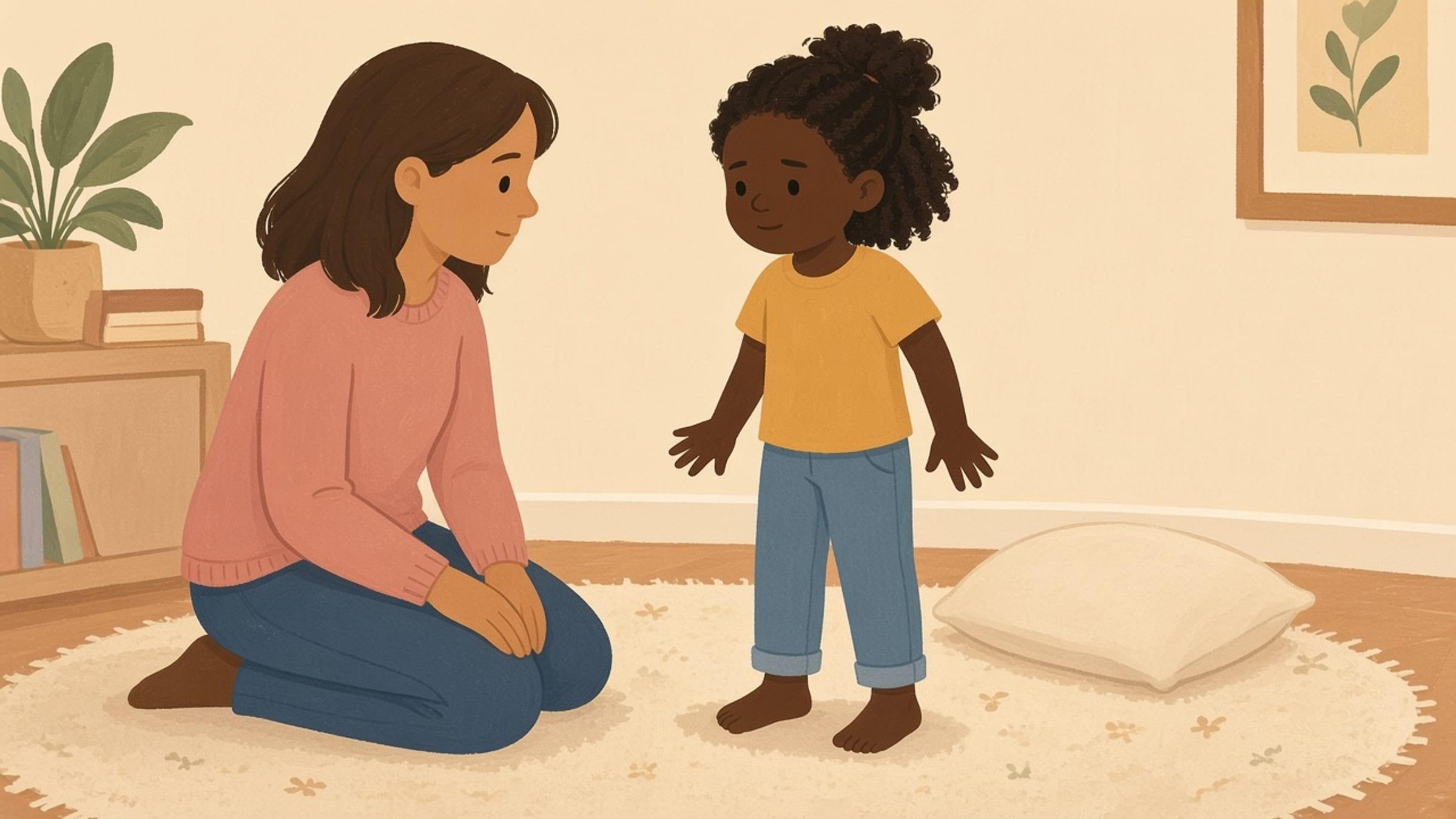
Nia's face is hot after her brother takes the blue cup. Her aunt stays low and calm and says, "You are angry. I will not let you hit." She does not add a speech. When Nia can hear her, Nia stomps both feet on the rug, the way they practiced on a quiet afternoon, and her hands stay down. The last page is not "and then she stopped feeling angry." It is Nia using the stomp, with the cup still not hers, and nobody hurt.
If the heat already landed on someone and the next need is an apology, leave this page for when your child was the mean one. If the wave is a tantrum they cannot hear through, start with big feelings and tantrums.
When should you call the pediatrician?
Call when the hurting is frequent, someone is getting injured, or you cannot keep people safe. Do not wait for a book to fix that.
For toddlers and preschoolers, the AAP says to consult the pediatrician if your child seems unusually aggressive for longer than a few weeks and you cannot cope on your own. The warning signs it lists are physical injury to themselves or others, such as teeth marks, bruises, or head injuries; attacks on you or other adults; being sent home or barred from play by neighbors or school; and your own fear for the safety of people around them. It says the most important warning sign is how often the outbursts happen, and it tells you to stay in touch with teachers and other caregivers. A pediatrician and other mental health specialists can help you build an approach that works at home and away. The page is written for young children. It is not a rule that one angry afternoon is a behavior disorder (10 Tips to Prevent Aggressive Behavior in Young Children).
The AAP's conflict page adds a shorter line that is not limited to toddlers: if your child is still having trouble getting along with other kids, talk with your pediatrician (Everybody Gets Mad).
ZERO TO THREE, still on toddlers, says some hitting and biting is typical, and that biting multiple times in a week is more of a concern. Seek a child-development professional if aggression is getting in the way of getting along with people, exploring, or learning, or if you have started avoiding play and activities because of it. It also says to pay extra attention, when the pattern is often and over time, to unprovoked hitting, a preoccupation with aggressive themes in pretend play, and aggression that begins after a traumatic episode or a major life change (Aggressive Behavior in Toddlers).
What can a story do with anger, and what can't it do?
A story helps before the next hard moment, as rehearsal. It does not help as treatment.
The useful book uses the real sentence you will say and the one choice you will actually practice — the stomp for a toddler, or the breath, the count, or the walk for an older child. A child can see that sequence on a quiet day, so it is familiar before the next hot face. That is preparation. It is not therapy, and it is not a promise that the hitting will fade.
Do not write a last page where one book removes the anger. Write a last page where they knew the limit, used the one choice, and nobody got hurt. The feeling can still be there. The cup can still be the brother's.
How the studio keeps the rehearsal on this child's afternoon
On the Characters step, Storybook Studio builds the child from one clear photo, in the art style you picked, so the face on the page is theirs. On the Plot Outline step, a few sentences is enough: the real trigger, the one sentence ("You are angry. Hitting is not allowed."), the one safe choice you will practice, and a last page that does not say they never got angry again. On the Voice step, a calm, matter-of-fact tone fits better than a rhyme that rushes to a happy ending. After the story is written, the review screen's edit mode lets you change page text if a magic cure, a lecture, or a "they were never angry again" ending slipped in.
For other everyday moments that can hold a short rehearsal like this, see personalized story ideas in everyday family moments.
Keep reading: if the hard part is a tantrum they cannot hear through, start with big feelings and tantrums.
More related guidance:
- When Your Child Was the Mean One: A Story That Teaches a Real Apology
- Losing a Game: A Story About Handling Disappointment
- Telling the Truth After a Lie? A Story That Makes Honesty Feel Safe
- Giving Up the Tablet Without a Meltdown? A Script That Helps
- Personalized Story Ideas Hidden in Everyday Family Moments