
Story ideas
How do you encourage a child to tell the truth after a lie?
After a lie, stay calm, praise honesty, separate it from the mistake, repair harm, and rebuild trust. A story rehearses coming clean. It cannot treat a pattern.
The short answer
Make telling the truth feel safe. Stay calm, do not trap them with a question you already know the answer to, and praise the courage of coming clean. Separate the honesty, which you thank them for, from the mistake, which you still repair. Rebuild trust with short follow-through, not a "liar" label. A story can rehearse coming clean and feeling believed. It cannot diagnose a lying pattern, treat it, or promise a child will never fib again.
Key takeaways
- An ordinary fib is often fear, wishful thinking, or a skill still growing — not proof the child is "a liar."
- Stay calm. Do not trap them with a question you already know the answer to.
- Praise the honesty. Address the mistake separately. Repair the actual harm.
- Rebuild trust with short, clear follow-through, then a chance to be believed again.
- A story can rehearse coming clean. It cannot diagnose a lying pattern or treat it.
How do you encourage a child to tell the truth after a lie?
Make telling the truth feel safer than hiding. Stay calm. Do not back them into a corner with a question you already know the answer to. When they come clean, thank the honesty first. Then handle the broken cup, the unfinished homework, or the hurt friend as its own job. Rebuild trust with a short next step they can actually keep.
This page is that home moment: a child already lied, or is about to, and you need the next five minutes to make honesty survivable. It is not being the mean one and apologizing, which owns the repair after unkindness to another child — the specific "sorry," the impact, the next try with that friend. It is not terrified of making a mistake, which is broader perfectionism: crumpling a drawing, quitting a new game, refusing anything that will not come out right. A fib to avoid trouble is not a crumpled picture. A forced apology is not the same job as making truth feel safe.
Child Mind Institute starts with the function of the lie, not a character verdict. Kids may test a new behavior, dodge a consequence, inflate a story to look special, or speak before they think. There are no hard-and-fast guidelines; the response depends on what the lie was doing and how serious it was (Why Do Kids Lie? Tips for Parents to Stop It). ZERO TO THREE adds the early-years line: for children under five, fantasy and wishful thinking still mix with reality, and a teaching response beats a shame response (When Young Children Lie).
Your job tonight is smaller than "raise an honest kid." Make this coming-clean safer than the last one. A story can walk a hero through that same fib and the lighter feeling after the truth. It cannot diagnose why the lying started, treat a repetitive pattern, or promise they will never fib again.
Is lying a normal kid moment, or a character verdict?
Treat the first fibs as development, not a permanent label.
ZERO TO THREE is plain about the preschool years. Children under five do not have a firm grasp on right and wrong, or on reality versus fantasy. Magical thinking still shapes their explanations. It is very common for preschoolers to lie when caught doing something they should not. The part of the brain that handles self-control is still growing, and kids this young do not fully understand that telling lies is wrong. Look at those early untruths as a gap in knowledge and skills, not as misbehavior you have to stamp out (When Young Children Lie).
The American Academy of Child and Adolescent Psychiatry draws the same early line from a second publisher. Young children ages 4 to 5 often make up stories and tell tall tales. That is normal. They enjoy hearing stories and making them up, and they may blur reality and fantasy. An older child may tell an isolated, self-serving lie to avoid a job or deny responsibility. The response that page names is a serious talk about truthfulness, honesty, and trust — not a character trial (Children and Lying).
Child Mind Institute is the labeling rule. Calling a child a liar is a mistake. The wound is bigger than the fib. It teaches "they will not believe me," makes the child feel bad about themselves, and can set up more lying (Why Do Kids Lie? Tips for Parents to Stop It).
| What you heard | Treat it as | Do not treat it as |
|---|---|---|
| "Batman did it," cookie crumbs on the mouth | Wishful thinking or a still-growing self-control skill (ZERO TO THREE) | Proof they are deceitful |
| A 4- or 5-year-old's tall tale | Normal story-making that blurs real and pretend (AACAP) | A secret they are hiding from you |
| "I didn't break it" after they did | Fear of your reaction, or a try at avoiding trouble (Child Mind, ZERO TO THREE) | A reason to call them a liar |
| One isolated dodge from an older child | A talk about honesty and trust (AACAP) | A diagnosis |
| Sudden, repetitive, or serious covering-up | A pattern to sort with your pediatrician (AACAP) | A story problem you can plot away |
The table is editorial sorting. ZERO TO THREE names early fantasy, fear of punishment, and a teaching stance. AACAP names tall tales versus an isolated older-child lie versus a repetitive serious pattern. Child Mind names the "liar" label as the wound. None of them publish a scorecard you can check off at dinner.
If the hard part is rage after they got caught, that is what to do with anger. This page stays with the lie and the coming-clean.
What do you say in the first minutes after a lie?
Do not run a cross-examination. Name what you already know, leave a door open, and keep your voice smaller than the fear.
ZERO TO THREE's first move is not to ask whether they did it. That on-the-spot question is what drives a toddler or preschooler into a tale. Make an observation, then propose a solution: you see the lipstick on the mirror, makeup is off limits, here is a towel, let's clean it up. Stay calm while you hold them accountable. Anger and shame make kids shut down and watch your reaction instead of the lesson (When Young Children Lie).
Child Mind Institute is the same "do not corner them" rule for older kids. If you already know the homework was not done, do not ask whether it was done. Go to the issue. Give a second chance when the first answer came out scared: walk away, come back, and call it a truth check — they can change the answer without extra trouble for the first dodge. That technique is not for a child who already lies all the time. The preamble method is the setup before a hard question: you may hear something you do not want, their behavior is not who they are, you love them anyway, people make mistakes, think about an honest answer (Why Do Kids Lie? Tips for Parents to Stop It).
CDC's preschool parenting tips do not mention lying. Use only what that page actually says: be clear and consistent, explain and show the behavior you expect, and when you say no, follow with what they should do instead. Help them through the steps to solve a problem when they are upset (Positive Parenting Tips: Preschoolers (3–5 Years Old)).
- If you already know, do not ask. "The cup is broken. Let's talk about what happens next." ZERO TO THREE and Child Mind both warn that a trap question invites a lie.
- Keep your body calm before your speech. ZERO TO THREE: stay calm as you hold them accountable. If you are still hot, wait one minute. A lecture delivered at full volume is more fuel.
- Open a door, once. Child Mind's truth-check line: you can walk away and come back. "If you want to try that answer again, that is a truth check."
- When the truth comes, name the honesty first. "Thank you for telling me. That was the brave part." Child Mind says to praise truth-telling and to remind them that telling the truth makes them more trustworthy.
- Then name the actual problem, in one sentence. The mess. The homework. The friend. Not "you always lie."
The numbered script is editorial sorting. Child Mind names no-cornering, truth checks, the preamble, and praise for honesty. ZERO TO THREE names observation-plus-solution and a calm hold-to-account. CDC names clear expected behavior and a "do this instead." None of them publish a five-line kitchen protocol.
Write down what they said, in their words. A vague "they lied again" evaporates. A dated note — the fib, the feeling, the repair — is what you take to the pediatrician if the pattern does not stay ordinary.
How do you separate honesty from the mistake, then repair the harm?
Thank the coming-clean. Still fix what broke. Do not trade the repair for a speech about character.
Child Mind Institute splits the two jobs on purpose. If a child hit someone and lied about it, there is a response for the lying and a response for the hitting — including, on that page, writing an apology to the other child. If they said there was no homework and there was homework every day, they still have to sit down and do the work. Consequences should be short-lived, not overblown, so the child can get back to practicing a better behavior. Parents can also reduce a consequence when the harder choice was telling the truth — a day without the phone instead of a week — and still say the limit is not up for negotiation when the child tries to bargain with "but I told the truth" (Why Do Kids Lie? Tips for Parents to Stop It).
ZERO TO THREE's repair is smaller and younger: clean it up together, then reconnect. After the lipstick, offer paper and crayons. The teaching is the cleanup and the next legal way to do the thing they wanted, not a verdict (When Young Children Lie).
CDC's "what they should be doing instead" is the same shape without the lying vocabulary: after a no, show the expected behavior (Positive Parenting Tips: Preschoolers (3–5 Years Old)).
| Move | What it is for | What it is not |
|---|---|---|
| "Thank you for telling me" | Praise for the honesty Child Mind already named | A pass on the broken cup |
| Clean up / finish the work / check on the friend | The actual harm, handled as its own job | A lecture about "liars" |
| A shorter consequence because they came clean | Child Mind's reduced-consequence example | A promise that truth erases every limit |
| A next legal way to do the wanted thing | ZERO TO THREE's paper-instead-of-the-mirror | A prize for the fib |
| A specific apology if someone was hurt | Child Mind's repair when the hidden act harmed another child | A mumbled "sorry" that skips the honesty talk |
If the hidden act was unkindness to another child, finish the honesty minute here, then switch pages. The wording of a real apology — what you did, that you are sorry, how you will do better — lives on being the mean one and apologizing. This page does not run that repair.
How do you rebuild trust after they come clean?
Give them a small next chance to be believed. Do not make them earn the whole relationship back in one night.
Child Mind Institute ties praise to trustworthiness: when telling the truth was the harder path, say so, and let the lighter consequence show that honesty changed what happened next. Keep the consequence short enough that they can practice the better behavior. Do not feed a low-level, attention-seeking tall tale with a pile of follow-up questions; ignore or redirect, or gently name it a tall tale and ask them to try again (Why Do Kids Lie? Tips for Parents to Stop It).
AACAP puts parents in the model seat. Honesty and dishonesty are learned at home. After a lie, take time for a serious talk about the difference between make-believe and reality, the importance of honesty at home and in the community, and alternatives to lying (Children and Lying).
CDC's consistency line is the follow-through: be clear and consistent, explain the behavior you expect, and show it (Positive Parenting Tips: Preschoolers (3–5 Years Old)). That is not a lying protocol. It is why a promised smaller consequence has to actually be smaller, and a promised next chance has to actually arrive.
- Say what will be different because they told the truth. One shorter limit, or one piece of the mess you will help with. Child Mind's reduced-consequence example is the warrant, not a menu.
- Give one concrete next chance. "Tomorrow I will ask about homework once. I am going to believe the first answer unless I already know otherwise."
- Model one small honesty of your own, then stop. AACAP says parents are the main role models. Do not stack confession stories.
- Do not keep retrying the scene. Three honesty lectures in one evening is a pile-up. The lesson already happened.
- If they stand up for someone else this week, notice that courage separately. That job lives on standing up for someone smaller. Do not fold it into a morality play about the fib.
When is this a story job, and when do you call the pediatrician?
A story helps in a calm hour, as a rehearsal of coming clean and being believed. It does not help as a diagnosis, and it does not replace a doctor.
Ordinary preschool wishful thinking, an isolated older-child dodge, and a child who needs the door left open are the pattern ZERO TO THREE and AACAP already called expected: tall tales at 4 and 5, a teaching stance in the early years, a talk about honesty and trust after one self-serving lie (When Young Children Lie; Children and Lying).
A story cannot diagnose a lying problem, an attention or learning issue, anxiety, or any other condition. Child Mind notes that some children speak before they think, that some inflate stories when confidence is thin, and that some hide how they feel so the spotlight moves off them. Those are reasons a clinician might explore. They are not a plot, and they are not yours to name from a picture book (Why Do Kids Lie? Tips for Parents to Stop It). AACAP is the action line for a pattern: if lying becomes serious and repetitive, professional help may be indicated. Evaluation by a child and adolescent psychiatrist can help the family understand the behavior and get recommendations. That page also notes that some repetitive lying is a bad habit for dealing with demands, not a child trying to be malicious, and that some lying covers another serious problem. Sorting those is clinical work, not a last page (Children and Lying).
Call the pediatrician when the lying is frequent and serious, when it is paired with other behavior that worries you, or when coming clean never feels safe no matter how calm you stay. One broken-cup fib is not that pattern. A child who cannot tell you what happened, week after week, might be. This page does not diagnose it.
The names below are invented for illustration. In a real personalized book the hero is your own child, built from your own photo.
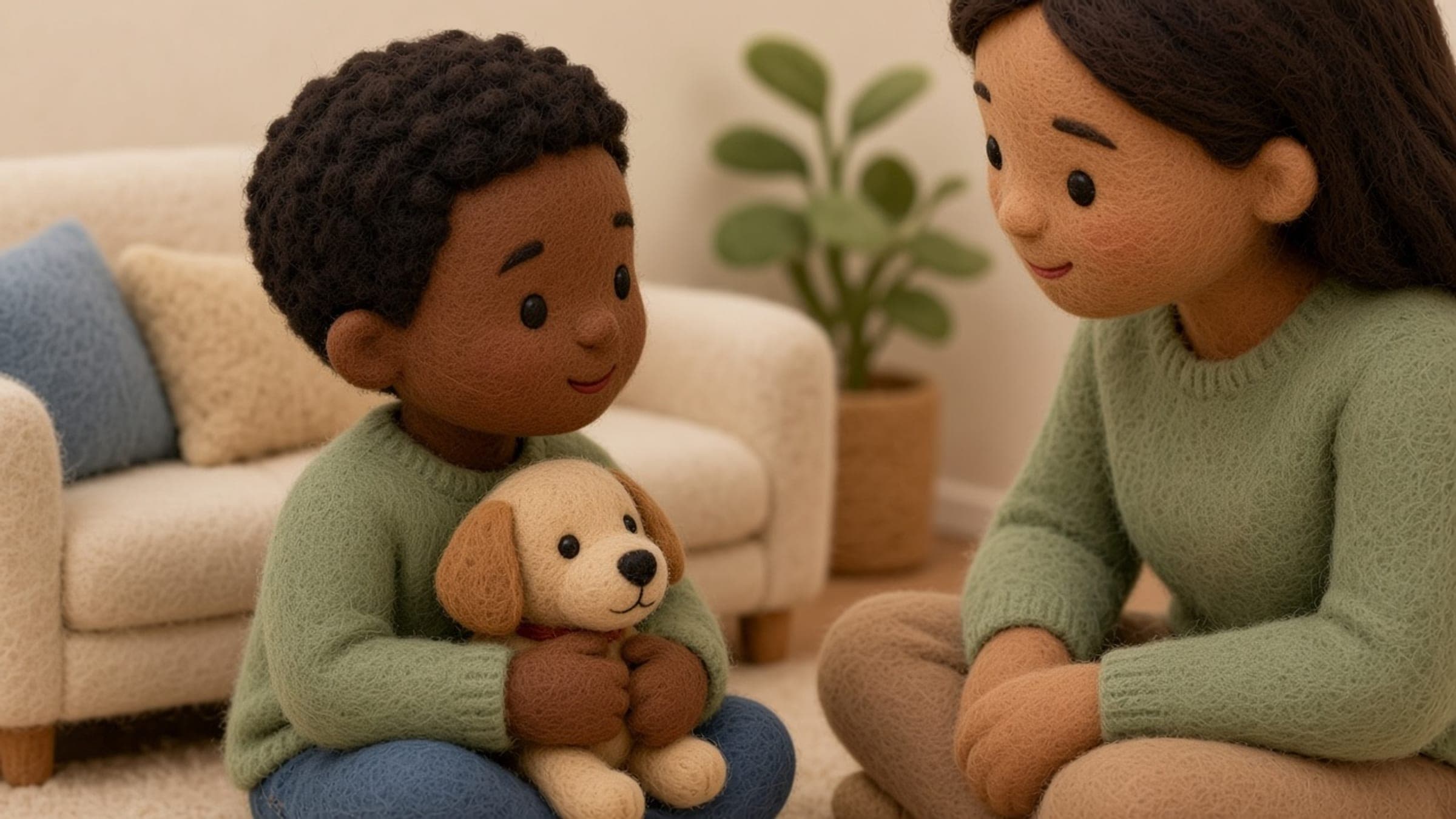
In the story, Elias broke a cup and said he didn't. His stuffed dog, Scout, does not clap. Scout names the shaky feeling, the parent's "thank you for telling me," the broom, and one next chance to be believed. The last page is not "and then he never lied again." It is Elias telling the real sentence and helping sweep.
Then the read-aloud has a job outside the book: say the real fib, the real thank-you line, and the real repair, and have them say the honest sentence out loud once before you close the cover. A story that ends at "they became honest forever" is entertainment. A story that hands them tonight's one true sentence is preparation.
CDC's preschool tips include continuing to read together and taking them to the library. That is the warrant for using a book at all — not a claim that a book treats lying (Positive Parenting Tips: Preschoolers (3–5 Years Old)).
How the studio keeps the rehearsal specific
The Plot Outline step asks a plain question — "What should happen in the story?" — as a free-text box, with the guidance that a few sentences is plenty. That is where the real fib, the real "thank you for telling me," and the real repair go, in your child's words, rather than a generic "learned to be honest" last page. The story requires you to name one Story hero. On the Story step you review the complete written story before illustrating the opening pages, and you can use edit mode if a promised forever-honest ending slipped in.
Do not write a last page where one book makes them never fib again. Write a last page where the truth was survivable, the honesty was thanked, and the repair was already named.
For other everyday moments that can hold a rehearsal like this, see personalized story ideas in everyday family moments.
Keep reading: if the hard part is making a real apology after they were unkind, start with being the mean one and apologizing.
More related guidance:
- Terrified of Mistakes? Trying Without Perfection
- What to Do With Anger: A Story About Safe Choices
- When Your Child Was the Mean One: A Story That Teaches a Real Apology
- Standing Up for Someone: A Safe Upstander Story
- Personalized Story Ideas Hidden in Everyday Family Moments