Meaningful gifts
How do you split chores fairly between siblings?
A fair chore system for siblings: age-appropriate jobs, rotating charts, splitting shared tasks, allowance or no allowance, and how to cut down on arguments.
The short answer
Split chores fairly between siblings by matching each job to a child's age and skill, rotating the unpopular ones weekly, defining what 'done' looks like, posting a visible chart, and keeping shared tasks clearly divided. Fair means matched to ability, not identical.
Split chores between siblings by matching each job to age and skill, rotating the jobs nobody likes every week, and writing down exactly what "done" means. Post the chart where everyone sees it, so the chart settles arguments instead of you.
Key takeaways
- The American Academy of Child and Adolescent Psychiatry describes chores as a way for kids to build responsibility and a sense of contributing.
- Weekly rotation stops one child getting stuck with the worst job.
- "Clean your room" means nothing until you list what clean looks like.
- Shared tasks need a clear split, like "you wash, you dry."
Jobs by age
Use this as a starting point and adjust for your kids:
| Age | Jobs many kids can handle |
|---|---|
| 3–5 | Put toys in bins, feed a pet with help, put laundry in the hamper, set out napkins |
| 6–8 | Make the bed, set and clear the table, sort laundry, water plants, empty small trash cans |
| 9–11 | Load the dishwasher, vacuum a room, fold and put away laundry, pack their own lunch |
| 12+ | Cook a simple meal, mow the lawn with supervision, clean a bathroom, do their own laundry |
An older child will do more, and that's fair. Say so plainly: "Jobs grow as you grow."
Build the system
- List every household job that a child could do.
- Sort them into daily, weekly and occasional.
- Assign by age. Give each child daily jobs they own all the time (like making their bed).
- Rotate the shared or unpopular ones weekly: trash, pet cleanup, unloading the dishwasher.
- Write the standard on a card for each job. "Dishwasher: all clean dishes put away, silverware sorted, door closed."
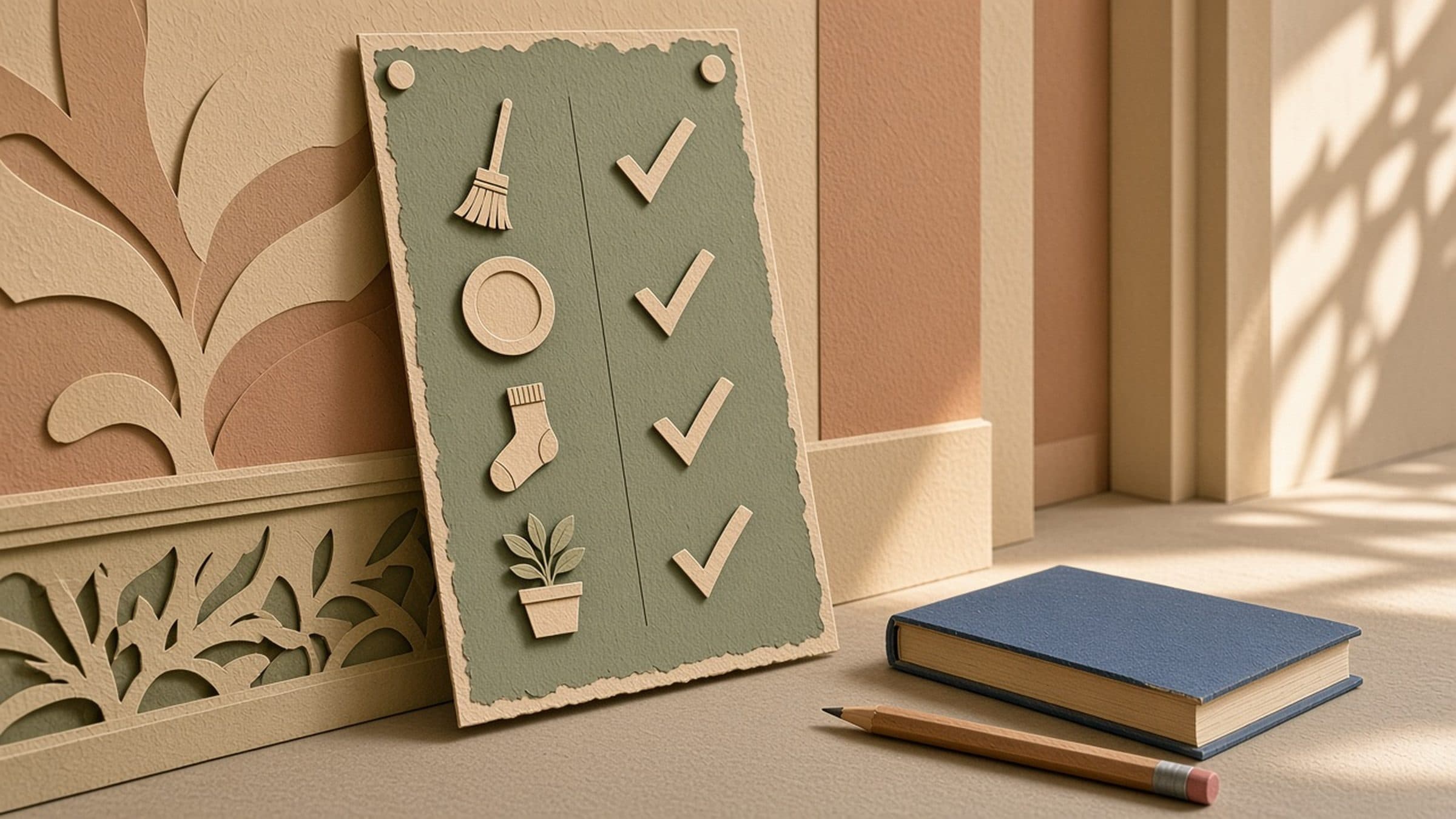
- Post it on the fridge or a family whiteboard with names and days.
Splitting shared tasks
Arguments start when two kids share one job with no split. Options:
- By step: one clears, one wipes the table.
- By area: one takes the left side of the playroom, one the right.
- By time: each child has the job on alternate days.
- By choice: the older child divides the work, the younger picks first.
To pay or not to pay
Families differ. Three common models:
- No pay for chores. Chores are part of living in a family; allowance, if any, is separate.
- Paid extras. Basic jobs are expected; bigger extra jobs, like washing the car, earn money.
- Allowance tied to chores. Pay depends on completing the chart.
Whichever you choose, keep it the same for every child, scaled by age.
Reducing arguments
- No trading without a parent's okay. Trades are fine but must be agreed out loud.
- Same time each day. Chores before screens, or right after dinner.
- Check once. Inspect when the child says they're done, point to the standard card, and let them finish.
- Don't redo their work. Redoing a job tells a child it wasn't worth trying.
- Praise effort. The AAP recommends praising the effort in each task, not the outcome.
When one child does less
Kids notice imbalance fast. If one child keeps skipping chores:
- Talk privately, not in front of the sibling.
- Ask what's getting in the way: too hard, forgot, avoidance.
- Adjust the job or add a reminder.
- Use a simple consequence, like chores done before screen time.
Don't hand the skipped job to the sibling; that breeds resentment.
A sample weekly chart
For a 6-year-old and a 10-year-old, one week might look like this:
| Job | 6-year-old | 10-year-old |
|---|---|---|
| Make own bed (daily) | Yes | Yes |
| Set the table (daily) | Week A | Week B |
| Clear and wipe the table (daily) | Week B | Week A |
| Feed the cat (daily) | Week A | Week B |
| Take out recycling (weekly) | Carries small bin | Takes bins to curb |
| Vacuum (weekly) | Living room rug | Bedrooms and hall |
Swap the A and B columns every Sunday night. Kids can see at a glance whose turn it is, and the younger child gets a smaller share of the same job instead of being left out.
Kids with different abilities
If one child has a disability or extra needs, choose jobs that fit what they can do and explain to siblings that everyone contributes in their own way.
Review every few months
Hold a five-minute chart check: what's working, what feels unfair, what job someone is ready to learn. Let kids suggest changes. When they help design the system, they're more likely to follow it.
A note for later
If a younger one is on the way, the siblings book tells a story with the older child at the center, for before or after the birth, with brother, sister or neutral wording and optional photos of real places; you approve a proof before it prints in softcover or hardcover with a PDF. Look through a sample siblings book, see the gift guide and check pricing.
Frequently asked questions
What age should kids start chores? Simple tasks like tidying toys work from about age 3.
How many chores is enough? Two or three daily jobs plus one weekly job is a common load for school-age kids.
What if they do a poor job? Show them again with the standard card, then let them redo it.
Related reading:
Sources
- Age-Appropriate Chores for Children, American Academy of Pediatrics (HealthyChildren.org), accessed November 3, 2026
- Kids & Money: Help Your Child Learn Good Financial Habits, American Academy of Pediatrics (HealthyChildren.org), accessed November 3, 2026