How Storybook Studio works
How do you make a book?
Make a children's book by finishing the pictures, setting the trim and bleed, and choosing a binding: stapled, coil, paperback, or casewrap hardcover.
The short answer
Making a children's book, once the words exist, means attaching a picture to each spread, setting a trim size with bleed and a safety margin, and choosing how the sheets stay together. A stapled booklet, a coil, a perfect-bound paperback, and a casewrap hardcover are different objects with different page minimums. An illustrated digital file, with an optional printed square copy after a proof, is one more route.
Making a children's book, after the sentences are written, is a manufacturing job. You pair each spread with a picture, lock a trim size, and pick a binding that can hold that many sheets. A handmade booklet, a coil, a paperback, and a hardcover are not ranks of quality. They are different ways the sheets stay together, and each one has a floor on how many sheets it will accept.
Key takeaways
- Lulu's perfect-bound paperbacks run from 32 to 800 interior pages. Casewrap hardcovers run from 24 to 800. Saddle stitch runs from 4 to 48. Coil runs from 2 to 470.
- A full-bleed file extends 0.125 inch past the trim on every side. Words stay 0.5 inch inside the trim.
- MCRL treats 32 pages, cover not included, as the usual picture-book length, and offset hardcovers need a count divisible by 4.
- Storybook Studio's illustrated file is 20 drawn pages from one photo. A printed copy is an 8.5 inch square softcover or hardcover, and only after you approve a proof.
What has to be finished before a printer will take the file?
The interior has to be one PDF, every sheet the same size, in reading order, including any blank sheets the binding needs. Lulu's create steps detect the trim and the count from that file. If the count is under the binding's floor, that binding does not appear as a choice (Tips for Formatting Documents, accessed November 2, 2026).
Count the blanks. A title opening, a quiet last sheet, and the extras a signature needs are part of the number the printer sees. MCRL says picture books are usually 32 pages, not including the cover, and that an offset hardcover's count has to be divisible by 4 because sheets fold into signatures (page count and paper, accessed November 2, 2026). A signature is one sheet folded into a group of leaves. If your count is 30, you add two blanks or you change the binding. You do not ask the machine to fold a sheet into a fraction.
Read the PDF out loud once before you export it. A missing sheet is cheaper to notice in the file than in a carton of copies.
How do the pictures get onto the spreads?
Three production routes, and they should be chosen before anyone paints at full size.
- You draw. Work at the final trim, not at a comfortable sketch size you will scale later. A square and a tall rectangle crop a face differently. Keep a small reference of each person taped where you can see it, so the second spread does not invent a new nose.
- You commission the art. Hand over the spread list, the trim, and the things that must not change: a real room, a real object, who is present. Agree the trim in writing before full-size art, because reflowing a finished painting into another shape throws away the edges.
- You place photographs. A photo-printing service reproduces pictures you already took. That is a record. It is a different job from drawn scenes that show a moment the camera missed. Mixing a pasted photograph into a painted spread works only when the spread list planned that collision.
The sentences themselves, and how to shape them when the subject is your own child, are a separate job: how to write a children's book about your child. Turning one family photograph into those sentences is turning family photos into a children's story.
What trim, bleed, and safety margin does a print file need?
Bleed is the extra image past the cut line. Lulu prints sheets larger than the finished trim and cuts them down, so color that should reach the edge has to continue 0.125 inch (3.18 mm) past the trim on every side. Even a file with white margins needs that extra size, or the cutter's wobble shows as a sliver. Words and other things you cannot lose sit inside a safety margin of 0.5 inch (12.7 mm) from the trim (What is Full Bleed?, accessed November 2, 2026).
A 6 by 9 inch trim, in Lulu's example, needs PDF sheets of 6.25 by 9.25 inches. Do the same arithmetic for whatever trim you picked: add 0.25 inch to width and to height. Export single sheets, not a facing-spread layout, unless the printer asked for spreads. Leave crop marks out.
At a kitchen table, with scissors and a stapler, you can ignore bleed and still keep words a thumb's width from every cut. The habit is the same. The machine is just less forgiving.
Which binding matches which page count?
Match the binding to the count and to how the object will be carried.
| Binding | How it holds | Lulu's interior range |
|---|---|---|
| Saddle stitch | Staples through the center fold | 4 to 48 pages |
| Coil | Plastic or wire through punched holes; lies open | 2 to 470 pages |
| Paperback, perfect bound | Flexible cover, glue at the spine | 32 to 800 pages |
| Hardcover casewrap | Rigid case around the signatures | 24 to 800 pages |
A short first object is often a saddle. It is cheap, it fails in an obvious way if the story is thin, and it does not pretend to be a case. Move to perfect binding or a case when the count clears the floor and you want a spine that survives a bag.
Thick paperboard leaves glued as pairs are a different construction. Do not send a thin-sheet interior to that spec, or the other way around.
Where does an illustrated digital file fit?
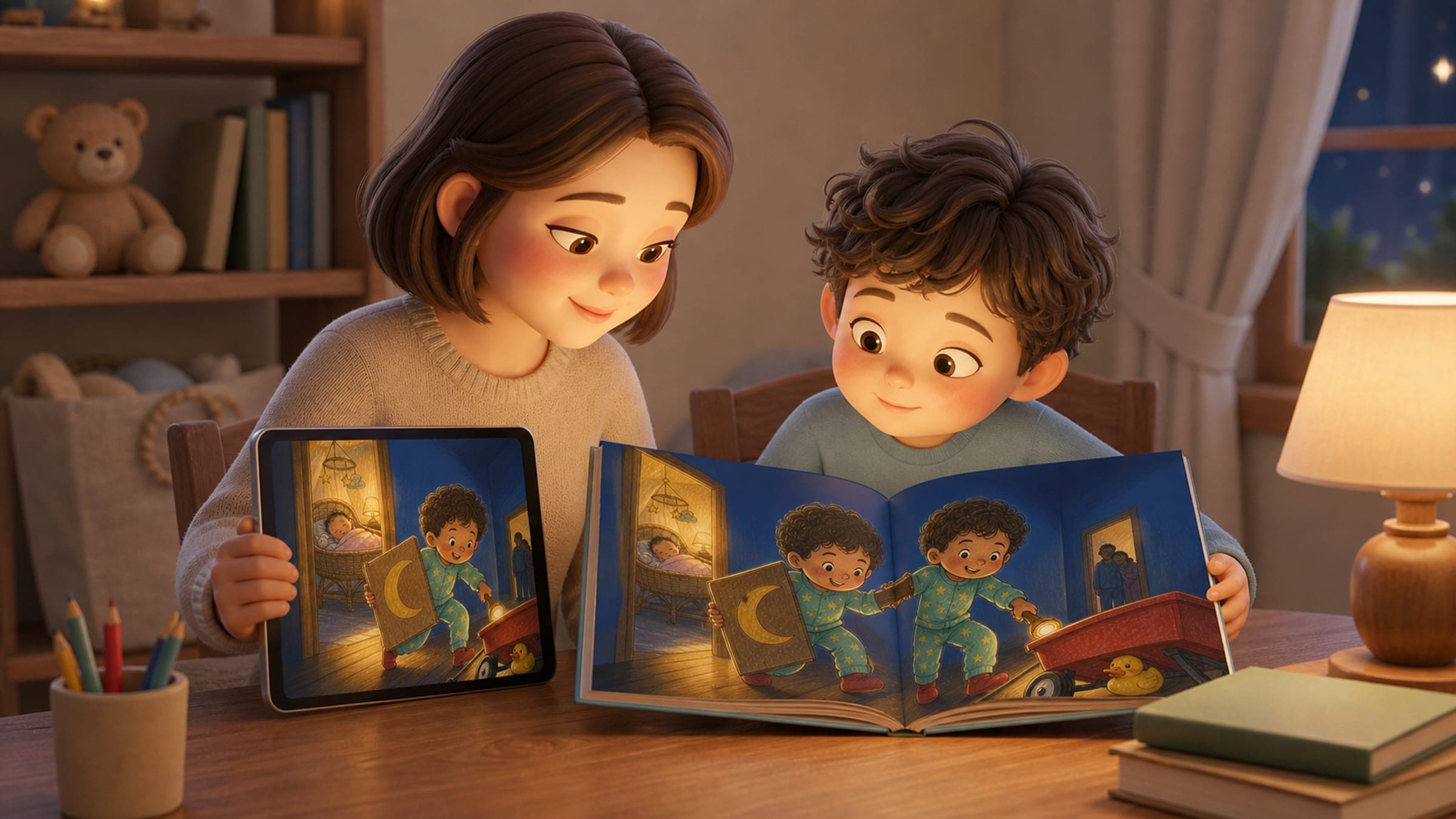
It is one route among the ones above, for people who want drawn scenes of their own family and do not want to draw them. On Storybook Studio the illustrated file is 20 pages, made from one photo and the details you supply. The drawings are created after payment. If you want paper, the printed options are an 8.5 by 8.5 inch softcover (the print file's minimum is 32 pages) or an 8.5 by 8.5 inch hardcover (minimum 24). Printing starts only after you approve the proof. Totals, and anything besides those two squares, are on pricing.
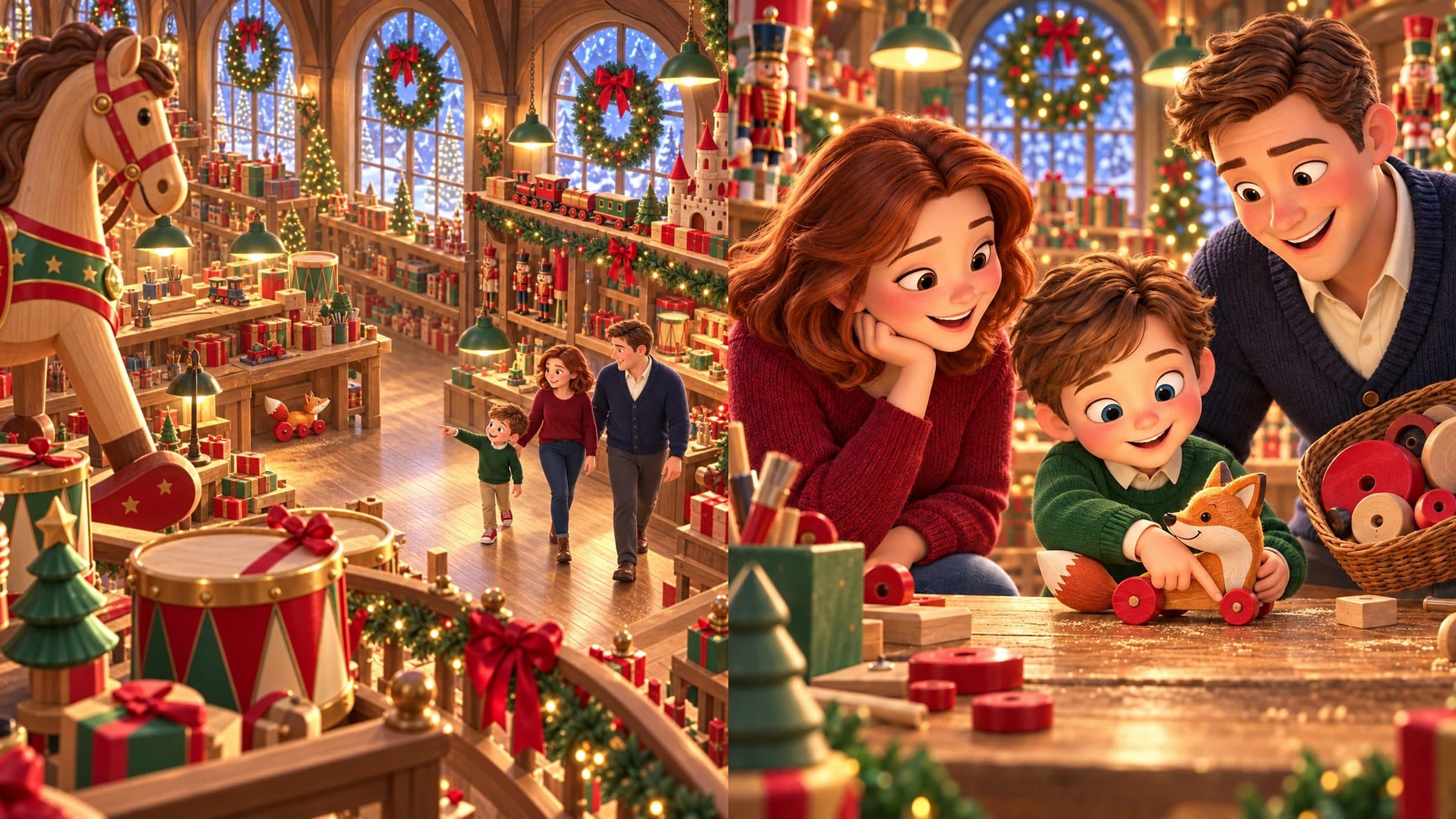
That path does not replace a stapled booklet or a photo-printed record. The photo lander is personalized storybooks from photos. A holiday example of the square file, cover through the last sheet, is the holiday picture-book example. The lander is the holiday book. Gift notes for it are on the Christmas book gift page.
Before you order more than a proof, check three things: the count matches the binding, the words sit inside the safety margin, and the proof you hold matches the PDF you approved. A proof is the manufactured object. The screen is not.