How Storybook Studio works
What is the difference between a digital and printed personalized storybook?
Compare digital and printed personalized storybooks by speed, sharing, editing, cost, durability, and the way a family expects to read the book.
The short answer
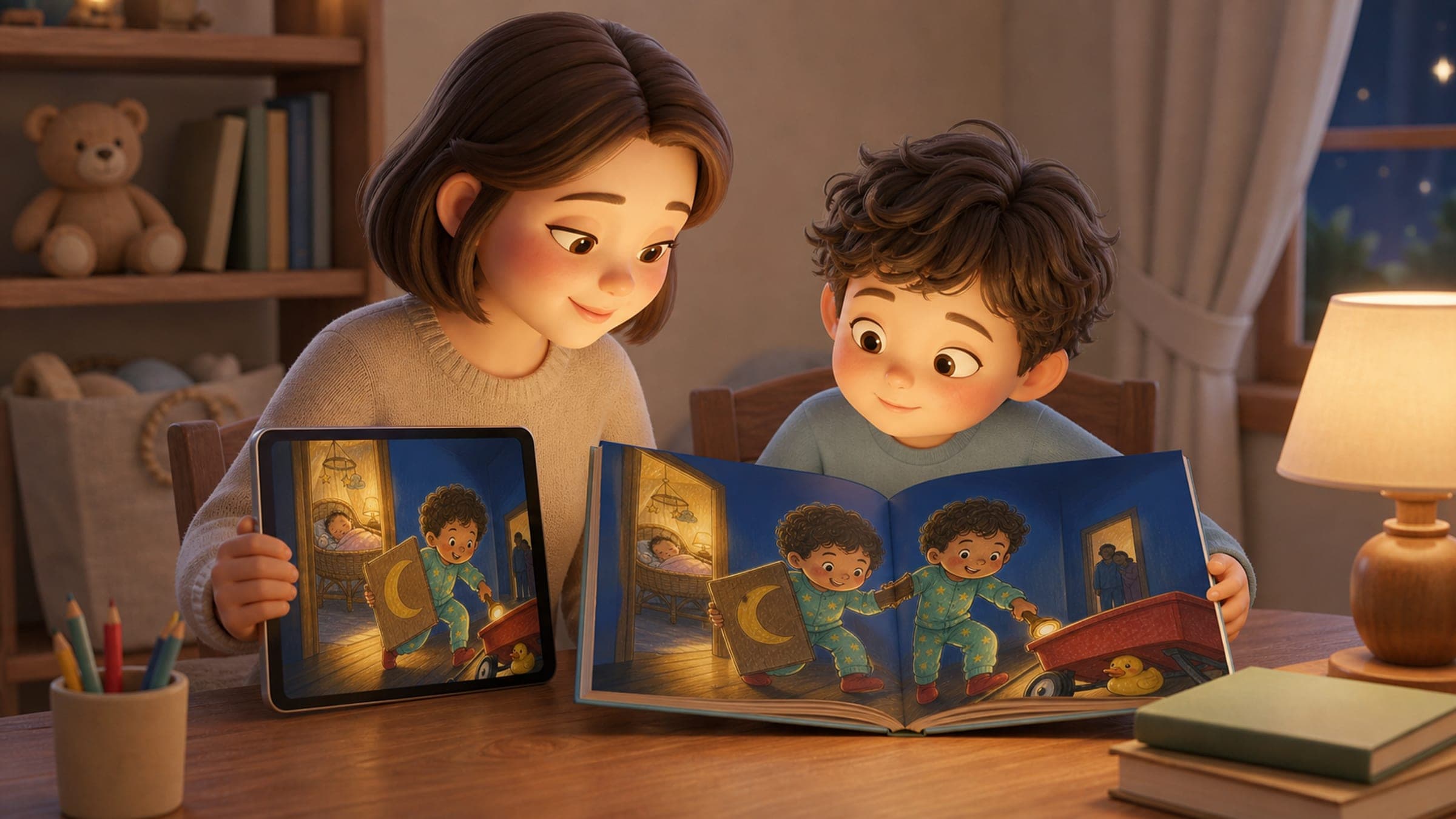
A digital personalized storybook is available sooner, easier to share, and can remain editable inside the service. A printed book is a fixed physical object with production and shipping time. Create and approve the digital story first; order print only when the pages, cover, and delivery details are ready.
Key takeaways
- Digital is faster to finish, share, and revisit; print turns the approved work into a fixed physical object.
- The formats are not a quality ranking. The American Academy of Pediatrics says reading in any format is good for children.
- Print tends to be less distracting during shared reading, and parents tend to talk more about the story.
- Printing adds production, shipping, address, and proof requirements.
- Approve the complete digital book before creating a print proof.
The short version: a digital personalized storybook exists as soon as the story is finished, can be opened on more than one device, and can still be changed inside the service. A printed copy is that same approved story manufactured as a physical object — it takes production and shipping time, and it stops changing the moment the proof is approved. Most families do not have to choose one. Finish the digital book first, read it, correct it, and treat print as a separate decision you can make later.
When is a digital storybook the better choice?
Choose digital when speed, access, and flexibility matter most. A digital story can be completed without waiting for manufacturing or delivery, and it can be opened from more than one device.
Digital is especially useful for:
- A gift needed immediately. For the published sitting, digital, and print clocks—not the format choice—use the turnaround guide.
- Family members in several locations, including grandparents who will not be there for the first reading.
- Reading while traveling, when a hardcover is one more thing to carry.
- Reviewing words and illustrations before print.
- Keeping the story without adding a physical purchase.
In Storybook Studio, completing the digital book unlocks the remaining illustrations and a downloadable PDF. The printed copy is a separate optional purchase.
When is a printed book worth adding?
Print is valuable when the object itself matters: a wrapped gift, a bedtime book that lives on a shelf, a keepsake for a grandparent, or a copy intended for repeated offline reading.
A printed book is fixed at the moment the proof is approved. Later digital edits will not change a copy already manufactured. For what you can still change after the opening exists—words, likeness, a page, or the proof—use the edit-after-you-make-it guide. Printing also introduces trim size, binding, paper, production time, shipping method, address validation, and tax.
| Consideration | Digital book | Printed book |
|---|---|---|
| Availability | After digital generation finishes | After proof, production, and shipping |
| Sharing | Link, account access, or PDF | One physical copy per order |
| Editing | Can continue in the product | Fixed after approval |
| Cost | Digital completion price | Production, shipping, and tax |
| Reading together | Screen is at hand anywhere | Fewer things competing with the page |
| Best for | Speed and flexible access | Gifting and physical keepsakes |
Does the format change how a child takes in the story?
It can, and this is the part most format comparisons leave out. The American Academy of Pediatrics starts from a reassuring place: "reading in any format is good for kids," and families are encouraged to try both and keep whichever works better for their own child. Format is not a measure of whether the story counts.
The AAP does note real differences during shared reading. It describes print as less distracting, because a child is less likely to have their attention pulled away by something like a hyperlink, and it links deeper recall of a story's plot to reading that engages more of the senses. It also reports that studies find parents tend to engage less when sharing an e-book than a print book.
The specific caution is about enhancements, not screens by themselves. Music, sound effects, animations, and buttons can help — but the AAP warns that too many of them "can distract children from the story and make it hard to remember the details."
Two practical things follow:
- If you read the digital version together, protect the conversation. The measured difference is largely about attention moving to the device instead of the story. Ask what the child thinks happens next, and connect a page to something that actually happened to them. That parent talk is the ingredient the research keeps pointing at.
- If the book is meant for a young child to return to alone, print has a structural advantage. A physical copy cannot navigate away from itself, and it does not need a charged device or a signed-in account.
A personalized story can prepare a child for something, normalize a feeling, or open a conversation. Neither format makes it a substitute for advice from your pediatrician or another professional who knows your child.
What should you verify before printing?
Review the exact print proof, not only the interactive reader. Confirm:
- The cover contains the correct title and image.
- Every interior page is present in the intended order.
- Important faces and text are inside safe areas.
- The ending page is included.
- Fonts are embedded in the exported PDF.
- The delivery address matches the carrier's recommended format.
- The selected binding, quantity, and shipping speed are correct.
Lulu's Print Book Creation Guide explains file and production considerations for print-on-demand books. Storybook Studio should preflight these technical details automatically; the creator should not need to understand font embedding to receive a valid book.
The reason the proof matters more than the reader: everything on this list is reversible in a digital book and permanent in a printed one.
How long should a printed book take to arrive?
Two clocks run in sequence. Production is the time the printer needs to manufacture the book, and shipping is the time the carrier needs to deliver it. A print-on-demand book is made after the order, so neither clock starts until the proof is approved. If you are working toward a specific date, count backward from it rather than ordering and hoping.
You also have a baseline consumer protection worth knowing. The Federal Trade Commission states that sellers "have to ship your order within the time they (or their ads) say," and that if no time is given, "they must ship within 30 days of when you placed your order." If shipping is delayed, the FTC says the seller "has to tell you and give you the choice of either agreeing to the delay or canceling your order for a full refund."
This is a floor, not an estimate for any particular order. Storybook Studio's own fulfillment, refund, and delivery terms are governed by the Storybook Studio Terms.
Can you decide about print later?
Yes. Completing the digital story first separates the creative decision from the fulfillment decision. You can read the finished work, make corrections, and order a printed keepsake later.
This is also why the order matters. A print run started before the story is approved locks in whatever was on the page at that moment, and the only fix is another order. A digital book that turns out to need one more correction costs nothing but the edit.
Current pricing, payment, refund, and fulfillment terms are governed by the Storybook Studio Terms, not by an old article screenshot or an estimated shipping example.
More related guidance:
- Giving Up the Tablet Without a Meltdown? A Script That Helps
- A Cancelled Plan: Sit With the Feeling, Then Name a Backup
- How Many Photos Do You Need for a Personalized Storybook?
- Learning to Use Scissors: Grip, Safety Rules, and Steps
- Personalized Story Ideas Hidden in Everyday Family Moments