Meaningful gifts
How do you teach kids about giving at Christmas without a lecture?
Teaching kids about giving at Christmas: sort toys into keep and give, set a home donation carton, and label jars for spending, saving, and sharing.
The short answer
Teaching kids about giving at Christmas works as three concrete jobs: sort toys into keep, give, and broken; park a donation carton by the door for one week; and, for a child who handles coins, label jars for spending, saving, and sharing. The CFPB's note for young children is a single saving jar and a wait. Its middle-childhood note is where spend, save, and share show up. Ages 3 and up. No promise that a sort changes a child's character.
Teaching kids about giving at Christmas is easier as a sort of what they already own, a carton by the door, and jars you only add when the child can tell coins apart. A speech about generosity does less than one object leaving the house.
Key takeaways
- Ages 3 and up. Not a lesson for babies or children under 3.
- A basket for what stays, a carton for what goes. The child chooses. You pull cracked and recalled items.
- CFPB's young-child page suggests one labeled saving jar. Spend, save, and share appear in its middle-childhood handout, which is an older group.
- Check CPSC recalls before anything goes to someone else.
How do you sort what they already own?
Use two containers, not a floor covered in everything they own. A basket stays in the room. A closed carton goes by the door.
The child may move their own things from the basket to the carton. You do not overrule a choice to keep something unless it is cracked, recalled, or not actually theirs. Overruling every choice teaches that the afternoon was a trick.
You own the cracked pieces. Missing wheels, dried markers, split plastic. Those do not go to another family. They go in the trash or the recycling your town accepts.
Recalled items do not go in the carton. Look up the name on the CPSC recall list before the carton leaves. A recall is a safety stop. If you cannot find the name and you are unsure, do not pass the item on.
Labels that say a product is not for children under 3 matter when a baby might receive it. This afternoon is for a household with a child who is at least 3. It is not advice that any item is right for a baby. Leave those packages out of the carton.
One shelf is enough. Emptying a whole bedroom is how the afternoon ends in tears. Tomorrow can be a second shelf. Stop while the basket and the carton are still peaceful.
What does a one-week donation carton do?
The carton sits by the door, closed, for seven days. What they chose to pass on goes in on day one. If they move something back to the basket on day three, that is allowed once. On day seven you take the carton to the place you already chose: a neighbor, a community drive, a donation door. Name the place on a piece of tape on the lid so "somewhere" does not become never.
Do not promise the other child will write back. Do not promise the toy will be loved. You can say where the carton is going and when.
If the drive wants new items only, your used things are the wrong carton. Ask before you pack. A week of sorting for a drive that will refuse the carton is a mess you made.
Money in an envelope is a separate decision. A preschooler can put a coin in a jar. They should not be handed a stack of bills to "give away" as a performance. If you donate money, you can tell them the amount in one sentence. You do not have to.
When is a spend, save, and share set of jars honest?
The CFPB's page for young children says to find a jar or can, label it for saving, and suggest the child put some of the money they get into it so they can buy a toy or treat when they have saved enough. It also ties saving to waiting, the way a child waits for a turn. That is one jar. It is the honest tool for ages 3, 4, and 5.
The CFPB's middle-childhood handout says that as children grow they may receive money as gifts or allowance and decide whether to spend it, save it, or share it. That handout is not written for a three-year-old. Three jars labeled spend, save, and share match that older note. Use them when the child can sort coins and can tell you which jar a coin is for. Using three jars earlier, as a photo, teaches the labels and not the choice.
A share jar is not a thank-you note. Weekly slips are a different practice, linked below. You can do both. Do not pretend the coin jar is the note.
None of this is a study of character. A finished sort does not mean a child will be generous in March. If you want one sentence written down, keep it to what you did: we filled a carton, we waited a week, we took it.
What does hanging an ornament have to do with giving?
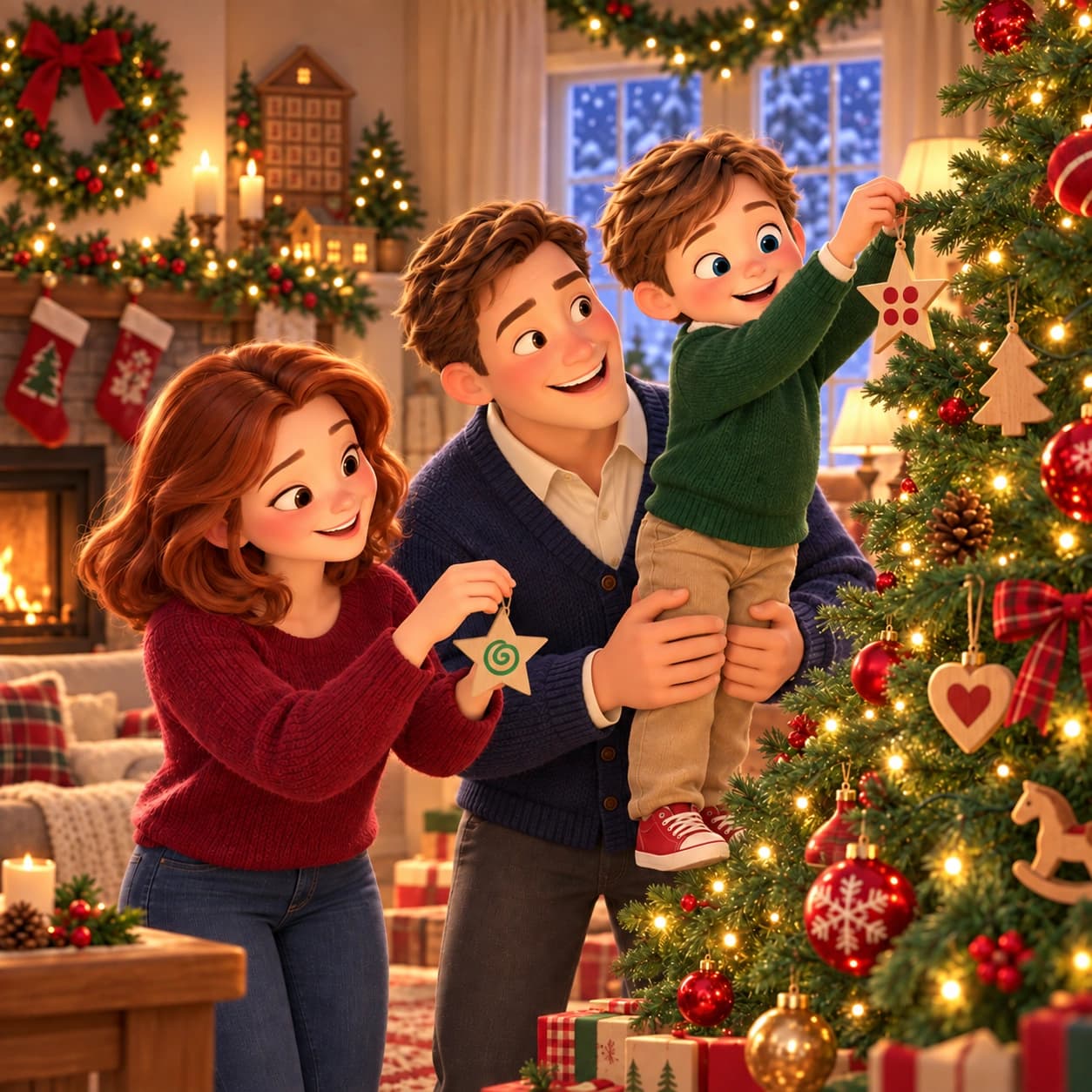
In the finished December pictures, a father lifts a child to hang a painted wooden ornament on a lit tree while a mother holds a second ornament. The giving is the made thing going onto the tree, with two adults there. It is not a donation carton, and it is not cash. The useful copy is the scale: one object, handed over, adults holding the child steady. See those pictures. The longer note is the gift guide, and you can begin from December stories.
Notes you mail, which are not this carton, are gratitude activities for kids. A recorded question for Grandma or Grandpa is questions to ask grandparents. A Hanukkah present that is not another truck is a Hanukkah gift for a young child. Other days are in personalized story ideas for everyday family moments.
Start a holiday story if you want the carton afternoon written for ages 3 to 7. Words and pictures are created after you pay, and you approve a proof before printing. Prices are on the pricing page.
Frequently asked questions
What if they will not put anything in the give pile?
Then the carton stays empty. You can put in one item that is yours, not theirs, and say so. Taking their favorite truck to force a point about sharing is a different lesson. Their truck stays unless they move it.
Can grandparents receive the carton?
Yes, if they asked or if they will actually pass the items on. A carton on a porch is not automatically a kindness. Ask. A drawing sent with one item is plenty.
Should we photograph the piles?
A photo of the child with the closed carton is enough if they agree. Do not post what another family will receive. The photo stays in your house.
When do you call a pediatrician?
Call emergency care if a battery from a "broken" toy is missing and a child may have swallowed it, or if they are choking. Call the pediatrician if a fight about the sort leaves a child withdrawn for days and you are worried about their mood, or if a cut from a broken toy looks infected. Sorting toys does not treat a mood and it does not replace that call.
Sources
- Young children and saving, Consumer Financial Protection Bureau, accessed October 30, 2026
- For your child during middle childhood, Consumer Financial Protection Bureau, accessed October 30, 2026
- CPSC recalls, U.S. Consumer Product Safety Commission, accessed October 30, 2026