Meaningful gifts
What questions should kids ask grandparents, and how do you record the answers?
Questions to ask grandparents, plus how to record the answers on a phone or a video call, using StoryCorps and Library of Congress interview guides.
The short answer
Questions to ask grandparents work best as ten short prompts a child can say, recorded on a phone after the grandparent agrees. The Library of Congress tells families to keep questions short, skip yes-or-no, name the date and place at the start, and not interrupt. StoryCorps offers a list you can trim. A home recording stays on your phone unless you use StoryCorps itself. This is for ages 3 and up.
Questions to ask grandparents are easier to record than to invent in the moment: ten prompts, a phone lying still, and a yes from Grandma or Grandpa before you begin. One question that gets a real answer is enough for a first recording.
Key takeaways
- Ages 3 and up. Not a script for babies or children under 3.
- Ask permission. If Grandma or Grandpa says no, you stop. A recording made after a no is not a keepsake.
- The Library of Congress says to keep questions short, avoid yes-or-no, state the date, place, and names at the start, and encourage without interrupting.
- A file on your phone is not automatically in the Library of Congress. StoryCorps is a separate project whose interviews that library archives.
What ten questions can a child actually ask?
The Library of Congress family post lists prompts for this conversation, such as what a parent was like growing up, whether a song comes back, what their own parents were like, and how they want to be remembered. StoryCorps says its great-question list is a menu: use the ones you like and write your own. The Smithsonian folklife guide says the same thing in interview language: there is no single list, pick among prompts, and do not stay welded to the page.
These ten are written for a child to say. They are short on purpose.
- What did you eat when you got home from school?
- Who else lived in your home when you were seven?
- What song did people sing in your car or your kitchen?
- What work did you hope you would do?
- What made you laugh when you were my age?
- How did you meet the person you built a home with?
- What was my mom or dad like when they were my size?
- What did your street sound like at night?
- What is one thing I should not throw away?
- What do you want me to remember about you?
Skip any line they do not want. Number 10 is a lot. Save it for a later recording if the first one should stay light. Number 6 can be skipped if it is a painful subject. You are not owed the answer.
The Smithsonian guide also suggests asking about foods, names, and how holidays were kept. Use one of those only if the child can say it. A follow-up is "what happened next," not a new essay question.
How do you record on a phone?
The Library of Congress says to pick a quiet spot, decide you are recording with a phone or another device, and test it. Then:
- Ask, in the room, "May I record you?" Wait for a yes. A nod from across the house yesterday is not today's yes.
- Put the phone on a table or a stack of books. Hands wiggle. A pocket muffles.
- Say the date, the room you are in, your name, and their name. The Library of Congress includes that opening so a later listener knows who is speaking.
- The child asks one question. You stay quiet. The Library of Congress says to encourage without interrupting. Nod. Do not repeat the question while they are answering.
- Stop after ten minutes or after they tire, whichever comes first. Listen back once together. If they want a sentence deleted, delete it before you copy the file anywhere.
Make a second copy the same day, on a computer or a drive you can find next year. A phone that is replaced will not keep the only file unless you moved it. Label the file with the date and their name.
This kitchen recording is yours. The Library of Congress post explains that the library archives StoryCorps conversations, and that StoryCorps records people from many backgrounds. Doing the ten questions at home does not send your file to either place. If you want StoryCorps' own archive, use StoryCorps' instructions, not this paragraph.
What changes when Grandma or Grandpa is on a video call?
Prop the phone so both faces stay in frame. One question per call is plenty if the child wanders off. Wave once if the picture freezes, then hang up. Do not stretch the call to finish the list of ten.
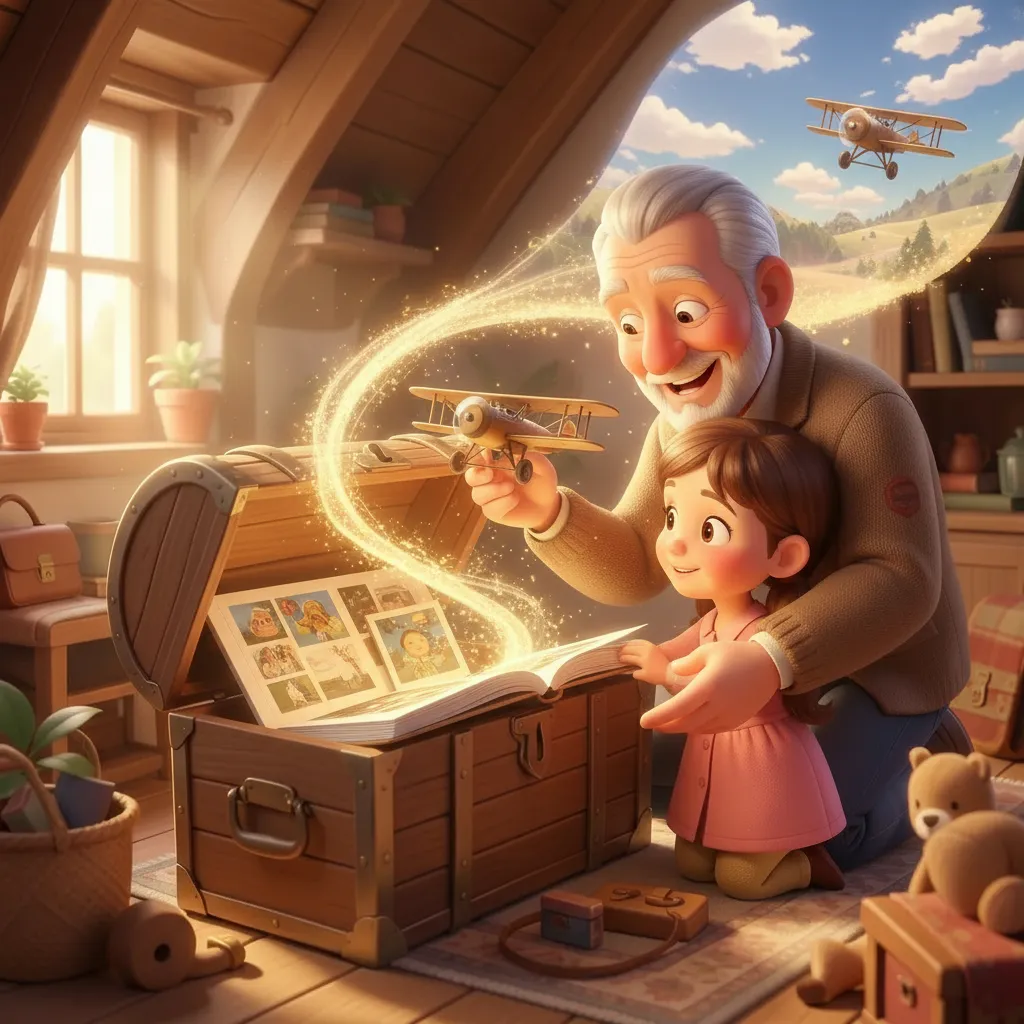
Grandma or Grandpa can hold one photograph or one object, the way a story needs a handle. In the finished grandparent book, a grandfather and a child kneel by an open chest. A photo album is in the chest. He holds a small wooden airplane. The useful part is the object in the hand, not the glow around it. On a call, a real photo from a real drawer does that job. See that finished grandparent book.
Travel days, when the child is the one away from home, are a different problem. Holiday travel with young kids covers the car, the plane, and sleep. A recording from a hotel works only if they still said yes and the room is quiet enough to hear them.
A dedication line can run up to 120 characters, which is one sentence, not a transcript of the recording. The book is for ages 3 to 7. A gift for grandkids who live far away is the distance note. Choosing one scene is the longer note. Begin at grandparents.
If the recording becomes a thank-you you mail, that is adjacent to teaching kids about giving at Christmas, which is a toy box and jars, not an interview. Other days are in personalized story ideas for everyday family moments.
Start a grandparent story when you want one recorded answer inside a book. Words and pictures are created after you pay, and you approve a proof before printing. Prices are on the pricing page.
Frequently asked questions
What if the child will not ask out loud?
You ask, using their wording, and they press the phone's recording control when you point. Or they hold the photo while you ask. The voice on the file can be yours. The question can still be theirs.
Can we record a song?
Yes, if they offer it. The Library of Congress list includes asking whether they remember a song and whether they will sing it. Do not demand a performance. A hummed line counts.
Where do we keep files the child should not edit?
A folder labeled with the year, copied off the phone. Tell the child the file is saved. You do not need a public page. If they later ask you to erase it, erase the copies you control.
When do you call a pediatrician?
Stop the recording if a child becomes frightened or cannot settle after a sad answer. Sit with them. If worry or sleep trouble lasts for days, call the pediatrician. A story hour does not treat grief. If you are the one who needs support after what you heard, that is a separate call for you, including a therapist if you want one. Do not push them to finish question 10.
Sources
- Preserving Family Stories, Library of Congress, accessed October 30, 2026
- Great Questions, StoryCorps, accessed October 30, 2026
- Some Possible Questions, Smithsonian Center for Folklife and Cultural Heritage, accessed October 30, 2026