Story ideas
How do you make losing the first tooth exciting instead of scary?
Give body facts, a parent script, and an optional tradition for a first loose tooth. Do not promise it will not hurt. A story rehearses pride, not numbness.
The short answer
Treat a first loose tooth as a growing-up milestone, not a crisis. Explain that a baby tooth loosens because a permanent tooth is coming in and the old root has been reabsorbed. Let your child wiggle it. If they want help, use clean gauze and a quick twist; skip the string and the doorknob. Add an optional family tradition. Do not promise it will not hurt. A story can rehearse pride. It cannot numb a tooth.
Key takeaways
- A first loose tooth is a growing-up milestone. It is not an emergency unless it came out from an injury, or there is pain, swelling, or a broken tooth.
- A baby tooth loosens because a permanent tooth is pushing in and the old root has been reabsorbed. There is often only a little tissue left holding it.
- Let your child wiggle a ready tooth. If they want help, AAP describes a clean gauze grasp and a quick twist. ADA says a string and a doorknob are not the method.
- Do not promise it will not hurt. A ready tooth often comes out with a wiggle. A tooth that is not ready is a dentist question, not a fairy deadline.
- A Tooth Fairy visit, a dish, or a keepsake is optional. Families who skip the fairy still have a milestone to mark.
- A story can rehearse pride and the real next step. It cannot numb a tooth or replace the dentist.
How do you make losing the first tooth exciting instead of scary?
Tell the truth about the body. Let them control the wiggle. Add a tradition only if your family wants one. Do not promise it will not hurt.
That is a smaller job than "make them excited." The American Academy of Pediatrics explains why a baby tooth gets loose in the first place: erupting permanent teeth cause the roots of baby teeth to be reabsorbed, so that by the time the tooth is loose there is little holding it besides a small amount of tissue. Children usually wiggle those teeth loose with their tongues or fingers (When Children Begin to Lose their Baby Teeth). Nemours KidsHealth says the same mechanism in kid language: a primary tooth falls out because it is being pushed out of the way by the permanent tooth behind it (Your Teeth).
This page is that job: a first naturally loosening baby tooth — usually a front incisor — and a parent who wants the moment to feel like growing up rather than like a medical surprise. It is not why is my child afraid of the dentist. That page owns fear of the chair, the tools, and the visit. It is not brushing teeth without a fight. Nightly toothpaste is a routine fight, not a loose tooth. It is not a first haircut. A salon snip is a different first, with scissors and a stranger, and it still should not promise a painless body.
A story can walk a hero with your child's face through a wiggly tooth, a gap, and whatever your family actually does with the tooth. It cannot promise the pop will not sting, set a fairy deadline, or replace the dentist.
What is actually happening when a baby tooth gets wiggly?
The timeline is a range. The biology is more useful than a birthday.
Nemours says most kids have twenty primary teeth by about age 3, and that those teeth start falling out, one by one, when a child gets to age 5 or 6. There are 32 permanent teeth in all. By about age 12 or 13, most kids have lost all of their baby teeth and have a full set of permanent teeth (Your Teeth). The American Dental Association's MouthHealthy eruption-charts page starts from the same inventory: people usually have 20 baby (primary) teeth, which fall out (shed) at various times throughout childhood, and by age 21 all 32 of the permanent teeth have usually erupted (Eruption Charts).
AAP is the order for the first ones: baby teeth ordinarily are shed first at about age 6 when the incisors, the middle teeth in front, become loose. Molars, in the back, are usually shed between ages 10 and 12, and are replaced with permanent teeth by about age 13 (When Children Begin to Lose their Baby Teeth).
| What you heard | What the sources actually say | What not to do with it |
|---|---|---|
| "Everyone loses the first tooth at 6 on the dot." | Nemours: they start falling out at 5 or 6. AAP: first shed is ordinarily about age 6, front incisors first. ADA: baby teeth shed at various times through childhood. | Treat a 5-year-old with a wiggle, or a 7-year-old still waiting, as late or early in a way that scares them. |
| "The tooth is rotten, that is why it is loose." | AAP and Nemours: a healthy baby tooth loosens because a permanent tooth is coming in and the root has been reabsorbed. | Joke that the tooth is "bad" or "dying." |
| "Yank it so the new one can come in tonight." | AAP: kids usually wiggle it themselves; a dentist may suggest extracting a primary tooth that is not loosening enough on its own. | Tie it to a doorknob, or pull a tooth that is barely movable. |
| "Baby teeth do not matter." | AAP: if baby teeth are lost by decay or accident too early, permanent teeth can erupt prematurely and come in crooked because of limited space. | Celebrate a decay-caused early loss as the same milestone as a ready wiggle. |
| "The Tooth Fairy has to come or it is not a real first." | ADA MouthHealthy describes the fairy as a tradition families can play, including a dish instead of a pillow. | Make a child who is scared of the fairy, or whose family does not do it, feel they missed the milestone. |
The table is editorial sorting of those AAP, Nemours, and ADA pages. None of them publish this five-row kitchen chart.
If the hard part is the chair rather than the wiggle, leave this page: child afraid of the dentist. If the leftover job is the nightly brush, use brushing teeth without a fight.
Does losing a baby tooth hurt?
Nobody can promise that. Do not write that promise into the evening, and do not write it into a book.
What the sources do say is why a ready tooth often comes out with a wiggle rather than a struggle. AAP: by the time the tooth is loose, there is little holding it in place besides a small amount of tissue (When Children Begin to Lose their Baby Teeth). Nemours names the part that actually hurts when something is wrong: the pulp is where each tooth's nerve endings and blood supply are found. When you eat hot soup, bite into ice cream, fall and hurt a tooth, or get a cavity, it is the pulp that hurts (Your Teeth).
Those are two different jobs. A baby tooth whose root has been reabsorbed is not the same as a tooth with an injured pulp. AAP says to contact the dentist whenever your child complains of a toothache, because the pain could be a sign of a decayed tooth (When Children Begin to Lose their Baby Teeth). Nemours tells parents to call the doctor or dentist for tooth or gum pain, a broken tooth, dark or light spots, or a tooth that falls out from a fall or injury (Keeping Your Child's Teeth Healthy).
Should you pull a loose tooth, or wait?
Wait unless the tooth is already very loose and your child wants help.
AAP is the child-led line: children usually wiggle their teeth loose with their tongues or fingers. If your child wants you to pull out the already loose tooth, grasp it firmly with a piece of tissue or gauze and remove it with a quick twist. Occasionally, if a primary tooth is not loosening sufficiently on its own, your child's dentist may suggest extracting it (When Children Begin to Lose their Baby Teeth).
ADA MouthHealthy is the "do not invent a stunt" line from a second publisher. It names two kinds of children — those who cannot wait to lose their teeth and those who are afraid of them falling out — and says there is a dentist-approved way to help wiggle a tooth out. The spoiler on that page is the method that is not involved: a string and a doorknob (My Child’s Tooth Is About to Fall Out. Should I Help Him Take It Out?).
- Check that it is already loose. AAP's method is for an already loose tooth, not a firm one you hope to hurry.
- Ask if they want help. AAP: if your child wants you to pull it. An eager child and a scared child are both on the ADA page. Do not pull to win a fairy deadline.
- If they say yes, use clean tissue or gauze and a quick twist. That is AAP's parent method, not a kitchen experiment.
- Do not use a string, a doorknob, or a yank on a tooth that barely moves. ADA: string and doorknob are not the method. AAP: a tooth that is not loosening enough is a dentist extraction question.
- If it came out from a fall or a hit, stop celebrating and call. Nemours: a tooth that falls out from a fall or injury is a doctor or dentist call, not a pillow.
The numbered list is editorial sorting. AAP names child-led wiggling, gauze, a quick twist, and dentist extraction when a tooth will not loosen. ADA names eager versus afraid children and rules out the string-and-doorknob stunt. Nemours names injury as a clinic question. None of them publish this five-line kitchen protocol.
What do you say and do tonight?
Name the body fact. Hand them the wiggle. Offer a tradition as a choice, not a requirement.
ADA MouthHealthy treats the Tooth Fairy as a tradition families can play, not as dental care. For generations, the Tooth Fairy has left a small gift for children who tuck fallen baby teeth under their pillows. The page also offers a dish instead of the pillow — one that is much easier to access — a notebook of visits, a brushing calendar left with the gift, and a "smilestone" scrapbook page. It suggests talking with your child about the experience of losing a tooth (5 Fun Ways to Welcome the Tooth Fairy). That is optional color. It is not a reason to yank a tooth before it is ready.
- Say what is happening in one sentence. "Your baby tooth is getting loose because a grown-up tooth is coming in underneath." AAP and Nemours both describe that push-and-reabsorb process.
- Say what you will not promise. "Some kids say it feels like a wiggle and then a gap. I will not tell you it cannot hurt."
- Let them wiggle it with a clean finger or their tongue. AAP: that is how children usually loosen the tooth.
- Offer help only if they ask. Gauze. Quick twist. Stop if it is not ready.
- Ask what they want to do with the tooth. Pillow, dish, keepsake box, or nothing. ADA's dish is an official alternative to the under-the-pillow trick. Families who do not do a fairy still have a first to mark.
- Keep the grown-up calm. ADA's page already splits kids into eager and afraid. Match the child in front of you, not the excited cousin.
The numbered list is editorial sorting of those AAP, Nemours, and ADA tradition pages. None of them publish this six-line script.
The same "preview the real first, do not promise a sensation" job shows up in a first haircut. The "big-kid pride without a fake finish line" job shows up in a birthday where they finally feel big. This page stays with the tooth.
When do you call the dentist about a loose tooth?
Call when the story is no longer a ready wiggle.
AAP: if your child loses baby teeth by decay or accident too early, permanent teeth can erupt prematurely and come in crooked because of limited space. Contact your dentist whenever your child complains of a toothache. Make sure your youngster has dental checkups twice a year. Parents may choose a pedodontist, a dentist with special interest and expertise in children's dentistry (When Children Begin to Lose their Baby Teeth).
Nemours: call the doctor or dentist if your child has tooth or gum pain, a broken tooth, dark or light spots on their teeth, or if a tooth falls out from a fall or injury. Kids should go to the dentist on a regular schedule — usually between every 3 months and once a year; ask your dentist what is right for your child (Keeping Your Child's Teeth Healthy).
AAP also notes that a child may need help brushing until they are between ages 7 and 10, because even with good intentions they may not have the dexterity to clean well (When Children Begin to Lose their Baby Teeth). Nemours puts independent brushing later: children 10 years and older usually can brush and floss on their own (Keeping Your Child's Teeth Healthy). The overlap is the point. A new gap does not mean they suddenly brush alone.
If the leftover worry is the whole dental visit, go to why is my child afraid of the dentist. If the leftover job is two minutes at the sink, stay with brushing teeth without a fight.
What can a personalized story do for a first lost tooth?
A story works on a calm evening, as a rehearsal of the real wiggle and the real next step. It is a poor teacher in a bathroom yank, and it is not dental care.
A child who is afraid the tooth will hurt often cannot hear "it's nothing" from a parent. They can watch a hero with their face and name notice a wiggle, ask whether they want help, keep the tooth if their family does that, and grin at a gap without a last page that swears it did not hurt.
The names below are invented for illustration. In a real personalized book, the hero is your own child, built from your own photo.
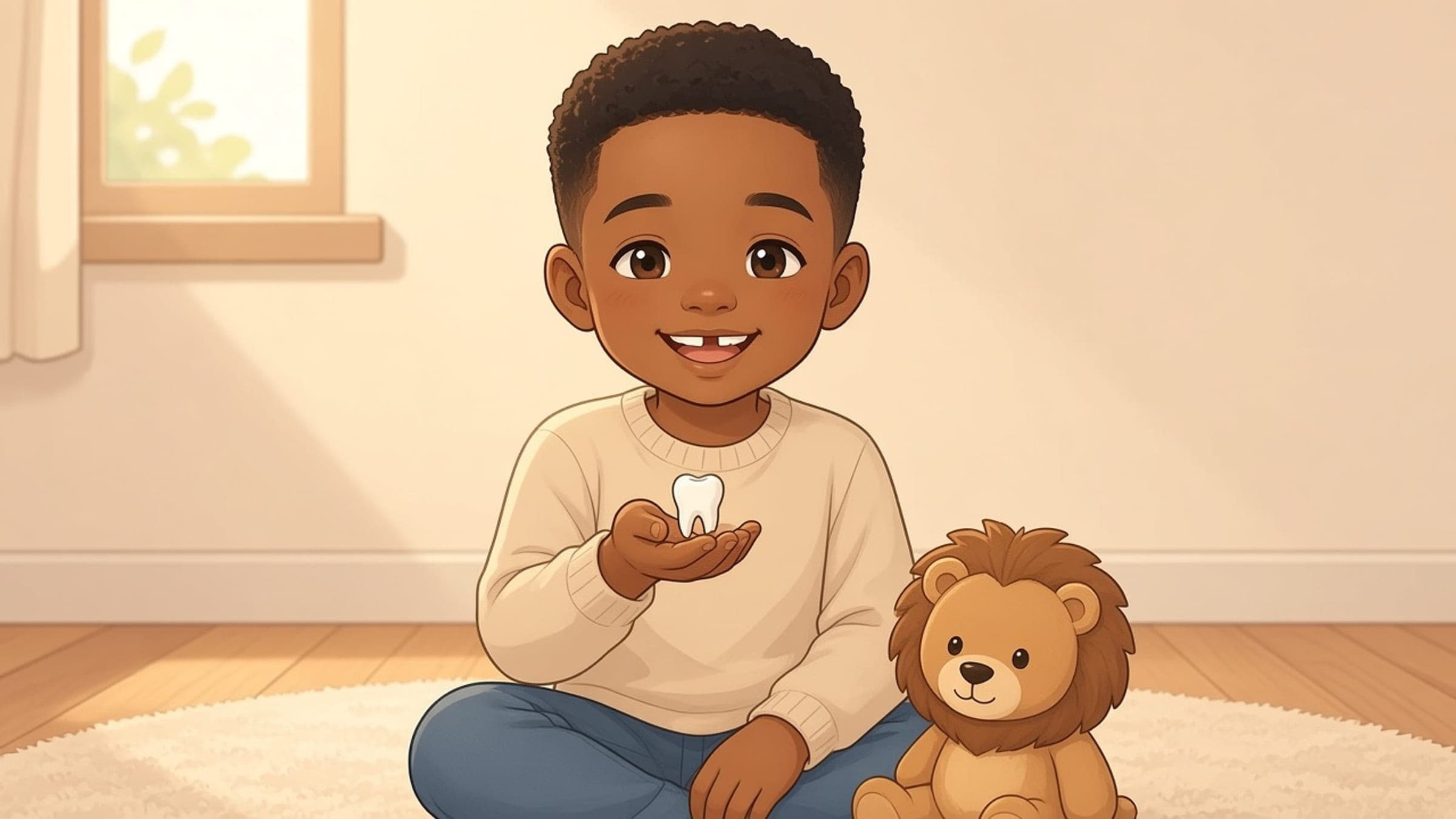
In the story, Malik is six. One bottom front tooth is already loose. His grown-up says a new tooth is coming in underneath. Malik wiggles it himself. Nobody ties it to a door. The book does not say the pop cannot sting. When the tooth comes out, Malik holds it in his palm next to his stuffed lion. His family uses a small dish on the dresser, not a pillow, because that is what they actually do. The last page is Malik looking at the gap. It is not "and then he was never nervous about teeth again."
After reading, have them point to their real loose tooth — if they have one — and say whether they want to wiggle it, wait, or ask for help. If the book used a fairy and your family uses a dish, fix the book. Wrong tradition is not a small detail.
How the studio keeps the rehearsal on this child's tooth
On the Plot Outline step, the studio asks what should happen in the story and notes that a few sentences is enough. Write the real tooth (which one, if you know), who wiggles it, and what your family does with it, in your child's words. Do not write "and then it didn't hurt." On the Voice step you set the tone. A calm, matter-of-fact tone fits. Once the book is finished, the review screen's edit mode lets you change page text if a pain promise, a doorknob, or "never scared again" slipped in.
For other everyday moments that can hold a small rehearsal like this, see personalized story ideas in everyday family moments. Other firsts that need a preview without a fake sensation live on a first haircut and learning to ride a bike — bikes still need a helmet this page does not have to solve.
Keep reading: if the leftover job is the chair rather than the wiggle, start with why is my child afraid of the dentist. If the leftover job is two minutes at the sink, see brushing teeth without a fight.
More related guidance:
- A Baptism, Christening, or Dedication Keepsake Story
- A First Plane Ride? A Story That Turns Nerves Into Wonder
- First Faith Milestone: A Story for Ramadan or Communion
- Scared to Put Their Face in the Water? A Story That Helps Them Swim
- Personalized Story Ideas Hidden in Everyday Family Moments