Story ideas
How do you help a child welcome a new stepparent?
Help a child adjust to a new stepparent: expect mixed loyalty feelings, let the child's parent lead on rules, protect their space, and give the bond time.
The short answer
Go slowly and take the pressure off. AAP describes the new stepparent, from the child's side, as a "guest in the house" who builds the relationship gradually. University of Minnesota Extension says to expect ambivalence, let the child's parent lead on rules, give the child a spot of their own, and make room for missing their other parent. A story can rehearse that pace. It cannot decide the family's rules or promise that love will come on schedule.
Key takeaways
- A child can like a new stepparent and feel guilty about it at the same time. University of Minnesota Extension says to expect that ambivalence.
- Go at the child's pace. AAP says the stepparent builds the relationship with the child gradually, on its own track.
- Let the child's parent lead on rules at first, and keep the rules few.
- A story can rehearse a slow, low-pressure start. It cannot set the family's rules or promise when the child will feel close.
How do you help a child welcome a new stepparent?
Take the pressure off. Let the child's own parent stay in charge of the hard parts at first, give the child a space of their own, and let the new grown-up earn trust through small, ordinary time together.
The American Academy of Pediatrics puts it from the child's side: the new stepparent is a "guest in the house." AAP says the stepparent needs to develop the relationship with the child gradually and independently of their relationship with the child's parent, and that becoming a stepfamily takes time, conscious effort from everyone, and occasionally some outside help (Becoming a Stepfamily).
This page is about one new grown-up. If the harder part is new kids in the house, see gaining stepsiblings. If it is going back and forth between two homes, see living in two houses. If the separation itself is still fresh, start with parents separating.
Why does a child act cold or guilty around a new stepparent?
Often because liking the new grown-up feels like being disloyal to their other parent.
University of Minnesota Extension says to expect ambivalence. It notes that ambivalence is normal in any relationship but may be stronger between a stepparent and stepchild because the child worries about disloyalty toward their biological parent. It also says it is normal for children to miss their biological parent, and to give them space to express those feelings. Children had little choice in the family change, so a range of emotions is natural (Guidelines for blended families).
| What it looks like | What may be underneath | What helps |
|---|---|---|
| Warm one day, cold the next | Liking the stepparent, then feeling guilty about it | Say out loud that liking someone new takes nothing from anyone |
| "You're not my dad." | Protecting the other parent's place | Agree calmly. The stepparent is not a replacement. |
| Quiet after a visit with the other parent | Missing them | Make room to talk about the other parent without flinching |
| Won't do what the stepparent asks | A rule from someone who is still a guest | Let the child's parent give the rule for now |
| Clings to their room or their things | Too much changing at once | Protect a spot that stays theirs |
The table is editorial sorting, not a clinical tool. If the pushing away looks more like jealousy of the new adult's time with a parent, that pattern overlaps with feeling jealous of a new baby.
Should a new stepparent discipline the child?
Not at first. University of Minnesota Extension's guidance for stepparents is to keep rules simple and few, and to follow the lead of the child's parent (Guidelines for blended families). A rule from a guest lands very differently than the same rule from a parent.
- Agree on the rules as adults, away from the child. Then the child's parent says them.
- Keep the list short. A few house rules, said the same way every time.
- Give the child a spot of their own. UMN suggests a spot in the home each child can claim, because that consistency can help them feel some control while things change (Guidelines for blended families).
- Let the stepparent skip the script. UMN tells stepparents not to try to fit a preconceived "stepparent" role and to be themselves with the kids (Guidelines for blended families).
- Listen before fixing. UMN says listening to each other and validating one another's feelings lays the foundation for healthy relationships (Guidelines for blended families).
Neither source on this page sets a timeline for when a stepparent should take on discipline, or what a child should call a stepparent. Those are family decisions. Decide them as adults, and do not make the child's name for the stepparent a test.
What can you say when a child pushes a stepparent away?
Short, calm lines work better than a speech. These are editorial examples, not quotes from the sources.
- "You don't have to love them. You do have to be kind, and so do they." It takes the pressure off without dropping basic respect.
- "Liking them doesn't take anything away from your mom (or dad)." It names the loyalty worry out loud.
- "You can miss your other parent here. That's allowed." It matches UMN's advice to give children space for those feelings.
- "This room is yours." It backs up the spot that stays theirs.
For the stepparent, the best line is often no line at all. Show up for one small thing the child already likes, such as a game, a walk, or cooking, and let it stay low-key.
How long does it take a child to bond with a stepparent?
There is no set timeline. AAP says the process takes some time and conscious effort from everyone, especially the parents (Becoming a Stepfamily). UMN says emotional bonds take time to form, and even if they never do, a stepparent can still have a respectful relationship with a stepchild (Guidelines for blended families).
That second point matters. A respectful, calm relationship is a real goal on its own. It is not a failure while you wait for something warmer.
AAP names outside help as part of how stepfamilies adjust (Becoming a Stepfamily). If home stays tense for a long stretch, asking your pediatrician or a family counselor is a reasonable next step.
What can a personalized story do for a new stepparent, and what can't it do?
A story can show a child a slow, low-pressure start, with the loyalty worry said out loud and a space that stays theirs. It works best read by the child's own parent, at a calm time.
The names below are invented for illustration. In a real personalized book, the hero is your own child, built from your own photo.
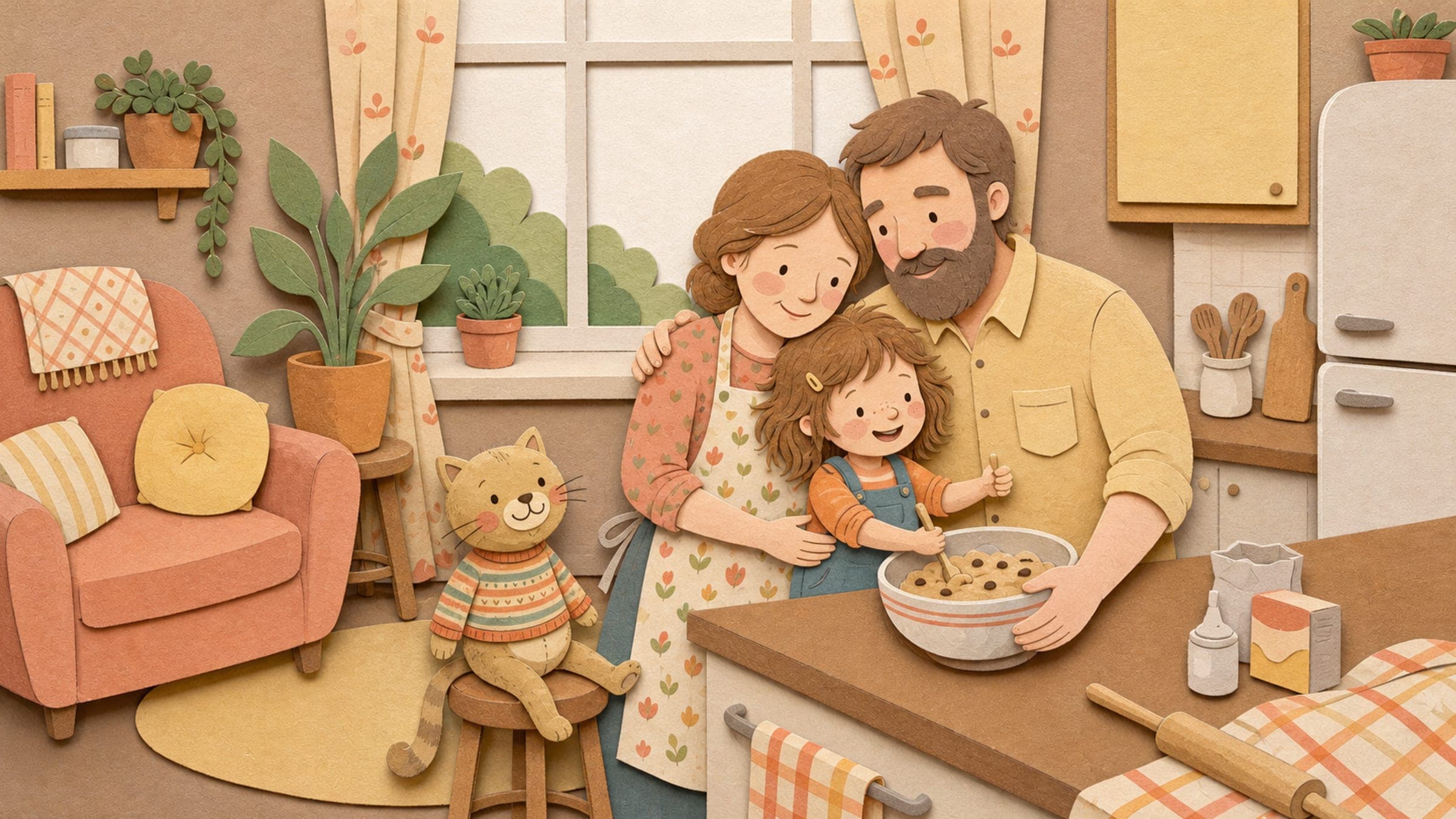
In the story, Nina's mom tells her that Dave is moving in, and that Nina's room is still hers. Nina is not sure about Dave. She likes his cookie recipe, then feels bad for liking it, because of her dad. Her stuffed cat Marigold says she can like a cookie and still love her dad. When Nina leaves her shoes in the hall, it is Mom who reminds her, not Dave. On the last page, Nina and Dave bake on Saturday, and she still calls her dad after dinner. The story does not say she loves Dave. It says baking is theirs, and her dad is still her dad.
How the studio keeps the story on your family's real plan
On the Plot Outline step, the studio asks you to tell it what happened and notes that a few sentences is enough. Write the real plan: the stepparent's name, the child's own space, who gives the house rules, the one thing they do together, and how the child stays in touch with their other parent. On the Voice step you set the tone and choose whether it rhymes. Once the book is finished, the review screen's edit mode lets you change page text, so you can remove any line that rushes the bond or says something about the other parent you would not want your child to hear.
For more everyday moments that can hold a small rehearsal like this, see personalized story ideas in everyday family moments.
Keep reading: a new stepparent often comes with new siblings too — see how this approach helps a child who's gaining stepsiblings.
More related guidance:
- A Parent Is Deploying: A Story for Staying Connected
- A Parent Who Travels for Work? A Story That Makes Goodbyes Easier
- Personalized Storybook Ideas for Grandparents
- Questions About Being Adopted? A Story That Keeps Conversation Open
- Personalized Story Ideas Hidden in Everyday Family Moments