Story ideas
How do you help an older child who is jealous of a new baby?
Welcome mixed feelings after a new baby. Protect one-on-one time, give helper jobs, and know when a story helps vs when to call the doctor.

The short answer
Welcome the mixed feelings without scolding. Say, in words and in protected one-on-one time, that your love for them has not shrunk. Give age-appropriate helper jobs so they feel included, not used as a third parent. Expect some regression and the occasional outburst. A story can rehearse feeling just-as-loved. It cannot diagnose attachment problems, replace pediatric guidance when aggression risks the baby, or promise that one book ends jealousy overnight.
Key takeaways
- Jealousy after a baby arrives is usually a bid for reassurance, not proof the older child is unkind.
- Welcome mixed feelings. Do not scold them for the feeling, and do not tell them to act like a big kid.
- Protect regular one-on-one time. Love is not a pie that shrinks when a baby is added.
- Age-appropriate helper jobs include them. They are not a third parent.
- A story can rehearse feeling just-as-loved. It cannot end jealousy overnight or replace a clinician when distress or aggression is the real job.
How do you help an older child who is jealous of a new baby?
Welcome the feeling. Then prove, in words and on the calendar, that they still have a place.
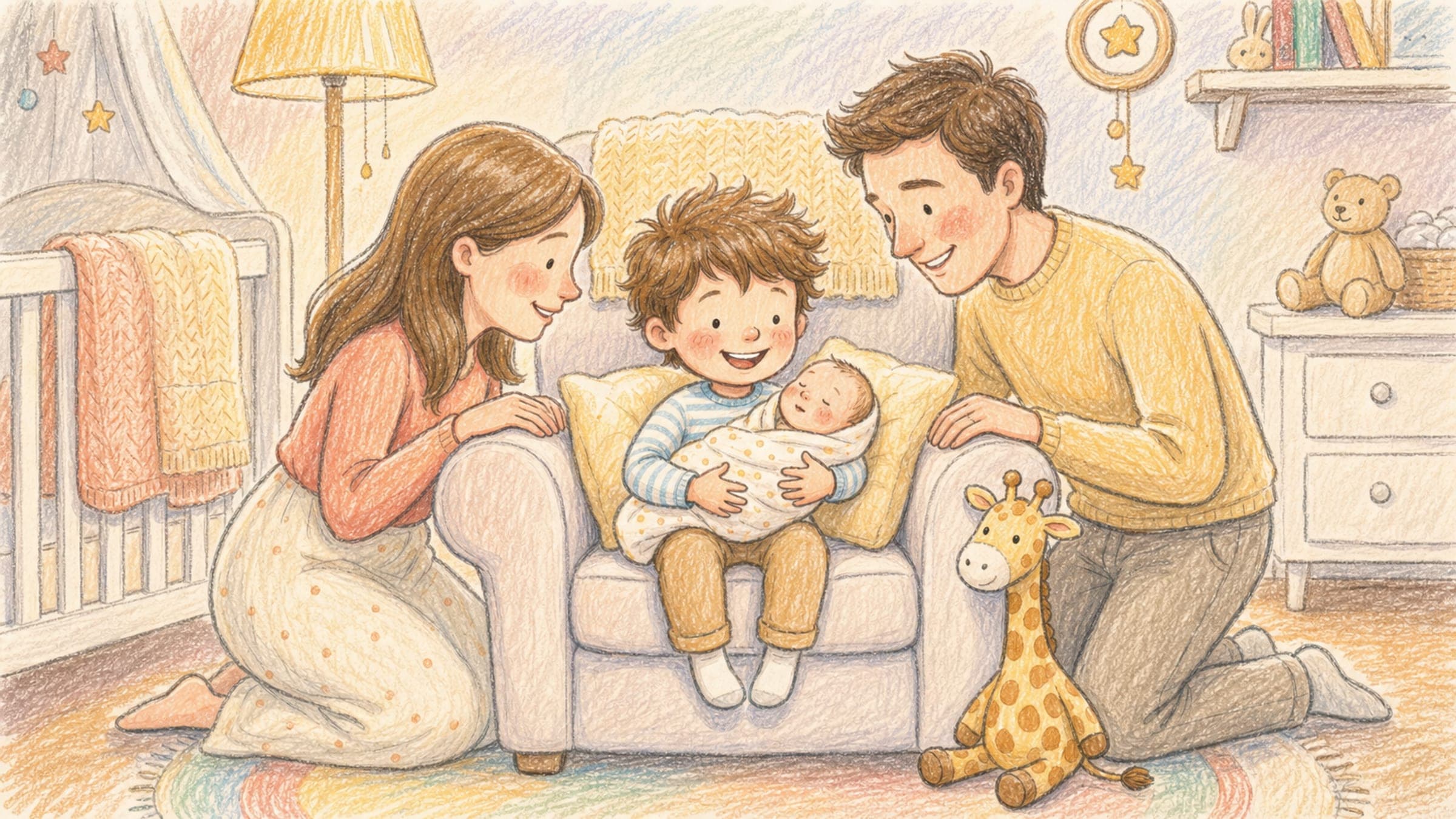
This page is the after-arrival job: the older child is already watching the baby take the lap, the visitors, and the night. It is not becoming a big sibling, which is the pregnancy and preparation job — telling them a baby is coming, giving them a proud role before the due date, and picturing the change. Keep those pages separate. Preparation does not finish the jealousy that shows up once the baby is home.
The American Academy of Pediatrics tells parents to reassure a preschooler that they will be loved just as much after the baby is born as they are now, to set aside special time once the baby arrives, and — for school-age children — to spend some time alone with them each day and use that time to remind them how special they are (Preparing Your Older Child for a New Baby: How to Help Siblings Adjust).
MedlinePlus says the same thing from a second publisher: spend a little time each day with the older child, when the baby is napping or another adult can watch the baby, and know that mixed feelings are part of the change (Preparing Children for Pregnancy and a New Baby).
Your job tonight is smaller than "make them love the baby." Name the feeling. Protect one stretch of time that is only theirs. Offer one helper job they can actually do. A story can rehearse feeling just as loved. It cannot make jealousy vanish, diagnose why it is there, or stand in for a pediatrician if aggression puts the baby at risk.
What does jealousy look like after the baby arrives?
It often does not sound like "I am jealous." It sounds like clinginess, baby talk, a toilet-trained child having accidents, a sudden wish for a bottle, or a sharp outburst when a visitor walks past them to the bassinet.
The AAP groups what to expect by age. Toddlers ages 1 to 2 may not understand much about a new sibling; the useful move is still to reassure them that they are loved, and after the baby arrives to keep the focus from landing only on the newborn — a special gift and a one-on-one date with a parent or another family member. Preschoolers ages 2 to 4 are still learning to share attention and may feel they have to compete for it; they also have a hard time when the family routine changes. School-age children, 5 and up, are usually less threatened, but they may resent the attention the baby gets (Preparing Your Older Child for a New Baby).
Expect some going backward. The AAP says a toilet-trained preschooler might suddenly have accidents or want a bottle, and that this is a normal way of checking that your love and attention are still there. Do not tell them to act their age. Give them the attention they need, and praise them when they act more grown-up (Preparing Your Older Child for a New Baby).
MedlinePlus describes the same pattern in its own words: the older child may get clingy, act up, start talking in baby talk, or act out. Set the same limits you always have. Be caring. Let them know they are still important. Help them talk about their feelings about the new baby. Do not tell them to act like a big boy or a big girl — they still think of themselves as your baby (Preparing Children for Pregnancy and a New Baby).
A second AAP page, written for new parents, is blunt about the hard days: do not be surprised if there are occasional outbursts or aggressiveness as older children get used to the new baby. Be clear about how to treat the baby. Praise them for being good helpers. Have healthy distractions ready (How to Cope With Challenges of Being a New Parent).
That is expected wobble. It is not a diagnosis. Write down what you saw and when. A dated note is what you take to a clinician if the week starts running on distress instead of ordinary jealousy.
What do you say when they feel replaced?
Talk when they are next to you, not while you are snapping a photo of the baby for someone else.
The lines below are a parent script built on the cited pages. No source hands you this wording.
- Welcome the feeling before you correct the behavior. "You wanted me, and the baby needed me first. That is a hard feeling. It is allowed." MedlinePlus asks you to help the child talk about feelings about the new baby, not to require excitement on cue (Preparing Children for Pregnancy and a New Baby).
- Say the love line in plain words. The AAP's preschool line is the one to keep: you will love them just as much after the baby as you do now (Preparing Your Older Child for a New Baby). "There is still enough love" is clearer than a lecture about families.
- Do not make them the big kid. "Act like a big sister" is the sentence both the AAP and MedlinePlus tell you to drop. The AAP says not to tell a regressing preschooler to act their age. MedlinePlus says not to tell them to act like a big boy or a big girl.
- Name one thing that is staying the same. MedlinePlus suggests telling the child what will stay the same after the baby comes — school, the playground, favorite toys, reading books with you (Preparing Children for Pregnancy and a New Baby). Pick the real one. "We still read at bedtime" beats "everything will be fine."
- Do not ask them to perform love. They do not have to kiss the baby for the visitors. They do have to be gentle. Those are different jobs.
Love is not a pie that gets smaller when you add a person. That metaphor is ours, not a quotation. The warrant underneath it is the AAP line: loved just as much as before.
If the fight is actually about a toy the baby reached for, that is a turn-taking job, not a sibling-love job — see sharing a favorite toy.
How do you protect one-on-one time once the baby is home?
Put it on a real day, not in a wish.
The AAP's after-arrival list is specific. Set aside special time: read, play games, listen to music, or simply talk. Show them you want to do things with them. Have them cuddle next to you when you feed the baby so they are part of the moment instead of parked across the room. Ask family and friends who come to see the baby to spend time with the older child too. Have a partner or another family member take the older child for time alone. For school-age children, make an effort to spend some time alone with them each day (Preparing Your Older Child for a New Baby).
MedlinePlus puts a clock on the same idea: try to spend a little time each day with the older child, when the baby is napping or another adult can watch the baby. When you breastfeed or bottle-feed, read a story, sing, or cuddle with the older child too (Preparing Children for Pregnancy and a New Baby).
- Pick a daily slot that survives a fussy evening. Ten minutes after the baby's first nap. A walk to the mailbox. One book on the couch. Write it where they can see it.
- Keep one stretch that is only theirs. No "special time" that is actually you bouncing the baby while they color at your feet. The AAP's school-age line is time alone with them, each day.
- Use feeding time as a together moment, not a exile. Cuddle the older child next to you, or read while the baby eats. That is the AAP and MedlinePlus move, not a consolation prize.
- Hand visitors a job. "Would you sit with Nora while I feed the baby?" MedlinePlus also says to let the older child open the baby's gifts, and to ask visitors to play and talk with them (Preparing Children for Pregnancy and a New Baby).
- Let another adult take them out. A grandparent, a partner, an aunt. The AAP names this as a chance for the older child, not as a way to get them out of your hair.
If the older child's week already moves between two addresses, protected time has to exist in both houses — that is the job on living in two houses, not this one. If the grown-up who used to do that hour is a grandparent who is raising them, start with being raised by grandparents.
How do you involve them as a helper without making them the babysitter?
Give them a job they can finish. Do not give them the baby.
The AAP says inviting a preschooler to help — so they feel included, not excluded — builds a bond, reduces jealousy, and promotes curiosity. For school-age children, make them feel they have a role in caring for the baby: they can hold the baby if they ask first, you teach them how, and you praise them when they are gentle and loving. On a separate new-parent page, the AAP also says to engage older siblings as special helpers in ways that fit their age, to be clear about how to treat the new baby, and to praise them for being good helpers (Preparing Your Older Child for a New Baby; How to Cope With Challenges of Being a New Parent).
MedlinePlus lists jobs that are actually doable: sing to the baby, help with a diaper change, help push the stroller, talk to the baby. It also says the honest thing parents skip: this takes longer than doing it yourself (Preparing Children for Pregnancy and a New Baby).
The toddler line on the AAP preparing page is the limit: older siblings can help at feeding or bath time, and the baby still needs one-on-one time too. Explain that sometimes you need to take care of the baby first (Preparing Your Older Child for a New Baby).
| Job | Age-appropriate helper | Not their job |
|---|---|---|
| Holding | Ask first, learn how, stay seated, an adult stays next to them | Carrying the baby from room to room, or being left "in charge" |
| Care | Fetch a diaper, sing, talk, push the stroller with you | Night feeds, soothing a screaming infant alone, watching the baby while you shower |
| Attention | Open a gift, greet a visitor, pick a onesie | Performing "I love the baby" for relatives |
| Feelings | Name jealousy. Keep the same house rules. | Being told they are the big kid now, so the feeling is not allowed |
The helper column is our editorial sorting of the cited jobs. The "not their job" column is the boundary those pages do not spell out as a table, and we would rather say so than dress it up.
If the new people in the house are not a baby but other kids, that is gaining stepsiblings. If the new person is a grown-up, that is a new stepparent. Do not collapse those into this page.
When does a story help, and when does jealousy need a clinician?
A story helps in a calm hour, as rehearsal. It does not help as supervision.
Ordinary jealousy, clinginess, baby talk, and a short outburst after a visitor leaves are the pattern the AAP and MedlinePlus already described. A book can put a child with their name and face in that week: the feeling is allowed, the parent still comes back, love did not shrink, one helper job is theirs.
A story cannot diagnose an attachment problem. It cannot replace pediatric guidance when hitting, squeezing, or throwing things puts the baby at risk. It cannot promise that one read ends jealousy. The AAP already told you to be clear about how to treat the baby and to expect occasional aggressiveness; that is a safety rule in the room, not a plot point (How to Cope With Challenges of Being a New Parent). If you cannot leave the baby and the older child in the same space without an adult's hands free, the book is the smaller half of the response. Call the pediatrician.
CDC's children's mental-health page draws a different line than ordinary jealousy: fears and worries are typical, and persistent or extreme fear or sadness that interferes with school, home, or play is the point to talk with a health care provider. The first step it names is a primary care provider or a mental-health specialist, not a picture book (Anxiety and Depression in Children). A rough Saturday after grandparents visit is not that pattern. A child who cannot use the house, sleep, or go to school because the baby is there might be. This page does not diagnose it.
The names below are invented for illustration. In a real personalized book the hero is your own child, built from your own photo.
In the story, Nora wants the yellow chair and the whole lap. The baby is in the room. Her stuffed rabbit, Button, does not make the baby leave. Button names the yucky feeling and stays for the ten minutes that are only Nora's — one book, no visitors. The last page is not "and then she loved the baby forever." It is Nora still sometimes jealous, still just as loved, and tomorrow's special time already on the fridge.
Then the read-aloud has a job outside the book: say the real time you will sit down, name the real helper job, and keep the last page from turning into a cure. A story that ends at "and then the jealousy was gone" is entertainment. A story that hands them tomorrow's ten minutes is preparation.
How the studio keeps the rehearsal specific
The Plot Outline step asks a plain question — "What should happen in the story?" — as a free-text box, with the guidance that a few sentences is plenty. That is where the real special-time slot, the real helper job, and the real "jealous is allowed" ending go, in your child's words, rather than a generic "learns to love the baby" last page. The story requires you to name one Story hero. On the Story step you review the complete written story before illustrating the opening pages, and you can use edit mode if a promised overnight cure slipped in.
Do not write a last page where one book makes them adore the baby. Write a last page where they had their time, the feeling was allowed, and they are still just as loved.
For other everyday moments that can hold a rehearsal like this, see personalized story ideas in everyday family moments.
Keep reading: if the baby is not here yet and the job is still preparation, start with becoming a big sibling.
More related guidance:
- Joining a Foster Family? A Gentle Story for the First Days
- A Parent Is Deploying: A Story for Staying Connected
- A Parent Who Travels for Work? A Story That Makes Goodbyes Easier
- When Parents Are Separating: A Gentle Story That Reassures Your Child
- Personalized Story Ideas Hidden in Everyday Family Moments