Meaningful gifts
What should you write in a personalized storybook for a grandparent?
Turn one real memory into a grandparent storybook: how to find the story, a worked before-and-after example, and who to make the hero.
The short answer
Write one specific thing that actually happened between them, not a list of compliments. Ask the grandparent for a moment rather than a summary, pick a single scene both people can act inside, and let the ending name the bond in your family's own words. A book about one afternoon lands harder than a book about a whole life.
Key takeaways
- Ask the grandparent for one moment, not a summary of their life.
- A single scene beats a tribute: give both people something to do in it.
- Decide early who the story is actually about — that choice shapes every page.
- Save the plain, unliterary sentence your family already says for the ending.
What should you write in a personalized storybook for a grandparent?
Write one specific thing that happened between this grandparent and this child. Not "Grandma is the best baker." One afternoon, one recipe, one burnt first batch.
The instinct with a gift book is to summarize a person — kind, patient, always there. That produces a card, not a story. A card can be read once. A story has a middle, and a middle is what makes a child ask to hear it again.
There is also reason to think the specific version does more work. Researchers Robyn Fivush and Marshall Duke at Emory University found that children in families that told coherent, emotionally open stories about family experiences had better self-esteem, higher social competence, better friendships, and less anxiety and stress. Notably, the useful stories were not the tidy ones. Emory's account describes narratives that acknowledge hardship rather than requiring a happy ending — relatives who got through something "by simply putting one foot in front of the other."
That is a permission slip. The story you are looking for does not have to be charming. It has to be true and it has to be particular.
How do you find the one story worth telling?
Most people ask a grandparent the wrong question. "Tell me about your childhood" asks for a biography, and a biography is exactly what will not fit in a picture book.
Reading Rockets, in its guidance on oral history with young children, separates the questions you can ask a relative into three kinds:
- Biographical — "When were you born? Where were you born?"
- Experiential — "What was it like when you were a child my age?"
- Reflective — "What are the most important things that have happened to you?"
The biographical ones give you facts. The experiential and reflective ones give you scenes, and scenes are what you can illustrate. Reading Rockets notes that when children interview grandparents this way, they "learn about their historical and cultural heritage, their families, and themselves" — the child doing the asking is part of the gift.
If the grandparent is the one being surprised, ask the people around them instead — the adult child usually holds three or four candidate scenes already and has never been asked to name them.
What does a vague idea look like once it is specific?
This is the step most gift books skip. Here is the same idea before and after.
Before: "Grandma loves to bake with the kids."
That is a fact about a person. There is nothing to draw, no problem, no ending.
After: "The morning Nana and Theo tried to make her mother's lemon cake and discovered they were out of lemons — so they walked to the corner shop in the rain, argued about whether limes would work, and used limes."
Look at what changed:
- Named people, not roles. "Nana" is what this child actually calls her.
- One occasion, not a habit. A morning, not "every Sunday."
- A problem that is small enough to be funny and real enough to require a decision.
- A journey, which gives the middle of the book somewhere to go.
- An imperfect ending — the cake is a lime cake now, and that is the point.
- An inherited detail, the great-grandmother's recipe, carried without a paragraph of history.
Run your own idea through those six checks. If it fails three of them, it is still a compliment and not yet a story.
Which premise shapes can you adapt?
If interviewing has not surfaced anything yet, start from a shape and replace every generic detail with your family's version.
- The recipe adventure. A missing ingredient turns a familiar dish into a small quest. Make it yours: use the dish only this family makes, and the substitution they actually reached for.
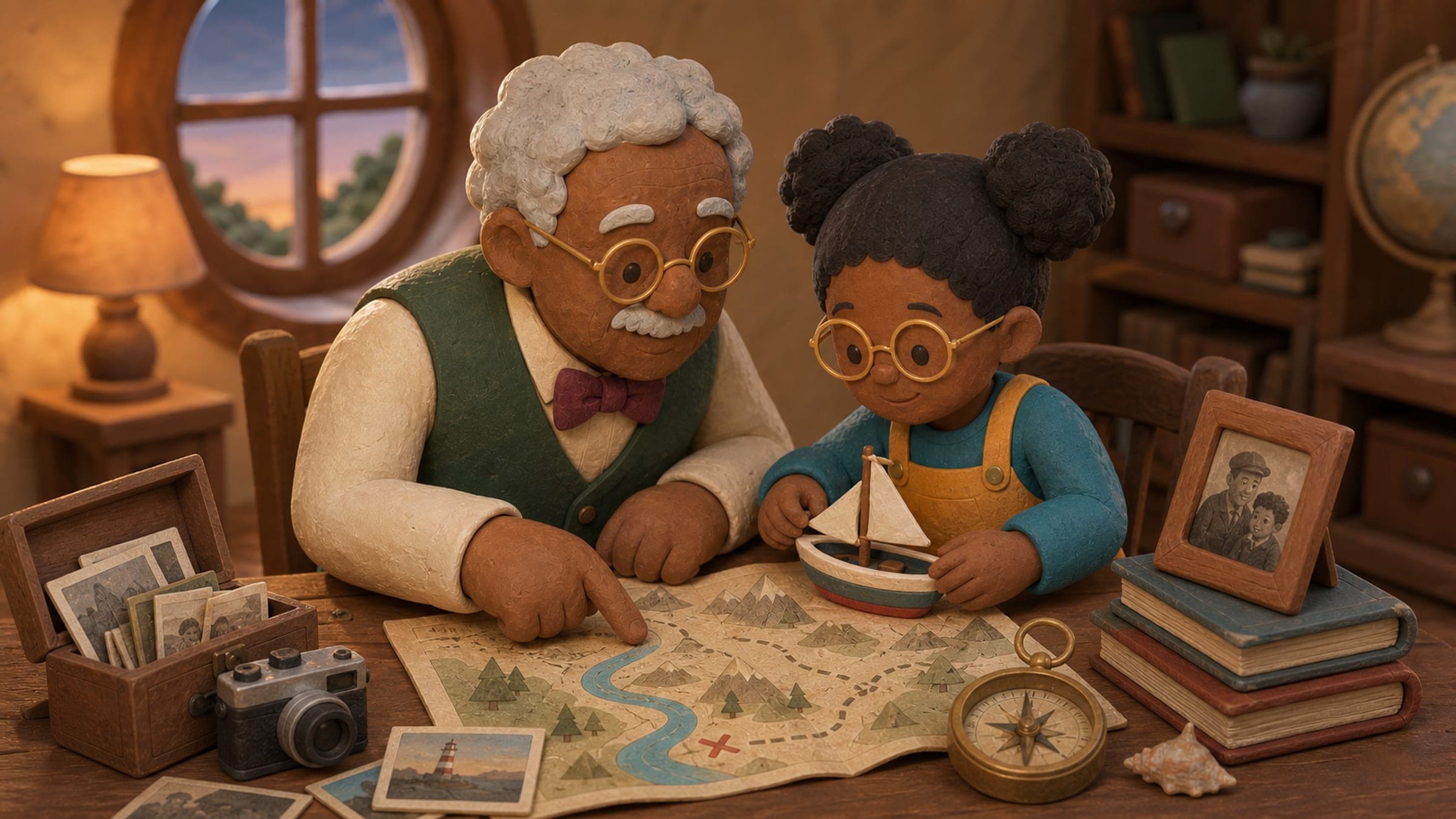
- The map of memories. A child and grandparent follow a map through places from the grandparent's childhood. Make it yours: pick three real places, not a whole hometown.
- The first day together. A new grandparent imagines the ordinary days ahead with a baby. Make it yours: name the specific things they said they could not wait to do.
- The secret skill. Gardening, sewing, fishing, fixing, or storytelling solves a gentle problem. Make it yours: the skill should be one the child has actually watched them use.
- The tradition keeper. The pair prepares for a holiday or ritual and learns why each detail matters. Make it yours: choose the one detail nobody outside the family would understand.
- The everyday expedition. A walk to the mailbox or a trip to the market becomes an adventure at child height. Make it yours: use the real route, including the dog they always stop for.
These are deliberately closer to gift premises than to the everyday prompts in personalized story ideas hidden in everyday family moments, which start from your own household's routines rather than from a relationship you are honoring.
Should the grandparent or the child be the hero?
Both will be in the book. Only one can be the main character, and in Storybook Studio that is an explicit choice rather than something the story drifts into.
One photo can hold both people. In the Characters step, the app proposes the people it detects and you confirm who belongs in the story, give each one a name and a relationship, and each confirmed person becomes a reusable character in your account — so the same Nana can appear in next year's book without starting over. How Storybook Studio turns a photo into an illustrated character covers that step in detail, and can one photo include siblings and pets? covers the crowded-frame version.
Then a later step asks directly: who is the main character of this story? Each option shows the name and the relationship you assigned, and the book will not continue until you pick one.
Choose by purpose:
- Grandparent as hero when the book celebrates them — a new grandparent, a milestone birthday, a memorial. The child is the reason the hero acts.
- Child as hero when the book is for the child and the grandparent is the steady guide who makes the brave thing possible.
Either way, the non-hero still needs something to do. A grandparent who only smiles in the background will not feel essential, and a child who is only carried is a passenger.
What should the dedication and the last page say?
You get two plain-language moments, and they do different jobs.
The personal note is a single line, up to 120 characters, that prints beneath the dedication at the front of the book. It is the shortest thing in the project and usually the most reread. Write it to the recipient, sign it the way you sign a card, and do not try to be literary in 120 characters.
The last page resolves the adventure and then names the relationship in the words your family actually uses:
- "Wherever we explore, I will always be your Grandma."
- "The cake was limes, but making it together was the best part."
- "Grandpa's stories became Maya's stories too."
- "There would be many firsts, and they would meet every one together."
Avoid an ending that could belong to any family. Echoing one image or phrase from the opening — the rain, the lemons — closes the loop without explaining itself.
A story like this can honor a relationship, open a conversation, and give a child language for what a grandparent means to them. It is a keepsake, not a substitute for the time itself, and it works best when the people in it recognize themselves.
If you are giving this on a date, check how long a personalized storybook takes before you plan around it, and digital versus printed if a grandparent would rather hold the book than open a link. For the wider question of why these land as gifts at all, see what makes a personalized storybook a meaningful gift.
More related guidance:
- Questions About Being Adopted? A Story That Keeps Conversation Open
- A Cross-Country Move? A Story That Helps a Child Carry Home With Them
- Adoption Day? A Story That Honors Belonging and Every Feeling
- Becoming a Big Sibling: Make Room for Mixed Feelings
- Personalized Story Ideas Hidden in Everyday Family Moments