Story ideas
What are good Thanksgiving traditions to start with kids?
Thanksgiving traditions with kids, sorted by effort: 2-minute, 20-minute and all-day ideas, the exact words to start each one, and options without a big dinner.
The short answer
Good Thanksgiving traditions with kids are the ones that fit the attention span you actually have at the table. Pick one 2-minute ritual, one 20-minute job, and at most one all-day project, and say the same opening words every year. A family that skips the big dinner can keep the same three sizes with a walk, a call, or a pancake breakfast.
The Thanksgiving traditions with kids that last are the small ones you can repeat with a tired four-year-old and a doorbell going off. Choose one ritual that takes two minutes, one job that takes twenty, and, only if you want it, one project that fills the day, then use the same opening words every November so the children know it is starting.
Key takeaways
- Sort ideas by effort before you choose. Most families keep one small ritual and drop the rest.
- Say the same first sentence every year. Repetition is what makes it a tradition.
- A big dinner is optional. The three sizes work with a walk, a call, or a breakfast.
Why sort traditions by effort?
Lists of fifty ideas assume a calm house and a free afternoon. The real day usually brings a schedule: relatives arriving at a set hour, an oven timer, and a young child who lasts about as long as their plate. The Library of Congress primary source set on the holiday notes that Americans have observed the day in many different ways over hundreds of years, from solemn days of prayer to football and parades. There is no single correct version to copy, so pick the size that fits your crowd.
Start with the smallest tier. If it sticks for two years, add one from the next tier.
Two-minute traditions (at the table or the door)
These need no supplies beyond what is already out.
- The one-word round. Before anyone eats, everyone says one word for something good this year. Toddlers can say "dog" or "pie." Opening words: "One word each, then we eat."
- The front-step photo. Every guest who arrives stands on the same front step for one photo. In ten years you have a strip of the same spot. Opening words: "Picture first, coats second."
- The empty-chair name. Say the name of one person who is not at the table this year, and one thing they like to eat. Opening words: "Who are we missing, and what would they put on their plate?"
- Pass the roll. Whoever holds the bread basket says who they want to pass it to and why. It moves around the table once.
Keep the words short. A child who is waiting for food does not want a speech, and an adult who gives one teaches the child that the ritual is about the adult.
Twenty-minute traditions (before or after the meal)
These need one simple supply and fit between arrival and the turkey coming out.
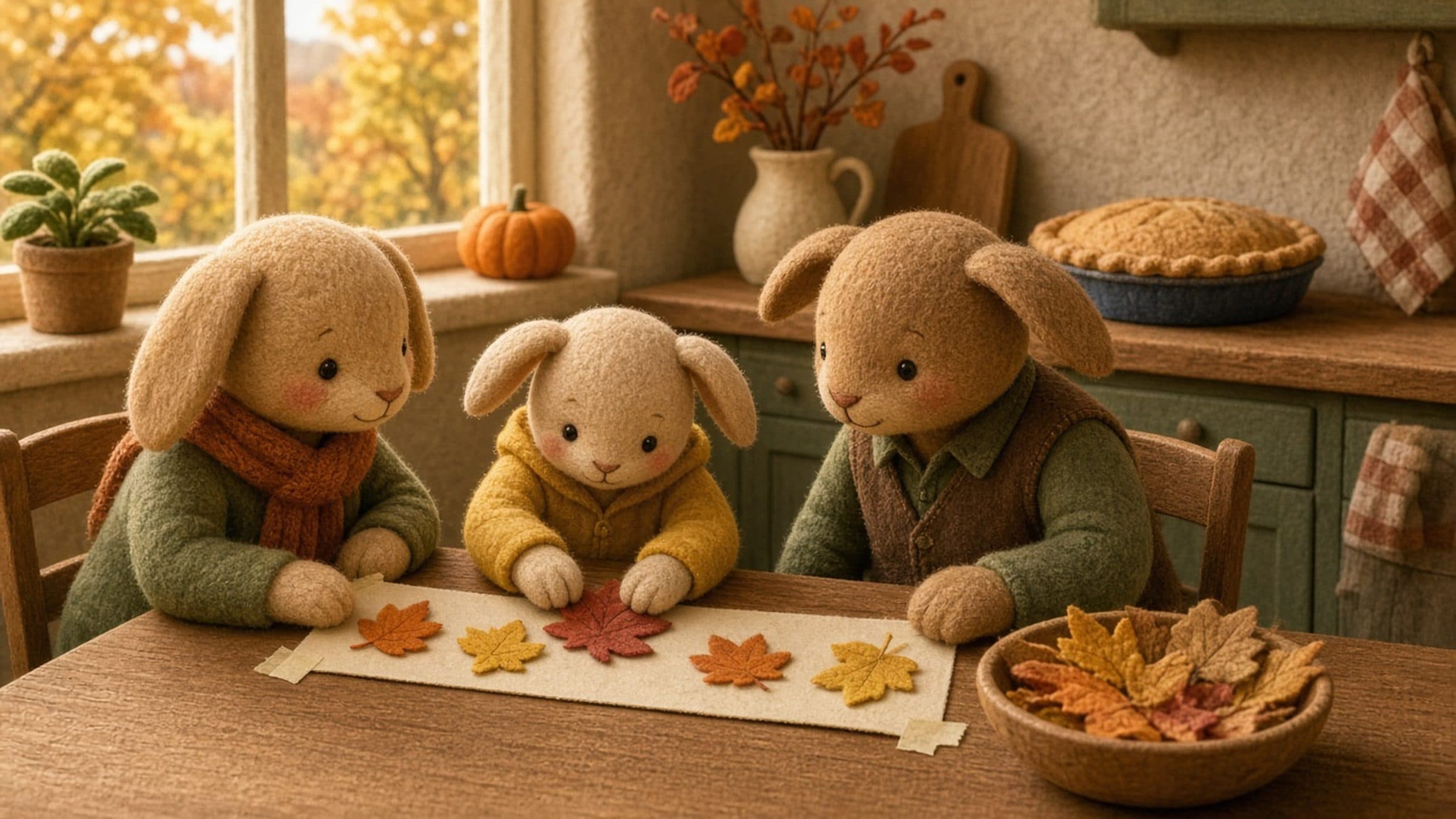
- The leaf strip. Tape a long strip of paper across the table. Each person traces a hand or a leaf and writes or dictates one line. Roll it up and store it with the serving dishes. Next November, unroll the old strip first.
- The recipe interview. A child asks the cook three questions about one dish: who taught you, what goes wrong, and what you changed. Write the answers on the back of the recipe card.
- The kids' place cards. Children fold index cards and draw one thing every guest likes. It gives restless hands a job while the kitchen is busiest.
- The walk loop. Everyone who wants to goes around the block once ahead of pie, on the same route every time.
All-day traditions (only if you want one)
One per family, at most. These are the ones that need a plan.
- Cooking one dish start to finish with a child, shopping list included. Pick something forgiving, like a cranberry sauce or a bread.
- A neighbor delivery. Bake or buy a small extra pie and carry it to a neighbor together in the afternoon.
- A photo-album hour. Pull out an old album and let the oldest guest tell the story behind three pictures. Children ask the questions; a grown-up writes the answers on a sticky note on the back of each photo.
What if your family does not do a big dinner?
Plenty of families work that Thursday, live far from relatives, or skip the turkey on purpose. The three tiers still work.
| Tier | With a big dinner | Without one |
|---|---|---|
| 2 minutes | One-word round at the meal | One-word round on the drive or at breakfast |
| 20 minutes | Leaf strip | Video call where everyone shows one thing from their week |
| All day | Cooking one dish together | A pancake breakfast, a park, and a movie at home |
A parent on a work shift can keep the front-step photo at shift change. A family with relatives in another state can mail the leaf strip and ask for one line back.
How do you keep a tradition going for years?
Write down the opening words and the date somewhere you will find them next November, such as an envelope kept with the gravy boat. Children remember the words long ahead of the reason. If a tradition stops being fun, retire it out loud: "We did the walk for three years. This year we are trying the recipe interview." That way the change becomes part of the family story instead of a thing that quietly disappeared.
A ritual can also live in a book. Our holiday story has an "Another holiday" choice where you type the name of the day and describe the ritual you keep, plus who was there and what to leave out. Words and pictures are made after you pay, you approve a proof before print, and costs are listed on pricing.
Traditions an older child can run (ages 7 to 10)
By second or third grade, many kids want a real role, not a craft. Hand one of these over completely.
- Menu writer. They copy the dishes onto a card in their best handwriting and tape it to the fridge. Misspellings stay; "mashd potatos" is funnier at age 15.
- Pie judge. Three categories (crust, filling, best bite), scored on sticky notes, results announced after dessert. Every pie wins something.
- Family trivia host. They collect five questions from adults by text during the week ("Which uncle drove the wrong way to the lake?") and quiz the room after the meal.
- Grocery checker. Give them the list at the store and a pencil. Crossing items off is the job.
Write the child's name and age on the menu card or score sheet and save it. In a decade, the stack of cards is a record of who ran what.
Frequently asked questions
At what age can a child join a tradition? As soon as they can sit at the table. A toddler can hold the bread basket or point to a picture; the words can come later.
How many traditions should we have? Start with one. A second one is worth adding only after the first has happened twice without reminders.
What if a relative thinks it is silly? Keep it short and let the children run it. Most adults go along with a two-minute ritual when a child is in charge.
Related reading:
Sources
- Thanksgiving: Primary Source Set, Library of Congress, accessed November 3, 2026