Story ideas
What is the best way to make a height chart for kids?
Height chart ideas for kids: doorframe marks, a movable wooden board, or a fabric strip, how to measure accurately, and what to write beside each line.
The short answer
The best height chart for kids is one you can keep when you move: a wooden board or fabric strip hung exactly 6 inches off the floor, or a doorframe you photograph before you leave. Measure barefoot against a flat wall with a book held level on the head, at the same time of day, and write the date, age and one short note beside each line.
The best height chart for kids is one that can move with you: a wooden board or fabric strip mounted a fixed distance off the floor, or a doorframe you photograph before you hand back the keys. Measure barefoot, with a hardcover book held flat on the head, and write the date, age and one short note beside each line.
Key takeaways
- Doorframes are free but stay with the house; boards and strips travel.
- Mount a board exactly 6 inches up and start its scale at 6 so the floor gap is counted.
- Measure in the morning, barefoot, heels and head touching the wall.
- Preschoolers usually grow about 2 to 3 inches a year, so a yearly line is easy to see.
Three kinds of height chart
| Type | Cost | Moves with you | Best for |
|---|---|---|---|
| Doorframe or wall marks | Free | No (photograph it) | Families staying put |
| Wooden board | A plank, paint, a tape rule | Yes | A keepsake you'll hang in every home |
| Fabric or canvas strip | Low | Yes, rolls up | Renters and small spaces |
Doorframe. The classic. Pick an inside frame that won't be repainted soon, like a pantry or closet. Before a move, photograph the frame with a tape measure beside it, or trace the marks onto a long strip of paper.
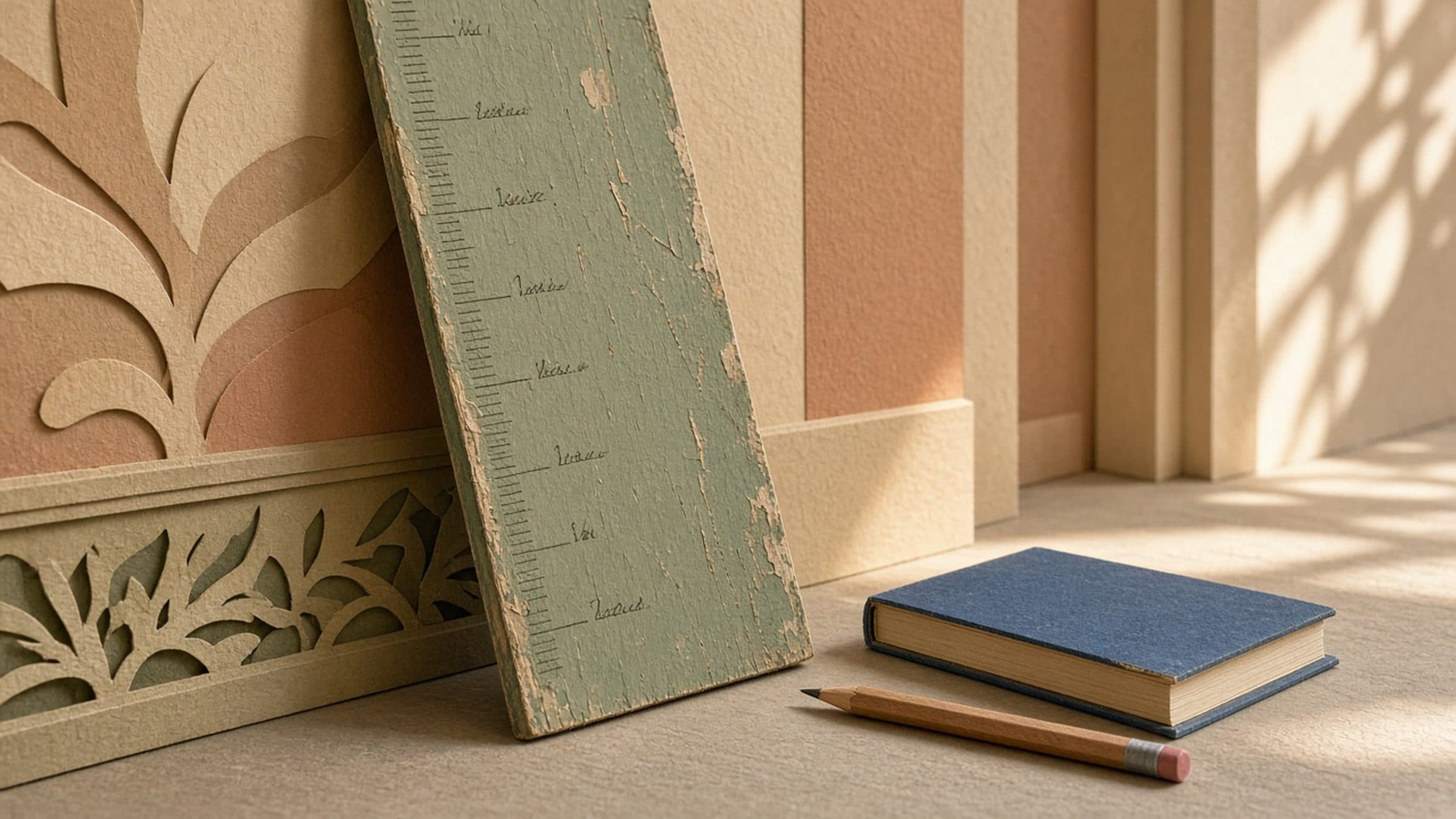
Wooden board. A 1-by-8 plank about 6 feet long works well. Sand it, paint or stain it, then add inch or centimeter lines with a ruler and a fine paint pen. Hang it so the bottom sits exactly 6 inches above the floor and start the scale at 6 inches. That way a baseboard doesn't throw the numbers off.
Fabric strip. Canvas ribbon or a painter's drop cloth cut to width, with a printed or hand-drawn scale. It rolls into a box and hangs from two nails, so it's the easiest choice for renters.
How to measure accurately at home
- Shoes and socks off, hair ties and clips out.
- Heels, bottom, shoulders and the back of the head touching the wall, feet together.
- Eyes looking straight ahead, not up at you.
- Lay a hardcover book flat on the head, pressed against the wall, and mark under it.
- Measure at the same time of day. People are slightly taller in the morning than at night because the spine settles during the day, so pick morning or evening and stick with it.
Do it on a birthday or the first day of a season so you remember. Twice a year is plenty for young children.
How fast children grow
The numbers are useful for setting expectations, not for diagnosis. MedlinePlus says a typical 3- to 6-year-old grows about 2 to 3 inches a year and gains 4 to 5 pounds. Growth in the second year is faster, and it slows into a steadier pace through the preschool years.
Home marks aren't medical measurements. Your pediatrician measures height at well-child visits and plots it on the CDC's clinical growth charts, which compare a child with their own past curve over time. A single low or high mark on the hallway board doesn't mean much. If a child seems to have stopped growing for a year or you're worried about height, bring it up at the next appointment rather than reading meaning into a pencil line.
What to write beside each mark
A date and an age are the minimum. The marks become much more fun to read later when each one carries a short note:
- "Age 3, could reach the light switch for the first time."
- "Age 4, insisted on standing on tiptoe; we measured twice."
- "Age 5, lost first tooth this week."
Keep it to one line so the board stays readable. Use a different color for each child if siblings share a board, and put initials beside every mark.
Making it part of the year
Families who keep height charts going for a decade usually tie them to a fixed day: birthdays, New Year's Day or the first day of school. Take a photo of the child next to the board each time. Years later, the photos and pencil lines side by side show more than either does alone.
A book about growing taller
The "growing taller" focus in our milestones book suits children about 1 to 5 who love being measured. You can mention the doorframe or the board, add a note or two from beside the marks, include parents, grandparents, siblings or a pet, and add a photo of the hallway if you like. You'll see a proof before a softcover or hardcover prints, with a PDF to keep. Look through a sample milestones book, read the milestones gift guide, or check current costs on the pricing page.
Frequently asked questions
Should I use inches or centimeters? Use whatever your pediatrician uses so the numbers match. Many boards show both.
What if the board has to come down? Note the mounting height on the back of the board so you can rehang it at the same height.
When can a child measure themselves? Around 5 or 6 most kids can stand correctly, but an adult still needs to hold the book level.
Related reading:
Sources
- Preschooler development, MedlinePlus, U.S. National Library of Medicine, accessed November 3, 2026
- Toddler development, MedlinePlus, U.S. National Library of Medicine, accessed November 3, 2026
- What Are Clinical Growth Charts?, Centers for Disease Control and Prevention, accessed November 3, 2026