Story ideas
How do you help a child wait their turn?
What to say while your child waits, one job to do in line, calm-day practice, and what turn-taking usually looks like at ages 3, 4 and 5.
The short answer
Give the waiting child one job and say when the turn comes back. At age 3, the American Academy of Pediatrics says children are learning to take turns and still need coaching. The CDC lists taking turns in games as a milestone most children reach by 5, and its 4-year tips include stop-and-wait games. A story can rehearse that job. It cannot make waiting easy or replace a doctor.
Key takeaways
- Help the child who is waiting, not the child who already has the toy. Name the order, give one job for the gap, and say when the turn comes back.
- At age 3, the American Academy of Pediatrics says children are learning to take turns and that you still need to encourage that cooperation. The CDC does not list taking turns as a 3-year milestone.
- The CDC's 5-year social milestone is that most children follow rules or take turns when playing games with other children. That is games, not every public line.
- Practice stopping and waiting on a calm day: a short "ready, set, go," red light / green light, or freeze dance. A line at the slide is a hard place to teach it for the first time.
- A book can rehearse the sentence and the job. It cannot make the wait feel short, and it is not a substitute for the child's doctor.
How do you help a child wait their turn?
Give the waiting child one job, and say when the turn comes back. "Be patient" names a trait. It does not tell a preschooler what to do with their hands for the next minute.
This page owns that job: the person who is not going yet. The favorite toy, and what to ask for instead of "share," is how to help a young child share a favorite toy. Do not collapse the wait and the handoff into one lecture.
The CDC's preschool tips are the shape of the script, not a minute-by-minute plan. Be clear and consistent. Explain and show the behavior you expect. Whenever you tell a child no, follow up with what they should be doing instead (Positive Parenting Tips: Preschoolers (3–5 years old)).
So the useful line is specific. "Not yet. That child is on the slide, then the next child, then you. While you wait, hold the rabbit and count who is ahead."
None of the pages below say how many minutes a child of a given age should stand in a line. If the line is longer than they can hold, shorten the wait or leave. A longer speech does not add minutes.
What do you say while they are waiting?
Use this order. The sentences in quotes are a parent script, short enough to say. The reasons under them are what the AAP and the CDC actually cover. Skip ahead and the earlier step is still undone.
- Stop the unsafe part first. If they push, grab, or hit, move in close. The American Academy of Pediatrics says that when anger or frustration gets physical, restrain them from hurting others, and if they do not calm quickly, move them away from the other children. Feelings can be understood. Hitting is not the way to show them (Social Development in Preschoolers).
- Say the order out loud. AAP: when two children are sharing a toy, each gets an equal turn, and particularly in the beginning you will need to encourage that cooperation. At a slide, the same idea is a sequence they can check: "First that child. Second the next one. Then you."
- Replace the no with one job. CDC preschool tips: whenever you tell them no, follow up with what they should be doing instead. One job, not four. "Hold the rabbit and count the children ahead of you." The jobs you can choose from are in the next section.
- Hand them the asking sentence. On the 4-year page, the CDC says to help a child use words to ask, and gives the example "Can I have a turn?" instead of taking something (Milestones by 4 Years). You say it first. They do not have to invent it in the line.
- Notice the wait after it happens. The same 4-year page says to give attention to the behavior you want, with a specific example such as "You're sharing that toy so nicely!" After a real wait: "You stayed until it was your turn." One sentence. Skip the speech about the kind of person they are.
- If they still cannot hold it, shorten the wait. AAP says a simple plan, such as drawing for who goes first or finding another activity, does not work every time. The CDC's 4-year tips say to stay nearby while children try to solve a problem, and to help if they cannot. Leaving the line is help. It is not a failed lesson.
If the wait tips into a meltdown, that is the neighboring job in big feelings and tantrums. If someone got pushed and a later apology is the point, that repair belongs on when your child was the mean one. The AAP says to ask for an apology only once the child understands what they did, and that by age 4 those explanations begin to mean something. Do not open with the apology while they are still trying to get on the slide.
At a playground, the CDC's preschool tips also say to watch your child at all times when they are playing outside, and to check equipment for loose parts or sharp edges (Positive Parenting Tips: Preschoolers (3–5 years old)). The script is not a reason to stand across the park.
What can a child do during the wait?
Two different times. Practice the skill when nobody is upset. Use one small job when you are already in the line. Mixing them up is how a slide line becomes a lesson nobody can hear.
What do you practice on a calm day?
These are activities the CDC prints as tips, not a finding that a child who plays them will wait calmly at a park.
| Age on the CDC page | What the page suggests | What it is for |
|---|---|---|
| 2 years | Play "ready, set, go." Pull a swing back, say "Ready, set...," wait, then say "Go." Take turns stacking blocks and knocking them down. | A few seconds of waiting, with you running the pause. |
| 3 years | Set a few simple rules, such as gentle hands. If a rule breaks, show what to do instead, and later notice when they follow it. Teach a short song they already like. | A rule they can remember, and a song they can use later. |
| 4 years | Play red light, green light, or freeze dance: music on, music off, everyone stops. Count simple things, such as fingers, toys, or bananas. Use "first," "second," and "finally," and ask what comes next. | Stopping when excited, and hearing a sequence. |
| 5 years | Play simple games with rules, such as Simon Says or a short board game. Notice when they calmly take "no" for an answer. | Turns inside a game, which is the 5-year milestone below. |
(Milestones by 2 Years; Milestones by 3 Years; Milestones by 4 Years; Milestones by 5 Years)
What is one job for the actual line?
Pick one. A child who is already wound up cannot hold a menu.
- Count who is ahead. The CDC's counting tip is fingers, toys, or bananas, so a child learns numbers. Counting the children in front of them is a parent use of that same count. It is not a CDC instruction for lines.
- Sing a song they already know. The 3-year tips include teaching a simple song. Using it to fill a wait is your idea. Keep it quiet enough that you are not performing for the playground.
- Watch the person who is going. "Watch their feet on the ladder" gives the eyes a place to be. That line is a parent script. It is not quoted from these pages.
- Hold a familiar stuffed animal. The 3-year tips include hugging a favorite toy to manage stressful feelings. The 4-year tips include hugging a stuffed animal when something feels scary. A rabbit can be that hold if the wait is upsetting. These pages do not say a stuffed animal teaches turn-taking.
If they need the rabbit to calm down, that is a feeling tool. It is not the same ask as "wait your turn," and it is not a reason to take the rabbit away to prove a point.
What is realistic at each age?
Treat the ages as ranges the sources describe, not a birthday when lines become easy. The CDC says developmental milestones are things most children — 75% or more — can do by a given age, and that the milestone materials are not a substitute for standardized developmental screening. If your child is not meeting a milestone, has lost a skill, or you have other concerns, the CDC's instruction is not to wait: talk with the child's doctor and ask about screening (Milestones by 4 Years).
| Age | What the source actually says | What to ask for in a line |
|---|---|---|
| About 2 | CDC: children this age play next to each other and do not know how to share and solve problems. Show them how to share, take turns, and use words. The "ready, set, go" pause is a few seconds you control. | You run a tiny wait. Do not expect a playground line. |
| Around 3 | AAP: once a child reaches 3, they "will be much less selfish than they were before." They will learn to take turns and share toys in small groups, though sometimes they will not. Three-year-olds can work out disputes by taking turns or trading toys, and particularly in the beginning you need to encourage that cooperation. CDC's 3-year social milestones are different: most children calm down within 10 minutes after you leave, and notice other children and join them to play. Taking turns is not one of those checkboxes. | You still say the order. One job. Stay close. |
| About 4 | CDC tips, not a turn-taking milestone checkbox: help them say "Can I have a turn?" Keep teaching taking turns. Practice stop-and-wait games. Give them time to solve a problem with a friend while you stay nearby. | The sentence, plus one job, with you next to them. |
| By 5 | CDC social/emotional milestone for most children: follows rules or takes turns when playing games with other children. Tips: teach rules in simple games, and praise calmly taking "no." | A turn inside a game. A long public line can still need you. The milestone is not a promise about every slide. |
The AAP's phrase "much less selfish" is their description of a shift at 3, not a verdict on a younger child who cannot stand in line. The 5-year milestone is specifically games with other children. A Saturday line for the slide can still be too long, too loud, or too abstract.
The CDC's preschool page also says to encourage play with other children so they learn the value of sharing and friendship, and to keep reading together (Positive Parenting Tips: Preschoolers (3–5 years old)). Those are supports. They are not a date by which waiting should look easy.
What can a waiting story do, and where does it stop?
The script handles the line. It does not, by itself, let a child rehearse the words before anyone is standing on the ladder.
On the 3-year and 4-year pages, the CDC says you can read stories or use pretend play to help a child feel more comfortable with new places and new people (Milestones by 3 Years; Milestones by 4 Years). A busy slide is that kind of place. A book can hold the order, the sentence "Can I have a turn?", and one job — count, song, watch, or rabbit — before you are in the line. That is rehearsal of a plan. These pages do not say a book makes waiting feel short, and they do not say it moves the 5-year game milestone earlier.
Read it on a calm day, not while someone else is already on the slide.
The names below are invented. In a real book the child is yours, built from your photo.
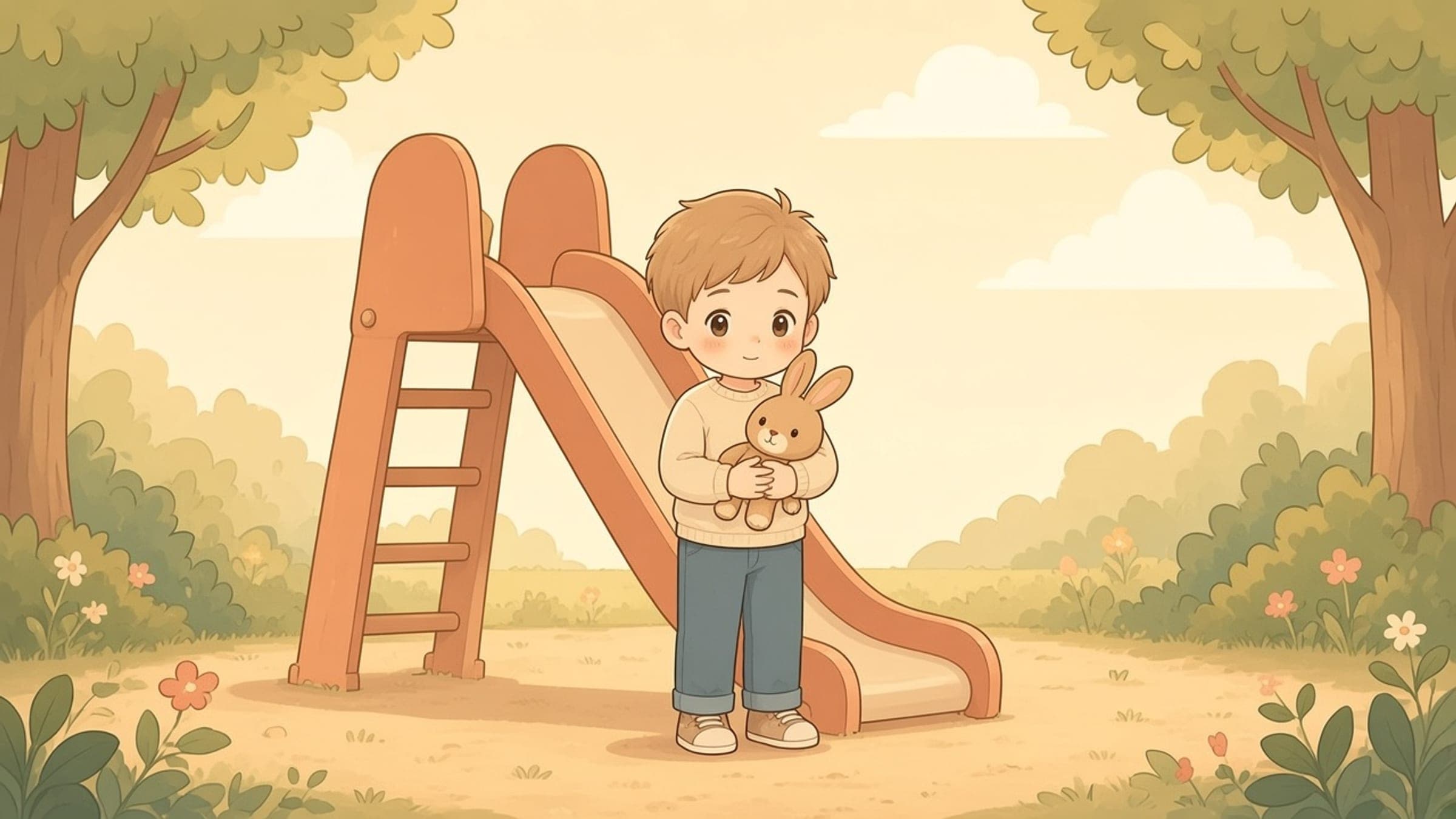
Owen stands beside a slide. One child is ahead of him. He holds a stuffed rabbit. A parent says, "First that child, then you." Owen counts "one" on the rabbit's ear. Then it is his turn. The last page is the turn. It does not announce that he loves waiting.
On Storybook Studio, start with one clear photo. On the Style step, pick the illustration look the pages will share. On the Characters step, the child is illustrated from that photo. The same path is walked in how Storybook Studio turns a photo into an illustrated character. On the Plot Outline step, a few sentences are enough: the slide, who is ahead, the rabbit or other job, and a last page where the turn arrives. On the Voice step, keep the tone matter-of-fact. After the story is written, you can still change page text if a last page claims they loved waiting, never cut in line again, or stopped minding at age 3. That edit window is can I edit a personalized storybook after I make it.
Boundaries, in plain language:
- A book can rehearse a sequence, the sentence "Can I have a turn?", and one job during the wait.
- It cannot make a two-year-old hold a playground line.
- It cannot replace the in-the-moment script, a shorter wait, or leaving.
- It is not a diagnosis and not a treatment. If you are worried about milestones, or a skill was lost, talk with the child's doctor. The CDC says not to wait on that conversation.
If the hard moment is losing once the game is over, rather than waiting to start, that is losing a game without falling apart. Everyday moments like a line at the slide are also a concrete place to start a book at all, which is the subject of personalized story ideas for everyday family moments.
More related guidance:
- How to Help a Toddler Share a Favorite Toy Without Forcing It
- Big Feelings and Tantrums? A Story That Helps a Child Find Their Calm
- Left Out at Recess: Join-In Scripts and When to Tell the School
- Making a First Friend: Hello Scripts, Playdates, and When to Wait
- Personalized Story Ideas Hidden in Everyday Family Moments
Sources
-
Positive Parenting Tips: Preschoolers (3–5 years old) — Centers for Disease Control and Prevention
-
Milestones by 2 Years — Centers for Disease Control and Prevention
-
Milestones by 3 Years — Centers for Disease Control and Prevention
-
Milestones by 4 Years — Centers for Disease Control and Prevention
-
Milestones by 5 Years — Centers for Disease Control and Prevention