Story ideas
How do you help a child make their first friend?
Practice a few friendly openers, set up low-pressure play, and celebrate brave attempts. A story can rehearse saying hello. It cannot promise a friend.
The short answer
Do not start with "just go make friends." Practice one short opener they can say out loud, then give them a real place to try it — a low-pressure playdate you set up, not a crowded yard and a pep talk. Celebrate the attempt whether or not it clicks. A story can rehearse saying hello. It cannot diagnose social anxiety, promise a friendship, or replace adult-facilitated peer time or clinical care when fear is persistent or extreme.
Key takeaways
- "Just go make friends" is too big a job. One short opener plus a real place to try it is enough.
- Adults set up the first chances: a short one-on-one playdate, and classroom pairings the child cannot arrange alone.
- Celebrate the hello whether or not it clicks. One no is about that kid that day.
- A story can rehearse saying hello. It cannot diagnose social anxiety, invent a friend, or replace real peer time.
How do you help a child make their first friend?
Do not start with "just go make friends." Start with one short opener they can say out loud, then give them a real place to try it.
A first friend is not the same job as finding a seat at lunch or joining a game that is already underway. Those pages stay with a cafeteria table and a recess ask. This page stays with the first hello — the child who wants a friend and does not yet have a script, or a place that is small enough to use one.
Adults often think children need to work friendship out themselves. The American Academy of Pediatrics is blunt: sometimes they do, but people rarely learn the fine art of friendship without support or role-modeling. Children with different social skills need different coaching. A shy child, in particular, needs help not answering peer conflict with fear, worry, and more isolation (What Parents Can Do to Support Friendships).
Your job tonight is smaller than making them popular. Practice one line. Set up one low-pressure playdate or a stretch of unstructured play you can actually watch. Celebrate the attempt whether the other child says yes. A story can rehearse that hello. It cannot promise the hello becomes a friendship, diagnose social anxiety, or stand in for adult-facilitated peer time.
How do you tell first-friend nerves from a missing opportunity?
Use a short conversation, not a pep talk. Sit down when they are calm — after school, before homework — and ask the questions in this order. Write down the answers in their words.
The AAP's peer-problems page starts from a child coming home upset that "everyone is being mean to me at recess and in the cafeteria." Most children have conflicts with friends and feel pushed away at some point, and reassurance can carry them until things settle. A pattern of rejection is the point to bring the school in (Problems With Peers).
A missing first friend can look like that complaint, or it can look quieter: they want someone and do not know how to start. These three questions sort the jobs.
- "Do you want a friend to play with, or do you like playing on your own right now?" Wanting solo play is an answer, not a problem to solve. Wanting a friend and not knowing how to start is a different job.
- "When you try to say hi, what happens?" One awkward shrug is a miss. Never getting a chance — no playdates, no unstructured play, only a crowded yard — is a missing opportunity. The same kids turning them away is exclusion, and that belongs with the school.
- "Is this one hard hello, or does being around kids feel scary most days?" Nerves before one ask are ordinary. Fear that takes over school, home, or play is the line for a health-care conversation, not a new opener.
Write the answers down the same night: who they wanted to approach, what they said or wished they had said, and how many days this week they had any real chance to try. A vague "they need more friends" evaporates by the next meeting. A dated note is what you take to the school if you need to go.
| What you are seeing | What it usually means | What to do next |
|---|---|---|
| They want a friend, freeze on the hello, and the rest of the day is fine | First-friend nerves, not a crisis | Practice one opener. Set up a short one-on-one playdate. |
| They want a friend and have almost no chance to try — no playdates, only a loud yard | A missing opportunity, not a failed personality | You create the chance. Ask the school for a classroom pairing too. |
| The same kids refuse them, tell others not to play with them, or shut them out on purpose | Deliberate leaving-out | Document days and words. Ask the school what aides see. |
| Fear of other children is persistent, extreme, or getting in the way of school, home, or play | The CDC's line for a health-care conversation | Talk with their doctor. A story is not the next step. |
Stay on their side while you sort that. The same AAP page notes that rejection may be a group reaction to someone peers see as different, or it may come from behavior on one or both sides that needs to be addressed (Problems With Peers). Do not call another child's parent from this first conversation. You do not yet know whether this is a missing hello, a missing chance, or a campaign.
If the hard part is a seat in the cafeteria, use the lunch-alone script. If the hard part is joining a game that has already started, that is being left out at recess. This page stays with the first friendship.
What opener can they actually try tomorrow?
Skip this section if they said they like playing alone right now. The moves below are only for the child who asked for a friend.
"Go make friends" is too big a task for a twenty-minute recess or a drop-off at the park. One repeatable line is enough.
The AAP friendship page tells you to help a child name their own feeling first — rejected, angry, hurt, or sad — and only then look at the other child's possible motive. Act after both of those, not from the first sting (What Parents Can Do to Support Friendships). "Nobody likes me" is a feeling. "That kid was already in the middle of a game" may be the motive. You will not know which until they have tried one line more than once, or you have watched a playdate yourself.
Turn that coaching into a short plan you can actually run at home.
- Pick one line and keep it low-stakes. "Hi, want to play?" or "Can I play too?" or "What are you making?" Practise it at the kitchen table until saying it out loud is boring.
- Add a smile or a wave as the smaller first move. For some children the words are the leap. A wave from a few feet away is still a hello. Do not stack a speech on top of it.
- Have a plan for no. One no is about that kid on that day. The plan is the next nearby child, or starting a small parallel game — a ball toss, a drawing, a pile of blocks — and calling "Who wants to play?" It is not a conclusion about themselves.
- Name the feeling before they walk over. "Your tummy feels tight. That is allowed. The job is the sentence, not making them like you."
- Stop at one or two tries in the same stretch of play. Three rejections in ten minutes is not practice. It is a pile-up. End on the attempt, not on a forced yes.
If the setting is a birthday party rather than a first friend, the warm-up is different — see too shy to join the party. If the setting is a team with a coach and a roster, that is joining a team where they know nobody.
How do you set up a low-pressure first playdate?
You set it up. The child should not have to invent the first chance in a crowded yard.
The AAP friendship page asks parents to be involved in creating social plans and to welcome friends into the house, so the child's world is bigger than one playground. From the preschool years on, it also asks you to be present and available when children are playing together — that is how you see how your child starts, and how you can warm up a shy first interaction without taking it over (What Parents Can Do to Support Friendships).
Unstructured play is useful here because there is no score, no audience, and no assigned role. A shared activity with one other child is enough. You do not need a party.
- Invite one child, for a short time. Sixty to ninety minutes is plenty. A third child turns a first try into a group.
- Put out one shared activity before they arrive. Blocks, sidewalk chalk, a simple craft, a ball in the yard. The activity is the third thing in the room, so the hello does not have to carry the whole visit.
- Put the most precious toys away first. A favorite that cannot be touched is a fight waiting to happen. That staging belongs with sharing a favorite toy, not with a lecture about being nice.
- Stay nearby for the first stretch. Warm up the first minute if they freeze — "Sofia brought the chalk. You two can pick a color." Then step back. Hovering from the doorway is different from running the play.
- End while it is still going okay. A short visit that ends on a wave is a success. Stretching it until someone is tired teaches the wrong ending.
Adults can widen the pool at school at the same time. CDC school-connectedness guidance reports that students feel more connected when they get to know each other well in class, enjoy school activities together, and work together on projects — so a teacher-arranged pairing does work a child cannot arrange on the playground (Peer Connection and Support). Ask for that in the classroom. Do not treat it as a replacement for a hello they still need to practice.
CDC's connectedness page is useful for what to ask the school to build, not only what to investigate. School connectedness is the student's belief that adults and peers at school care about them and their learning — a sense of being cared for, supported, and belonging. Classroom activities that strengthen peer relationships are one of the levers schools already use (Enhance Connectedness).
When should you involve the school — or a clinician?
Do not call the school because one hello went nowhere. Do call when the answers from tonight show a pattern, or when other children are already shutting them out.
The AAP advises that if there seems to be a pattern of rejection, you schedule an appointment with your child's teacher and consider asking the principal or guidance counselor to attend — then asks for the step most parents skip: have them gather information from the recess and lunch aides about what is happening (Problems With Peers). Those aides watch the unstructured parts of the day. Classroom teachers often cannot see them.
- Wait when they are nervous about one hello, and the rest of the day is fine. Practice the line. Host one playdate. Recheck in two weeks.
- Go in when the same refusal repeats, or they have no real chance to try. Bring dates, the words your child reported, and how long it has been going on.
- Ask for the aides' observations, and for one structural pairing. A classroom project partner, a recess club, or a buddy arrangement is adult-built peer time. It is not a diagnosis.
- Set a check-back date. Two or three weeks, written down. An open-ended promise is not a plan.
The AAP also suggests talking with your child's pediatrician, who knows your child's developmental patterns, once you have gathered enough information (Problems With Peers). That consult is for persistent distress or a pattern you cannot sort — not a first response to one shy Tuesday.
CDC's children's mental-health page draws the clinical line carefully: fears and worries are typical. Persistent or extreme fear that interferes with school, home, or play is the point to talk with a health care provider. Under anxiety, it lists social anxiety as being very afraid of going to places where there are people, such as school. The first step it names is a health care provider or mental-health specialist, not a picture book (Anxiety and Depression in Children). One nervous hello is not that pattern. Dreading every peer, or every ordinary school day, might be. This page does not diagnose it.
If other children are targeting them — teasing them for something they cannot change, or shutting them out on purpose — that is not a first-friend skill they failed to learn. Take that to teased for something they can't change, not a new hello.
When does a story help, and when does a first friend need more than a book?
A story helps before the next try, as rehearsal. It does not help as treatment, and it does not make another child say yes.
The useful book names the real opener, the real place they will try it, and the real plan for no. A child can watch a character who looks like them feel the tight tummy, say the line, and either get a yes or move to the next kid without deciding they are unlikable. That is preparation. It is not a promise that friendship arrives on page twelve.
The names below are invented for illustration. In a real personalized book the hero is your own child, built from your own photo.
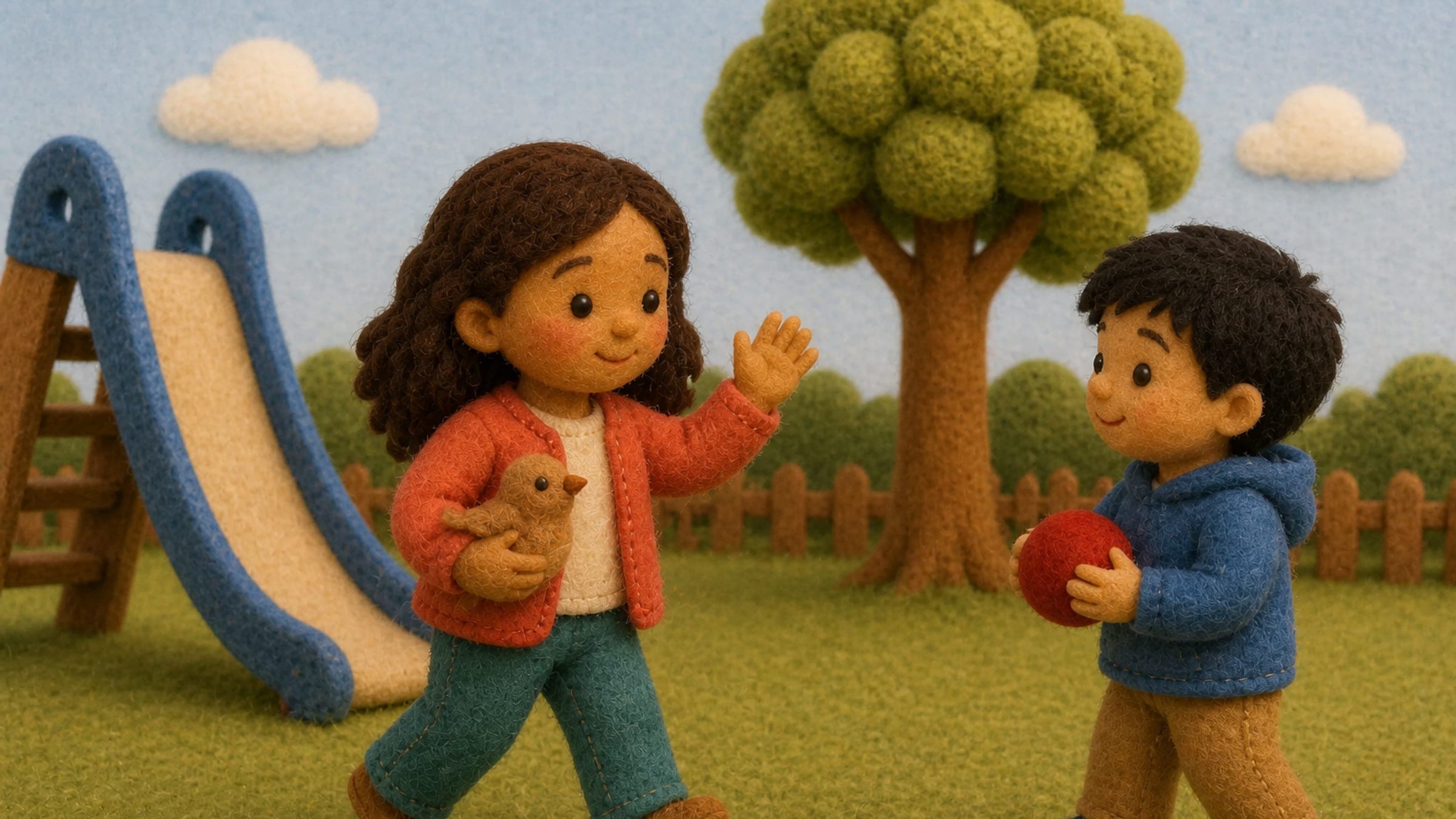
In the story, Sofia wants a friend and keeps waiting for someone to walk over first. Her stuffed bird, Pepa, tells her to pick one line — "Hi, want to play?" — and to have a next step if the answer is no. One child is already in the middle of something. The next page is not the conclusion that nobody likes her. It is the next nearby kid, and a small chalk game she starts herself.
Then the read-aloud has a job outside the book: name your child's real line, and their real fallback, and have them say both out loud once before they close the cover. A story that ends at the last page is entertainment. A story that hands them one sentence for tomorrow is preparation.
How the studio keeps the rehearsal specific
The Plot Outline step asks a plain question — "What should happen in the story?" — as a free-text box, with the guidance that a few sentences is plenty. That is where the real opener and the plan for no go, in your child's words, rather than a generic "makes a friend" ending. The story requires you to name one Story hero. On the Review step you read the complete written story before any of it is illustrated, and you can edit individual pages if a promised instant friendship slipped in.
Do not write a last page where one hello creates a best friend forever. Write a last page where they tried, and the try is the win.
For other everyday moments that can hold a rehearsal like this, see personalized story ideas in everyday family moments.
Keep reading: if the hard part is a cafeteria seat rather than a first hello, start with eating lunch alone.
More related guidance:
- Struggling to Wait Their Turn? An Active-Waiting Story
- When a Child Is Bullied: Speaking Up and Getting Help
- When Your Child Was the Mean One: A Story That Teaches a Real Apology
- How Storybook Studio Turns a Photo Into an Illustrated Character
- Personalized Story Ideas Hidden in Everyday Family Moments