Story ideas
How do you help a young child share a favorite toy?
Most toddlers cannot truly share until 3.5 to 4. Ask for a turn instead — plus a script for the moment your child will not hand over the toy they love most.
The short answer
Stop asking for sharing and ask for a turn. True sharing develops between 3.5 and 4 years old, so a younger child who refuses is not being selfish — they are being two. Let the one or two most precious toys be off-limits before a playdate, then run the rest on turns: narrate what is happening, say both children's feelings back to them, and let a timer end the turn instead of you.
Key takeaways
- Sharing skills develop between 3.5 and 4 years old, so a two-year-old who refuses is on schedule, not badly behaved.
- Sharing and turn-taking are different asks. Turn-taking is the one a young child can actually do.
- The one or two most precious toys are allowed to be off-limits. Put them away before the playdate rather than negotiating over them.
- In the moment, narrate what is happening, reflect both children's feelings, and let a timer end the turn instead of you.
How do you help a young child share a favorite toy?
Stop asking them to share it and start asking for a turn. ZERO TO THREE places the development of sharing skills between 3.5 and 4 years old, and notes that 43% of parents surveyed expected children to have mastered sharing by age 2 (Helping Young Children With Sharing). That gap — between when parents expect sharing and when it actually arrives — is where most playdate meltdowns live.
So the honest answer to "how do I make my child share their favorite toy" is often that you cannot yet, and that the more useful move is to change the request.
At what age can a child actually share?
Roughly:
- Under 2. Expect parallel play and possession. A child this age is still working out that other people have thoughts separate from their own, so "how would you feel if he did that to you" lands on nothing.
- 2 to 3. Turn-taking becomes teachable, even though it is not yet reliable. This is the age to run short, adult-supported turns rather than to expect spontaneous generosity.
- 3 and up. The American Academy of Pediatrics writes that once a child reaches 3, they will be "much less selfish than they were before," will "learn to take turns and share toys in small groups," and are "able to work out solutions to disputes by taking turns or trading toys" (Social Development in Preschoolers). Even then the AAP is clear that "particularly in the beginning, you'll need to encourage this cooperation."
Two caveats worth keeping. These are ranges, not deadlines — a child on either side of them is not a problem to solve. And neither source addresses the favorite toy specifically; both describe sharing in general, which is why the next section is our editorial judgment rather than a cited finding.
What is the difference between sharing and taking turns?
They feel like synonyms to an adult and they are not the same task for a child.
Sharing is open-ended. It means handing the thing over without a stated end, and to a young child it is indistinguishable from losing it. That is why the answer is so often an instant, total no.
Turn-taking has a shape. Someone has it now, then someone else has it, then it comes back. It is a sequence a child can hold in their head, and it contains a promise the child can verify: the truck came back last time.
This is the single most useful swap in the whole topic. "You need to share your truck" asks for a surrender. "It's Maya's turn, then it's your turn again" asks for a wait — and waiting is a skill you can practice on its own, away from the flashpoint, which is the subject of struggling to wait their turn.
Is it okay to let my child keep one toy to themselves?
Yes, and it usually makes the rest of the visit go better.
Before a playdate, let your child choose one or two items that are not going to be available — the lovey, the thing they sleep with, the toy that is currently everything. Put them somewhere else in the house before the other child arrives. Then everything still in the room is genuinely in play.
This is a practical staging tactic rather than a research finding, and we would rather say so than dress it up. The reasoning is simply that a rule set before anyone is upset is easier to hold than a negotiation conducted over a toy two crying children are both holding.
Expect a real feeling when a favorite goes into rotation anyway. A prized object can function as a piece of the child's own security, and being asked to hand it over is closer to an emotional event than a manners lesson — closer to the territory in big feelings and tantrums than to a discipline problem.
What do you say in the moment?
ZERO TO THREE's guidance for the actual conflict runs roughly as follows, and it works because it slows the moment down instead of resolving it by force:
- Ensure safety first. Step in calmly if anyone is grabbing or hitting. Nothing else in this list works until that stops.
- Narrate the situation. "Sportscast" it: You have the truck. Ben wants the truck. You're holding it tight. Saying it out loud slows everything and buys both children a moment.
- Reflect both children's feelings. You're not ready to let it go. Ben, it's hard to wait for something you really want. Naming the disappointment is the work here — not fixing it.
- Use a timer as the neutral turn-keeper. Let the clock end the turn rather than you. Consider a long turn: one child plays until they are genuinely done while the other is set up with something else.
- Then brainstorm with them. Once everyone is calm, invite the children toward their own solution rather than issuing one.
(Helping Young Children With Sharing)
The AAP adds a small, concrete line for the same moment: tell your child to "use your words," remind them that "when two children are sharing a toy, each gets an equal turn," and — above all — model peaceful conflict handling yourself (Social Development in Preschoolers).
Notice what is absent from both sets of guidance: making the child hand it over immediately to prove a point.
Where does a personalized story fit?
The script above handles the conflict. It does not do much about the belief underneath it, which is that letting go of the truck means the truck is gone.
That belief is best argued against before the playdate, not during it — and a story is a low-stakes place to run the experiment. A book where a character with your child's name and face refuses, then tries a turn, then gets the toy back gives them a rehearsal of the outcome they do not yet believe in. The next time a timer dings in real life, it is a repeat of something they have already seen end well.
The names below are invented for illustration. In a real personalized book the hero is your own child, built from your own photo.
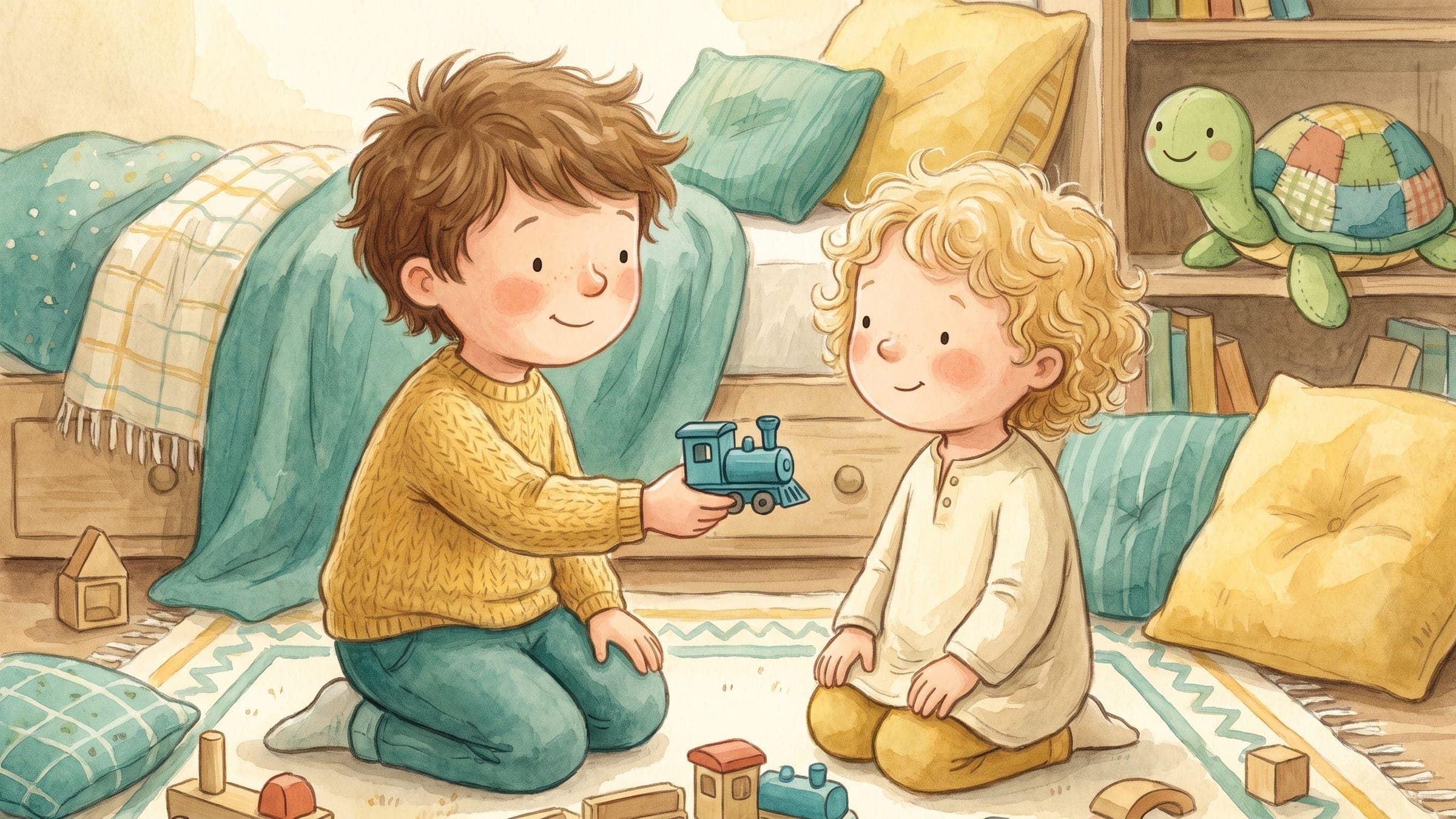
Ari's truck was the best toy in the world, in his opinion, and when a friend reached for it his whole body said no. In his book, a stuffed turtle named Tuck shows him the turn: Ari holds the truck, then the friend holds the truck, then the truck comes home to Ari. It comes back. It always comes back. Then they race it together, which turns out to be better than racing alone.
Read it in a calm moment, a day or two before the visit — not while the other child is standing in the doorway.
Boundaries worth stating plainly: a story can rehearse a turn, name a feeling, and make a routine familiar. It cannot make a two-year-old developmentally ready to share, and it is not a substitute for advice from your pediatrician if a child's aggression around possessions is persistent, escalating, or out of step with everything else you see. Sharing that arrives late is common; sharing that never comes with any peer is worth mentioning at a well visit.
For the neighboring versions of this — the same skill in a competitive setting, and the friendship it is usually in service of — see losing a game without falling apart and making a first friend. Everyday moments like this one are also the easiest place to start a book at all, which is the subject of our personalized story ideas guide.
More related guidance:
- Teased for Something They Can't Change: A Self-Respect Story
- Too Shy to Join the Party? A Warm-Up-at-Your-Pace Story
- When a Child Is Bullied: Speaking Up and Getting Help
- Being Left Out at Recess? A Story That Helps a Child Find Their Way In
- Personalized Story Ideas Hidden in Everyday Family Moments