Reading together
What short Christmas poems can kids ages 3 to 8 read aloud?
Original Christmas poems for kids to recite at home: an echo piece, a traded piece, and a room piece, with two quiet rehearsals before visitors arrive.
The short answer
Christmas poems for kids to read aloud should be original, brief, and easy to share out loud. Use an echo piece when a grown-up should lead, a traded piece when you alternate phrases, and a room piece when everyone joins the last refrain. Rehearse twice on an ordinary evening. Skip the gathering if the child refuses. These are not greeting-card verses. The American Academy of Pediatrics recommends reading aloud together at least through kindergarten.
Key takeaways
- Christmas poems for kids work out loud when a grown-up leads an echo, a pair trades phrases, or the room joins one refrain.
- Rehearse twice on a plain evening. Visitors hear the third try, or they hear nothing.
- The pieces below are original. They are speaking pieces, not greeting-card verses.
- If joining a familiar song has stopped, or looking at people causes real fright, call the pediatrician.
Christmas poems for kids to read aloud are easiest when the piece is original, brief, and built for a voice in the room: an echo if a grown-up should start, a trade if you alternate, and a room refrain if everyone finishes together. Rehearse twice before anyone visits, and drop the performance if the child shakes their head.
What is an echo piece?
An echo piece is for a speaker who is still happy to copy you. You speak a phrase. They copy it. You never ask them to begin.
Lamp
The lamp is on.
The tree is dark.
We plug one cord.
The room turns gold.
Stand by the lamp while you do this. Point at the dark branches, then at the cord, then at the glow. The gesture carries the meaning when the phrase is new. If they copy only "gold," that copy is enough. Stop there. A second piece on the same evening is optional, not owed.
Cinnamon
Somebody hid the jar.
We sniff the shelf.
The smell is there.
The jar can wait.
Open a real spice jar if you have one, then close it. The sniff is the rehearsal. Do not quiz them on which phrase comes next. The Centers for Disease Control and Prevention says that by a fourth birthday, most children (about 75 percent or more) can join some words of a familiar song. Echoing one phrase is that skill in a living room, not a test you score. If they used to join songs and have stopped, or you are worried, call the pediatrician and bring the milestone list. Do not wait for a recital to raise it. A poem will not explain a language loss, and it is not treatment.
In a 2024 policy statement in Pediatrics, the American Academy of Pediatrics recommends that clinicians encourage grown-ups to read aloud with young children, starting early and continuing at least through kindergarten, with back-and-forth rather than a performance. Kindergarten is younger than eight, so the traded piece below is how some households keep that habit going. The policy did not study poetry. If every evening of reading is a fight, ask the pediatrician. Joy is the point of the recommendation.
What is a traded piece?
A traded piece splits the speaking. You take the odd phrases. They take the even ones. Hand them a printed copy only if they reach for it.
Windows
Count the lit windows.
Stop when you reach seven.
Leave one cookie on the plate.
Whoever comes home may have it.
Quiet room
Hands rest at your sides.
Speak the phrase once.
Speak it once more, softer.
Then let the room stay quiet.
Trade "Windows" at the actual window. Trade "Quiet room" on the rug, with the lamp already on, so nobody is hunting for a prop. If they stumble, you speak their phrase with them and then you sit. Sitting down is the rescue. Do not ask for a louder voice.
Cross out a couplet if they ask. Six true phrases beat a piece they dread. Invented wording is welcome. If they swap "cookie" for "cracker" because that is what your plate holds, keep their swap.
How do the two rehearsals work?
Do both on ordinary evenings. Not in the car on the way to anyone's house.
- You speak the whole piece while they hold a cup or a spoon. They do not echo yet. This is only so the sound is familiar.
- Echo or trade, once. End while it is still a game. If they refuse, the piece stays private. Visitors do not need to know it existed.
A visitors script, if they do choose to try: "We have one piece. We will hear it once." You say that so an aunt or uncle does not demand an encore. After the refrain, offer cocoa or a cracker. Do not offer a critique.
Skip costumes, a microphone, and any recording they did not agree to. Freezing is information for next time, not a flaw to discuss in front of them.
Greeting-card verses are a different job. Someone reads those silently beside a signature. Do not move these pieces onto a card, and do not import card couplets into the living room. Rhythm, listener, and length are different jobs. A wish sheet is a third job: how to help a child write a Christmas list. An Eve read-aloud with a different aim sits in the Eve guide.
Where does a spoken piece sit beside a holiday story?
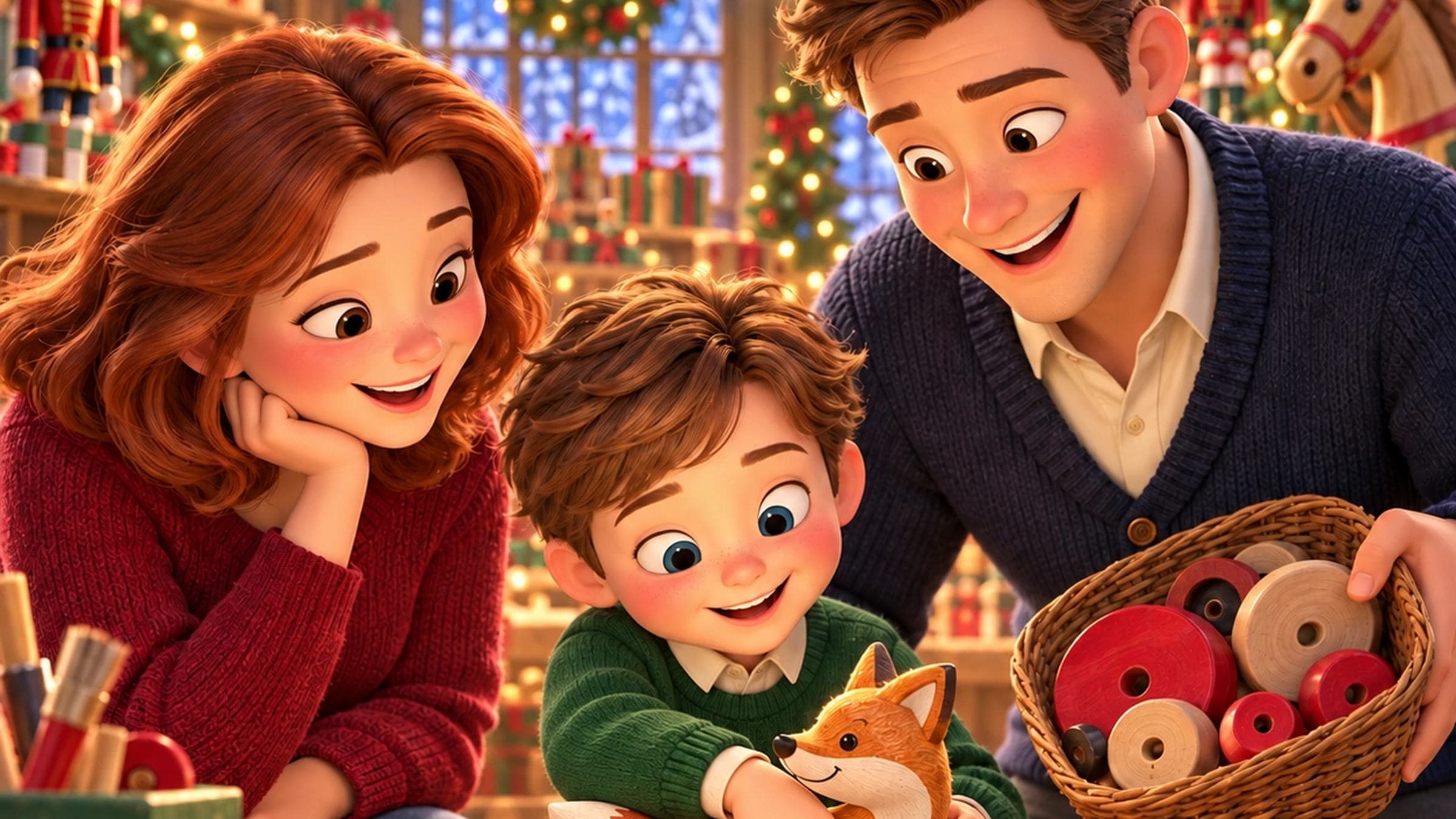
In the holiday book we keep as the finished picture, a mother, father, and child lean over a wooden bench and smile at a small wooden fox. A basket of round wooden wheels sits at the father's side. It is a close huddle, the right size for an echo. Look through the finished pictures. The gift notes and the holiday stories show that same household.
Start one for your household if you want tonight's refrain kept beside a story you can reread. The story and pictures are created after payment, and you approve the proof before anything is printed. Prices are on the pricing page. Other evenings of the year are in personalized story ideas for everyday family moments.
Frequently asked questions
Must they memorize it?
No. A printed copy in their hand counts. Echo speakers should copy you. A child who trades phrases can hold the copy at chest height so their face stays up.
What if someone wants a long classic?
The grown-up can speak the long classic. The child's job stays the echo, the trade, or the room refrain. A nineteenth-century piece is a different evening.
May we change the nouns?
Yes. Swap the lamp for a hallway light, or the cookie for a cracker, if that is what your room actually has. Keep the phrase lengths. A piece about your real shelf is easier to remember than a piece about a sleigh they have never seen.
Is this a school assignment?
No. If a teacher handed them a specific piece, use that piece at school and keep these at home. Do not tell a teacher we assigned anything.
When do I call a pediatrician?
Call if your child cannot join a familiar song by the later preschool period, lost language they had, or becomes frightened whenever people look at them. Reciting is optional. The AAP's advice is a joyful habit, not a recital you have to survive.
Related reading:
- See the finished pictures
- Start one for your household
- Gift notes for this season
- A wish sheet
- The Eve read-aloud guide
- Personalized story ideas for everyday family moments
- Holiday stories
Sources
- Literacy Promotion: An Essential Component of Primary Care Pediatric Practice, American Academy of Pediatrics, Pediatrics, 2024, accessed October 30, 2026
- Milestones by 4 years, Centers for Disease Control and Prevention, accessed October 30, 2026