Reading together
What Christmas jokes work for kids ages 3 to 8?
Christmas jokes for kids by age: silly-sound jokes for 3 to 5, two-meaning riddles for 6 to 8, plus a lunchbox note and a 120-character dedication.
The short answer
Christmas jokes for kids work when the laugh matches the age. Ages 3 to 5 enjoy a wrong name, a silly sound, or a one-line surprise. Ages 6 to 8 can follow a riddle that uses one word two ways. The jokes below are original. Put one in a lunchbox note, or in a holiday-book dedication, which holds 120 characters including spaces. Skip jokes that tease a person.
Key takeaways
- Ages 3 to 5 laugh at sounds, wrong names, and a short surprise. Save puns for later.
- Ages 6 to 8 can follow a riddle, because they can hold two meanings of one word.
- One joke fits a lunchbox note. A holiday-book dedication holds 120 characters, so the joke has to be short.
- If a joke makes a child the target, drop it. Meanness is not a punch line.
Christmas jokes for kids work when the laugh matches the age: 3-to-5-year-olds enjoy a wrong name, a silly sound, or a one-line surprise, and ages 6 to 8 can follow a riddle that uses one word two ways. The jokes below are original, written for reading aloud, a lunchbox note, or a dedication of no more than 120 characters.
Humor researcher Paul McGhee describes a long stretch, roughly from 3 to 5, when children play with word sounds and nonsense, then a shift around 6 or 7 when they start to understand that one word can mean two things. He calls the earlier stretch a pre-riddle period: a kindergartner may tell a joke in the right shape and laugh anyway, even when the answer does not hinge on a double meaning. By about 6 or 7, that double meaning is the joke. Ages on his timeline are peaks, not deadlines. A 5-year-old who already loves riddles can use the older list. A 7-year-old who still wants sound play can use the younger one.
The Centers for Disease Control and Prevention says that by age 4, most children (about 75 percent or more) can say a sentence of four or more words. That is enough language for a short joke you repeat together. It is not a test. If you are worried your child is not speaking in short sentences, or has lost words they used to say, talk with the pediatrician. A joke will not explain a speech delay, and it is not a treatment.
What Christmas jokes work for 3-to-5-year-olds?
Read these slowly. Pause before the last line. Laugh first so your child knows the game. If they repeat the line all afternoon, that is the point.
- Why did the mitten sit on the step? It was waiting for its other hand.
- What did the cocoa say to the marshmallow? Hop in, the cup is warm.
- Knock knock. Who's there? Snow. Snow who? Snow need to whisper, the cookies can hear you.
- What do you call a tree that will not stop giggling? A chuckle-fir. Tell it twice. The sound is the joke.
- Why did the stocking wiggle? Someone left a tangerine in the toe, and the toe got ideas.
McGhee's preschool pattern shows up here: wrong jobs for ordinary objects, and sounds that are fun to tell. You do not need to explain "chuckle-fir." Tell it, snort, and let them try.
A game that fits this age: you tell a true Christmas sentence, then a silly one, and they point to the silly one. "Boots go on feet." "Boots go on the turkey." The CDC note about sentences of four or more words is why the lines stay short. A paragraph-length joke collapses before the pause.
Skip sarcasm. At this age the words land as facts. "You are such a messy elf" is not funny if they hear "you are messy."
What Christmas riddles work for 6-to-8-year-olds?
These need a second meaning. Tell the setup, count to three, then give the answer if they want it. Guessing is optional.
- Why did the candle refuse to argue? It did not want to lose its temper.
- Why did the calendar look proud in December? Its dates were all taken.
- What did the wreath tell after the party? I am well rounded, and a little tired.
- Why did the wrapping paper go to practice? It wanted to be ripped... at the right moment. (If "ripped" sounds mean in your house, use this instead: Why did the ribbon cross the room? To get to the other side of the gift.)
- What do you call a quiet bell? A hush-jingle. It still has to be said out loud.
McGhee ties this shift to the new ability to move between two meanings of a word, which he places around 6 or 7, alongside the broader thinking changes children show near that age. "Temper" is heat and anger. "Dates" are days and plans. If your child explains the joke back to you, they have it. If they laugh and cannot share why, enjoy the laugh and try again next week. Do not quiz them.
A mean riddle still fails, even when the wordplay is clever. Leave out body jokes, jokes about a classmate, and jokes that need a child to be the fool.
How do you put a Christmas joke in a lunchbox note?
Use one joke, their name, and a short sign-off. Write it the night before so morning is only the tucking-in.
A lunch note, counted for a small card:
"Why did the mitten sit on the step? It waited for its other hand. Love, Dad."
That is the whole note. A second joke makes the card look like homework. If your child is 3 to 5, read the note at breakfast so the joke is already shared before lunch. If they are 6 to 8, leave the answer off and write "flip me" on the back.
Practical limits:
- Pencil smears against a sandwich. Pen, or a sticker over the words.
- No food words that embarrass them in a loud lunchroom. "You eat like a reindeer" stays home.
- One note a week beats a note they ignore. Repetition is the tradition.
A picture list of wishes is a different piece of paper: how to help a child write a December list.
How do you fit a joke into a book dedication?
On Storybook Studio, the dedication stored with a holiday book holds 120 characters, including spaces. A two-sentence joke does not fit. One line does.
These fit, with the count in parentheses so you can check before you type:
- "The mitten waited for its other hand. Love, Mom." (48)
- "Why did the candle stay calm? It kept its temper. Love, Dad." (60)
- "Snow who? Snow need to whisper. Love, Papa." (42)
Tell the beat out loud. If you run out of breath, it is too long for 120 characters anyway. The dedication guide covers what else belongs in that beat. A joke should not carry a medical claim, a promise about who the child will become, or a private family conflict.
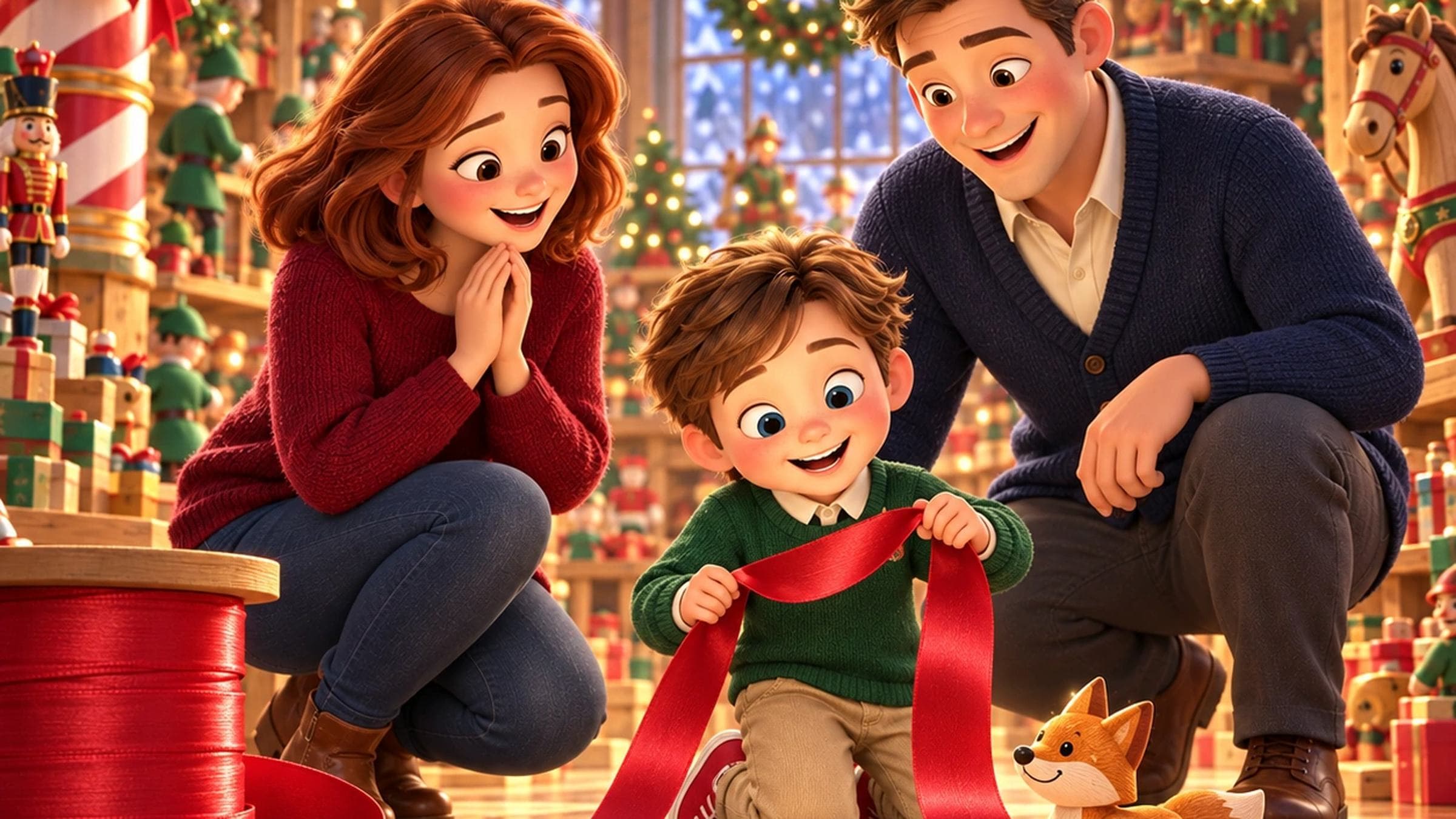
In the holiday book we keep as the finished picture, a mother and father crouch on a workshop floor while their child holds a long red ribbon and laughs. A wooden fox on red wheels sits in the ribbon's loop. That picture is the mood of a joke that lands: everyone is already smiling before the last word. You can look through the finished season keepsake and read more ideas in the December keepsake guide. The season lander shows the same keepsake before you begin. Everyday moments that are not December sit in personalized story ideas for everyday family moments.
If you want the joke inside the story rather than only on the inscription, start a holiday story. The story and pictures are created after payment, and you approve the proof before anything is printed. Current prices are on the pricing page.
Frequently asked questions
Are these December jokes safe to share at school?
Yes, if they do not name a classmate or a body. The mitten, the cocoa, and the candle are objects. Ask your child which beat they want to share, and practice once at home so the pause is theirs.
What if my 5-year-old does not laugh at riddles?
That matches McGhee's timeline. Offer the years 3 to 5 list, and try one riddle again in a few months. Forcing the explanation turns the joke into a lesson.
Can I invent the answer with my child?
Yes. For years 3 to 5, a nonsense answer is the game. For years 6 to 8, write their answer down even if the pun is wobbly. Their beat is the one they will remember.
Should I correct a joke they share wrong?
Only if the mistake is unkind. A scrambled ending is still practice. Repeat their version, then yours, and let them pick.
When should I call a pediatrician about humor or speech?
Call if your child is not using short sentences by the later preschool years, stops using words they had, or seems distressed when people laugh. A joke list is play, not a screening tool. The CDC's 4-year milestones are the checklist to bring to that visit.
Related reading:
- See a finished season keepsake
- Start a season keepsake
- December keepsake guide
- How to help a child write a December list
- What to write in a children's keepsake inscription
- Personalized story ideas for everyday family moments
- Season books
Sources
- Children's riddles and the first adult-style jokes, Paul McGhee, The Laughter Remedy, accessed October 30, 2026
- Milestones by 4 years, Centers for Disease Control and Prevention, accessed October 30, 2026