Meaningful gifts
How do you help a child ages 3 to 7 write a Christmas list?
Help a child ages 3 to 7 write a Christmas list with pictures, four piles (wish, need, wear, read), and a plain way to say which wishes will wait.
The short answer
Help a child ages 3 to 7 write a Christmas list by letting pre-writers draw the wishes and by sorting ideas into wish, need, wear, and read. Research on real letters to Santa found short lists, about two or three written items, and longer lists when children drew. You write the words they say. Then you say out loud that some wishes wait. A list is a conversation, not a promise.
Key takeaways
- Ages 3 to 7 can make a list. Pre-writers draw. You write the sentence they say under each picture.
- Sort the pictures into four piles: wish, need, wear, and read. One item from each pile is a complete list.
- Studies of real letters found short written lists. Drawing raised the number of requests, because writing was the limit, not desire.
- Say which wishes might wait. A list is not a contract.
You help a child ages 3 to 7 write a Christmas list by capturing what they can already show: a drawing if they are not writing yet, and a few spoken words you print underneath. Then you sort those ideas into wish, need, wear, and read, and you say clearly that some wishes will wait.
Karen Pine and Avril Nash studied letters to Father Christmas in England, published in 2002 in the International Journal of Behavioral Development. Among 99 children, 83 of them ages 4.8 to 6.5 who had written letters and 16 nursery children ages 3.8 to 4.8 whose parents reported requests, the mean number of items was 3.10. When 34 of the school children were allowed to draw their requests instead, the mean rose to 5.47, with a range of 2 to 6. The authors read that gap as writing skill limiting the list, not as children wanting less. Almost three quarters of the children asked for at least one branded item, and the mode for branded requests was one. Nearly 90 percent of the toys advertised in the run-up they recorded never appeared in a letter at all.
A later content analysis by Rodrigo Uribe and Carolina Martínez looked at 500 letters Chilean children sent before Christmas 2004. The average was 2.1 gifts per letter, and the most common count was 2. Children ages 5 to 7 asked for more gifts than children years 8 to 10. Younger children were not writing longer novels. They were naming a few concrete things.
Those studies are why a picture list is the right tool for years 3 to 7, and why a list of twenty logo-heavy lines is usually an adult's anxiety, not the child's. Our how-to stays inside years 3 to 7. It is not guidance for babies.
What is a picture list for a child who is not writing yet?
Give them four sheets, or one sheet folded into four boxes. Ask one question per box, then be quiet while they draw.
- Something they wish for. A toy, a trip to the park in the snow, a morning with a grandparent.
- Something they need. Boots that fit, a warmer coat, a new cup they can hold.
- Something to wear. Pajamas, a hat, socks with a pattern they pick.
- Something to read. A book they already love, or a book about a thing they drew in box one.
You write their sentence under the picture, in their words, even if the grammar is new. "Red truck snow" can become "A red truck for the snow," and you can show them both lines. Pine and Nash's drawing result is the reason you do not wait until handwriting is neat. The wish is already there.
By the later preschool years many children draw a person with several body parts and name colors. If the picture is a scribble, the scribble still counts. Ask "What is this?" and write the answer. If you are worried they are not drawing or speaking in short sentences at all, that concern belongs with the pediatrician, not on a wish list. Bring it up at the next visit rather than turning December into a test.
Brand names can go on the list if the child says them. Pine and Nash found branded requests were common and that most advertised toys were never requested. You do not need to ban logos. You also do not need to add five more because an ad was loud. One branded wish is a normal list, not a failure of parenting.
How do wish, need, wear, and read keep the list kind?
The four piles stop the sheet from becoming only toys, without a lecture. After the drawings, lay them out and label the piles in pencil. Then choose together:
- One wish they care about most.
- One need you were going to buy anyway, so they see a real yes.
- One wear they picked, even if it is loud pajamas.
- One read, which can be a library card and a Saturday, not a stack.
Four items is close to the means in both studies (about 3 written, about 2 in the Chilean letters, about 5 when children drew). You are not copying a study. You are using the finding that children name a handful of things when the paper is not doing the wanting for them.
If a grandparent asks "what should I get?", send a photo of one pile, not the whole kitchen table. Say which pile is still open. That is the entire coordination. It also keeps two households from buying the same wish. For a toddler whose shelf is already full, see what to give a 2-year-old who has everything.
A picture sheet is different from a letter that pretends to be from someone else. We are not writing in a parent's disguised handwriting here. The child is the author, with you as the scribe.
How do you talk about wishes that might not come?
Before the sheet goes on the fridge, say one sentence you can keep: "We will try for the book and the pajamas. The truck may have to wait until your birthday."
Children hear a sheet as a plan. The studies counted requests. They did not find that every request arrived. Your sentence is the part the research does not do for you.
A script you can borrow:
"You asked for four things. I can say yes to two of them now. The other two are still wishes. Wishes can stay on the paper. They do not all have to come in December."
Then stop explaining. A long speech about money turns into worry. If you need a number, talk about it with the other adults after the child leaves the room.
If your child falls apart whenever a wish is a no, shrink the sheet to two drawings next time. The skill is hearing a limit, not producing a longer page. If the distress is bigger than a holiday, lasts for days, or comes with sleep trouble or fear that is not about gifts, call the pediatrician. A sheet will not treat anxiety.
Where does the sheet live after you make it?
Tape it inside a cabinet if the fridge makes visitors quiz your child. Or fold it into an envelope with their name. Read it once a week in December and cross off anything they no longer want. Changing their mind is allowed. Pine and Nash's children were interviewed about letters already written. Your child gets a second pass.
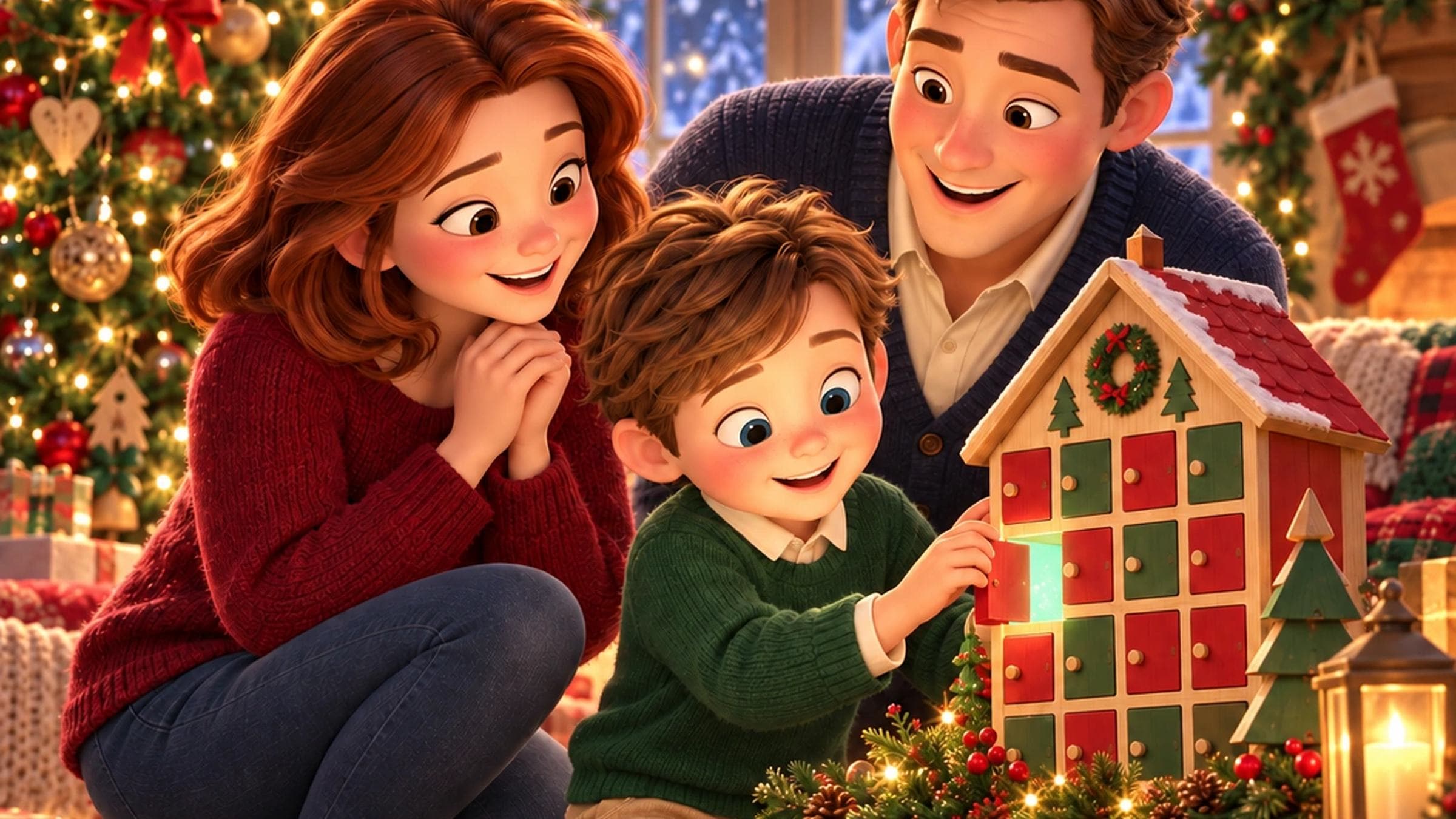
In the holiday scrapbook we keep as the finished picture, a mother, father, and child kneel by a wooden house with many small red and green doors, one door open, wrapped gifts on the rug and a lit tree behind them. It looks like choosing, one door at a time, which is what a short sheet is. Look through the finished midwinter scrapbook. More gift context is in the Christmas scrapbook guide, and the midwinter lander shows that scrapbook first.
A joke is a different slip of paper: Christmas jokes for kids. A poem to recite after the sheet is done: Christmas poems for kids. The wider set of family moments is personalized story ideas for everyday family moments.
If the wish they care about is a story with your family in it, start a midwinter scrapbook. The story and pictures are created after payment. Prices are on the pricing page, not on the wish sheet. You can put a single line from their sheet into the dedication if it fits in 120 characters. "The red truck can wait. The book is this. Love, Mom." is the kind of line that fits.
Frequently asked questions
What if my child only names toys from ads?
Write the one they repeat, then ask the wear and read questions anyway. Pine and Nash found that watching more commercial television went with more requests, and also that most specific ads never showed up in the letters. You are allowed to decline a fifth toy from the same ad.
Should grandparents get the whole sheet?
No. Send one yes and one maybe. A full photographed sheet invites duplicate trucks and a child who expects every square to fill.
Can two children share one sheet?
Give each child their own sheet. A shared page tends to keep only the louder wish. This how-to is about one child's own words, years 3 to 7.
What if they cannot draw a recognizable thing?
Ask them to tell you, and you draw while they watch, then they add color. The scribe can be the artist too. Write "they said: a hat" so the authorship stays visible.
When is a sheet a reason to call the pediatrician?
If your child cannot name or point to things they want and that seems new, or if disappointment turns into days of withdrawal, call the pediatrician. Ordinary frustration at a no is not an emergency. A sheet is not medical care.
Related reading:
- See a finished midwinter scrapbook
- Start a midwinter scrapbook
- December scrapbook guide
- December jokes for kids
- December poems for kids
- Personalized story ideas for everyday family moments
- Midwinter books
Sources
- Dear Santa: The effects of television advertising on young children, Pine and Nash, International Journal of Behavioral Development, 2002, accessed October 30, 2026
- Author manuscript with the request counts, University of Hertfordshire Research Archive, accessed October 30, 2026
- Gender, age and brand in children's December requests, Uribe and Martínez, Innovar, accessed October 30, 2026