Story ideas
How do I make a personalized potty training book for my child?
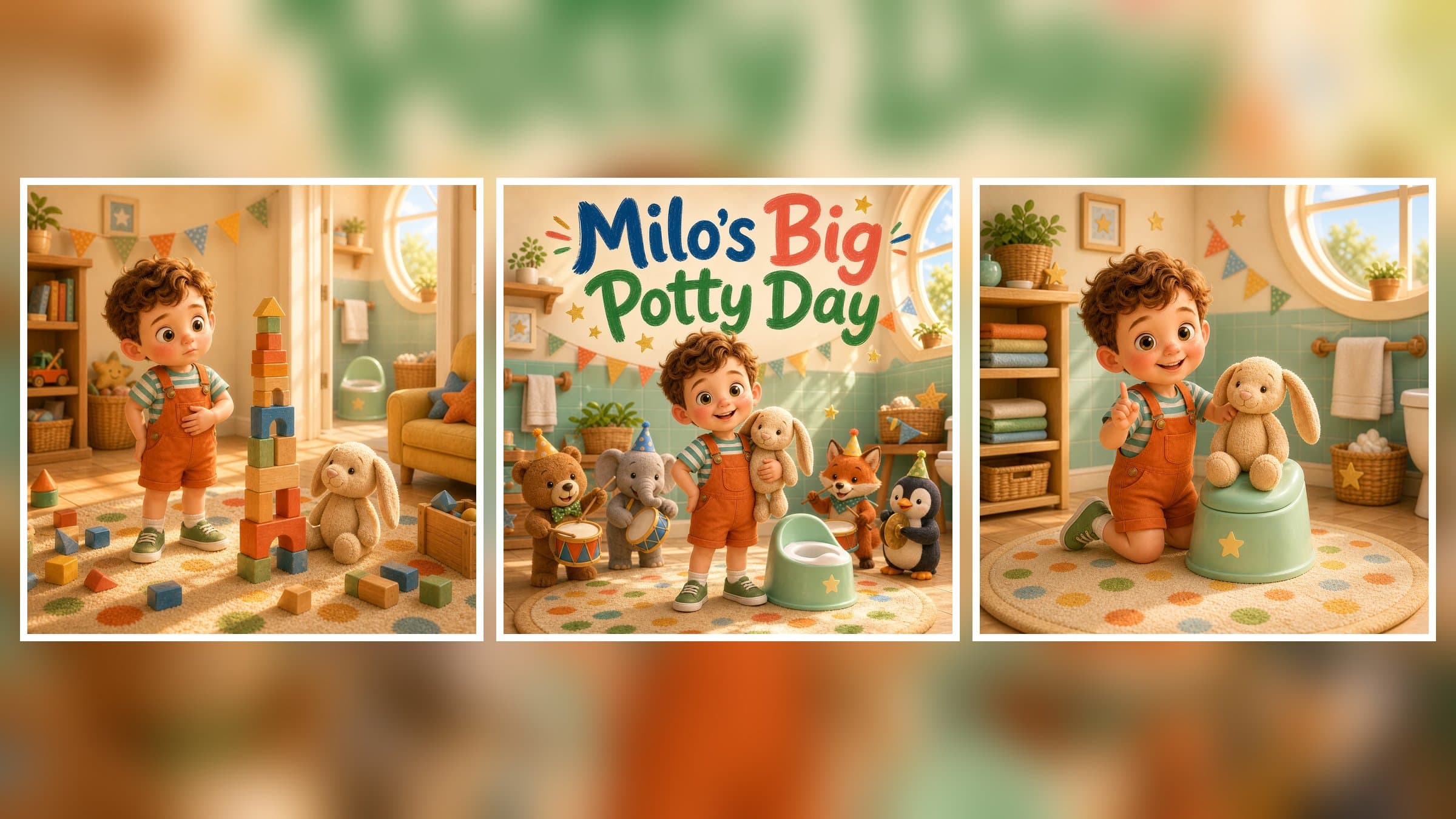
Two ways to make a potty training book about your child: a DIY notebook with page-by-page text, or an illustrated book made from a photo.
The short answer
Pick the routine you are actually using, write one short page for each step (body clue, sit, wipe, flush, pants up, wash hands, celebrate), and make your child the central character with their name, their potty word, and the people who help them. You can make it by hand in a notebook in an evening, or use a photo of your child to make an illustrated version. Read it at calm times, not right after an accident.
To make a personalized potty training book, decide which routine you are using, write one short page for each step your child will do, and put your child in every page with their name, your family's potty word, and the people who help them. A hand-made notebook version takes an evening. An illustrated version made from a photo of your child takes a few minutes to set up. Either way, keep the words the same ones you say out loud, and read it at calm moments.
Key takeaways
- The American Academy of Pediatrics (AAP) suggests reading children's books about using the toilet to help the process make sense and seem inviting.
- A personalized book works because it repeats your words: the same potty word, prompt, and response to accidents your child hears every day.
- Keep each page to one action. Toddlers follow a sequence better than a speech.
- Make it by hand (free, slower) or from a photo (illustrated, paid). The steps below cover both.
What should a potty training book say on each page?
One action per page, in the order your child does it. This is a 12-page outline you can copy. Swap in your child's name and your own words.
| Page | What happens | Sample text |
|---|---|---|
| 1 | Meet the child | "This is Maya. Maya is learning to use the potty." |
| 2 | Who helps | "Mom, Dad, and Grandma help Maya practice." |
| 3 | Body clue | "Maya's tummy feels wiggly. That means it's potty time." |
| 4 | Say it | "Maya says, 'I need to go pee-pee!'" |
| 5 | Go and sit | "Maya walks to the potty, pulls down her pants, and sits." |
| 6 | Wait | "Maya waits and sings a song. Sometimes pee comes out. Sometimes it doesn't. Both are okay." |
| 7 | Wipe | "Maya wipes front to back and puts the paper in the potty." |
| 8 | Flush | "Flush! It's loud, and that's okay." |
| 9 | Pants up | "Maya pulls up her pants." |
| 10 | Wash hands | "Maya washes with soap and sings until her hands are clean." |
| 11 | Accidents happen | "Sometimes pee comes before Maya gets there. We clean up and try again next time." |
| 12 | Celebrate | "Maya is learning something new. Maya is proud!" |
Two notes. Use the exact words your family uses on page 4. And keep page 11 calm: AAP advises avoiding words like "dirty," "naughty," or "stinky" (AAP, 12 Tips).
Which routine should the book follow?
The one you are actually doing. A book that describes a different plan from the one at home confuses more than it helps. Common routines:
- Gentle and child-led: readiness, body clues, and small choices, with plenty of time.
- 3-day focused: a few days of close support at home.
- Scheduled sits: short, predictable potty breaks around daily routines.
- Reward-based: a clear goal and a small celebration for trying, without taking rewards away after accidents.
AAP says to keep the sequence the same every time and keep your approach consistent with other caregivers (AAP, Create a Potty Training Plan). Nemours adds that babysitters, grandparents, and daycare workers should use the same routine and the same words (Nemours KidsHealth). If your child spends time with other caregivers, give them a copy of the book. Our guide to potty training with every caregiver has a one-page plan.
How do I make one by hand?
- Get a book. A small spiral notebook, a blank board book, or sheets in a binder all work. Thick pages are easier for toddlers to turn.
- Write the outline first. Copy the 12-page table above onto scrap paper and change the words until they sound like you.
- Add pictures. Print photos of your child at each step (fully dressed), draw stick figures, or let your child color the pages.
- Write one sentence per page in large print.
- Read it once through with your child, then keep it near the potty.
Cost: whatever the notebook costs. Time: one evening. The trade-off is that photos of a child on the potty are not something most parents want to print, so the pictures usually end up as drawings.
How do I make an illustrated one from a photo?
This is how it works on Storybook Studio. Other services differ, so check what each one shows before you pay. To see a sample before you start, visit the personalized potty training book page.
- Start the potty book. Go to /create/potty-training. You do not need an account or card to start.
- Upload one clear photo of your child. A plain, well-lit face photo works. The photo is used to draw your child as the illustrated hero, fully dressed in every scene.
- Pick the routine. Choose gentle and child-led, 3-day focused, scheduled sits, or reward-based, or use "Match our family" to enter your potty word, the prompt you use, the order of steps, how you respond to accidents, and the praise you prefer.
- Add helpers if you want. Your child is the one hero. You can add people like a parent or grandparent as supporting characters.
- Preview the cover. You see your child's illustrated cover before you pay. The rest of the pages are illustrated after checkout.
- Choose digital or print. Digital is $15. A softcover with the PDF is $35, and a hardcover with the PDF is $45. Shipping and any tax are shown before you pay.
- Approve the proof before printing. Printed books are made from the proof you approve.
Printing takes about 4–6 business days; 7–10+ from mid-November through December. Checkout shows a delivery estimate for your address. If you need it soon, the digital book is ready after checkout and you can read it on a tablet while the printed copy is made.
When should we read it?
At calm, ordinary times: before a nap, after breakfast, or while your child sits on the potty. Not right after an accident, when it can feel like a lecture. AAP notes that books or toys for "potty time" may help make this time more fun (AAP, 12 Tips). Read it the same way each time, so the words become part of the routine.
What can a potty book do, and what can't it do?
A book can make the steps predictable and use the words your child already hears. It can't make a child ready, and it doesn't replace patience or your pediatrician. If your child was trained and is now having accidents again, start with our potty regression guide. If you're still choosing an approach, see three-day or gradual potty training. If your child is afraid of the potty, see toddler scared of the potty. For more moments a story can help with, see personalized story ideas in everyday family moments.
Potty training book questions parents ask
How many pages should a potty training book have?
Ten to fourteen short pages covers the full sequence, from body clue to hand washing, plus a page for accidents and one for celebrating. Toddlers lose interest in long books.
Should the book show my child actually on the toilet?
It doesn't need to. Showing your child fully dressed next to the potty, and keeping the actual toileting in the words, works fine and is easier to share with family.
What if we change routines halfway through?
Update the book or make a new one. The value of the book comes from matching what happens at home.
Can I make one for a child who goes to daycare?
Yes. Ask the program which words and steps they use, put those in the book, and share a copy so everyone says the same thing.
This article is general information, not medical advice. Talk with your child's doctor about your child's development.
More related guidance:
- Teaching a Child to Tie Shoes: Start With the Last Step
- Won't Sleep in Their Own Room? A Story That Helps Them Stay All Night
- Picky Eater: Offer One Bite — Don't Force the Plate
- Weaning Off the Bottle: A Story That Makes the Big-Kid Cup Exciting
- Personalized Story Ideas Hidden in Everyday Family Moments