Story ideas
How do you help a child learn to tie their shoes without frustration?
Hand them the last step of the knot first so every try ends in a bow. Setup, age myths, and where a personalized story actually helps.
The short answer
Stop asking your child to complete the whole knot. Do the earlier steps yourself and hand them only the last one, pulling the two loops tight, so every attempt ends in a finished bow. Then give them the step before it, working backward until they own the sequence. Occupational therapists call this backward chaining. It exists so a discouraged child gets immediate success. A story can rehearse the retry. It cannot build the motor skill.
Key takeaways
- Give your child the last step of the knot, not the whole knot. Every attempt then ends in a finished bow.
- Occupational therapists call this backward chaining. NHS Wales recommends it specifically for children with low frustration tolerance because it gives immediate success.
- Change the equipment before you change the child: wider, flatter laces, two different colours, shoe off the foot.
- Milestone pages describe the start of shoe-tying, not a fluent bow by a birthday. CDC's five-year motor milestone is buttons, not laces.
- A story can rehearse the retry. It cannot build the motor skill or replace a pediatrician or occupational therapist.
How do you help a child learn to tie their shoes without frustration?
Stop handing them the whole task. Tie the shoe almost all the way yourself, then let them do the final step — pulling the two loops tight — so the attempt ends with a bow and a win. Once that step is boring, give them the step before it, then the one before that, working backward until they are doing the whole thing.
This is not a motivational trick. It is a standard teaching sequence. Asking a beginner to perform all seven steps means their first several dozen attempts all end in a collapsed knot. Backward chaining inverts that. The child's first attempt ends in success, and every practice session after it ends in success too.
Is this the knot, the morning rush, or a motor-skill question?
Sort the job before you drill the knot. The same "I can't" can mean three different things.
| What you are seeing | What to do first | What this page does not own |
|---|---|---|
| They can manage buttons and zips, but the bow collapses and they refuse to try again | Hand them the last step. Change the laces and the angle. Practice when nobody is late. | Getting dressed owns shirts, socks, and the rest of the morning sequence. |
| They can almost do it, but any missed loop feels like proof they are bad at everything | Use the parent script below, then read terrified of making a mistake if the leftover job is any failure, not laces. | This page does not treat a collapsed bow as a character verdict. |
| Buttons, zips, scissors, and name-writing are all still a fight, not just laces | Pause the lace drill. Talk with your pediatrician or the school occupational therapist. | Scissors and writing their name own those tools. |
The table is editorial sorting. None of the sources publish this three-row chart.
If the leftover job is an outdoor first with a helmet and a traffic-free path, that is learning to ride a bike, not a knot at a table.
Why does "just keep trying" make it worse?
Because by the time a parent says it, the child has usually already collected the evidence that they can't.
Shoelaces stack three hard things — fine motor control, a memorized sequence, and the patience to hold both while fingers fumble. A child who loses the loop four times in a row is not being dramatic when they announce "I'll never do it." They are reporting their actual data. More encouragement does not change the data. Changing what counts as an attempt does.
NHS Wales children's occupational therapy guidance makes this explicit: the adult performs most of the task while the child performs the last step of the sequence to receive positive reinforcement for completing it, and practice continues with the adult doing fewer steps as the child takes on more. The guidance notes that backward chaining is particularly helpful for children with a low frustration tolerance or poor self-esteem, because it gives immediate success (Shoelaces – Backward Chaining).
Children and Family Health Devon describes the same method for self-care in general: break the task into small steps, teach the last step first, keep practicing that step until the child can do it without help, then add the step before it (Backward chaining: teaching young ones self-care). Devon's page uses a t-shirt as the worked example, not a bow. The method still applies: you write out your knot, then hand your child the last action first.
That is the whole reframe. You are not lowering the bar. You are moving the child's finish line to somewhere they can already reach, then moving it back one step at a time.
What does backward chaining look like for shoelaces?
Here is the ladder, from the step your child learns first to the step they learn last. You do everything above the rung they are on; they do the rung and everything below it.
- Pull both loops tight, once you have positioned them. You build the entire bow and hold it ready. They pull. The shoe is tied, and they tied it.
- Pull both loops tight on their own. Same finish, without you holding the loops in place for them.
- Push the lace through the inner circle with the index finger toward the thumb, making the second loop — then pull tight.
- Wrap the lace around the first loop.
- Make a loop with one lace.
- Pull the two laces to tighten the first half knot.
- Bring the top lace over the other and through the inner circle to start that half knot. At this rung they are tying the shoe from the beginning.
That sequence follows the NHS Wales children's occupational therapy handout for shoelaces (Shoelaces – Backward Chaining). If your family already teaches a different knot — bunny ears, for instance — the ladder still applies. Devon’s instruction is to do the task yourself and write down each action in turn, then teach the last written step first (Backward chaining: teaching young ones self-care). What matters is that they finish, not which knot they finish.
Do not rush the rungs. A step is ready to move when your child does it without narration from you, twice in a row, on a day when nobody is late.
What do you say when they announce they will never do it?
Name the data they already have, then change the attempt. Do not argue with the feeling.
| They say | Don't say | Say instead |
|---|---|---|
| "I'll never do it." | "Yes you will. Just keep trying." | "The whole knot is too many steps at once. You do the last one. I'll do the rest." |
| "You do it. I can't." | "You're being lazy." | "I'll set the loops. You pull them tight. That's the finish." |
| "It's too hard." | "It's easy. Watch me." | "It's a long sequence. We are only practicing this one bit today." |
| "I did it wrong again." | "You almost had it. Try the whole thing once more." | "The bow still counts. Tomorrow we add the step before the pull." |
The lines are editorial. The sources do not publish this four-row script. They do publish the method behind it: the child completes the last step, gets the finish, then takes on one earlier step (Shoelaces – Backward Chaining; Backward chaining: teaching young ones self-care).
CDC's five-year parenting tips include a related stance that is not about laces: let your child do things for himself even if he does not do it perfectly — the examples on that page are making a bed, buttoning a shirt, or pouring water — and celebrate that without fixing anything you do not have to (Milestones by 5 Years). Use that as a posture, not as proof that CDC lists shoe-tying as a five-year milestone. It does not.
How do you set up practice so it is winnable?
Most of the difficulty parents blame on the child is actually in the equipment and the angle. Fix those first.
- Use wider, flatter laces. NHS Wales notes these are easier to use because the knot will not come undone as easily — so a success stays a success instead of collapsing while they admire it (Shoelaces – Backward Chaining).
- Use two different-coloured laces. Then "wrap the red one around the blue one" is an instruction a five-year-old can follow, instead of "wrap the lace around the other lace."
- Start with the shoe on a lap or a table, not on a foot. The same handout recommends this first. Tying a shoe you are wearing means working upside down and at arm's length.
- Never practise on the way out the door. Practice belongs to a Saturday afternoon. Mornings belong to whatever gets everyone out of the house, including you tying them.
- Keep it short. Two attempts that end well beat ten that end in a knot and a slammed door.
The same "change the setup, not the child" logic applies across most fine-motor jobs at this age — it is how learning to use scissors works, and why learning to write their name goes better in short bursts than long practice sessions.
What age do kids learn to tie their shoes?
Around five is when several pediatric pages say it typically begins. Beginning is not fluent.
| What you heard | What the page actually says | What not to do with it |
|---|---|---|
| "Kids should tie shoes at five." | CHOC lists, for five-year-olds, begin learning how to tie shoes (Developmental Milestones: 4 to 5 Year Olds). | Treat a sixth birthday without a bow as a delay. |
| "A four-year-old should already have it." | AAP's preschool hand-skills page says a four-year-old may even be able to tie their shoes (Hand and Finger Skills of Your Preschooler). "May" is not "should." | Use a neighbor's four-year-old as the deadline. |
| "If they dress themselves, they can tie." | AAP's 4-to-5 milestone list includes dressing and undressing without assistance and unbuttoning and buttoning medium-size buttons. It does not list tying shoes (Developmental Milestones: 4 to 5 Year Olds). | Collapse dressing independence into a lace requirement. |
| "CDC says five-year-olds tie shoes." | CDC's five-year movement milestones are buttons some buttons and hops on one foot. Shoe-tying is not on that list (Milestones by 5 Years). | Cite a milestone that is not there. |
The table is editorial sorting of those four pages. None of them publish this four-row chart. CHOC also notes there is a wide range of what is considered normal, and that you should talk with your doctor if you have concerns (Developmental Milestones: 4 to 5 Year Olds).
Readiness is more useful than a birthday. A child who can already manage buttons and zips has more of the finger strength and two-handed coordination the knot needs. CDC's five-year motor milestone is buttons some buttons, not a bow (Milestones by 5 Years). If buttons and zips are still hard, laces will be a fight no method fixes, and that is worth mentioning to your pediatrician or your child's school occupational therapist rather than drilling through.
When should you talk to a pediatrician or occupational therapist?
Talk when the leftover job is not this one knot.
CHOC tells parents to talk with their doctor about progress, especially if there are concerns, and notes that children who were born prematurely reach milestones later (Developmental Milestones: 4 to 5 Year Olds). CDC says you know your child best: if they are not meeting one or more milestones, have lost skills they once had, or you have other concerns, act early and talk with the child's doctor (Milestones by 5 Years). AAP's 4-to-5 watch list includes trouble taking off clothing and seeming uncomfortable holding a crayon as reasons to talk with the pediatrician — not as a diagnosis (Developmental Milestones: 4 to 5 Year Olds).
This page does not diagnose a coordination disorder, name an OT program, or tell you to keep drilling through pain.
Where does a personalized story actually help?
In the gap between "I can't" and picking the shoe back up.
Backward chaining fixes the practice. It does not, on its own, undo a child's conclusion that they are the kind of person who fails at this — and that conclusion is often what stops them from starting. A story where a character with their name and their face fumbles the same loop, feels the same frustration, and then gets the last step is doing a different job from the practice session: it makes the fumbling part of the plot rather than proof of anything.
The names below are invented for illustration. In a real personalized book the hero is your own child, built from your own photo.
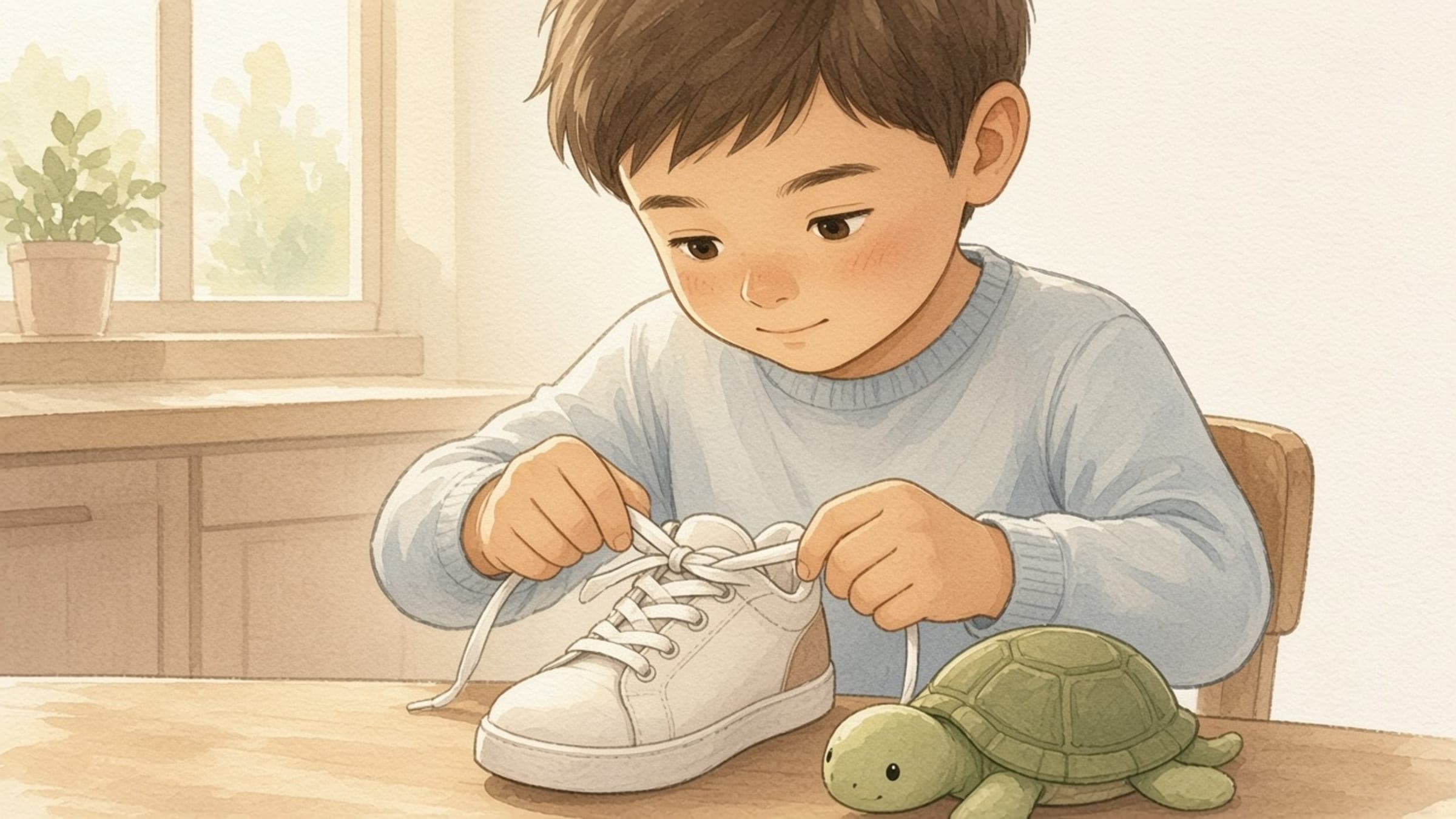
Mateo could do cartwheels and read the cereal box, but every morning he held his shoes out for a grown-up. In his book, a slow stuffed turtle named Pokey stays on the table while story-Mateo practices only the last pull. He misses a few times. One bow finally holds. The last page is not "and then he never needed help again." It is Mateo looking at a finished bow he was allowed to finish.
Read it before the practice, not instead of it. Then give him the last step first.
How the studio keeps the rehearsal on this child's knot
Start from one clear photo. On the Characters step, Storybook Studio builds the child from that photo so the face on the page is theirs, not a stand-in. On the Plot Outline step, a few sentences is enough: the shoe is on the table, the grown-up does the early steps, the child pulls the two loops tight, and the bow can fail once before it holds. Do not write "and then he could tie every shoe forever." On the Voice step, a calm, matter-of-fact tone fits. After the book is finished, the review screen's edit mode lets you change page text if a magic overnight mastery, a shame line, or a morning-rush ending slipped in.
For other everyday moments that can hold a small rehearsal like this, see personalized story ideas in everyday family moments. If the leftover job is any failure rather than laces, stay with terrified of making a mistake. If the leftover job is the rest of getting dressed, go to getting dressed by themselves.
Keep reading: if the leftover job is a fine-motor first with a tool rather than a lace, start with learning to use scissors. If the leftover job is two wheels and a helmet, see learning to ride a bike.
More related guidance:
- Toddler Scared of the Potty: Name the Fear, Don't Force
- Won't Sleep in Their Own Room? A Story That Helps Them Stay All Night
- Picky Eater: Offer One Bite — Don't Force the Plate
- Weaning Off the Bottle: A Story That Makes the Big-Kid Cup Exciting
- Personalized Story Ideas Hidden in Everyday Family Moments
Sources
-
Backward chaining: teaching young ones self-care — Children and Family Health Devon
-
Hand and Finger Skills of Your Preschooler — American Academy of Pediatrics
-
Developmental Milestones: 4 to 5 Year Olds — American Academy of Pediatrics
-
Developmental Milestones: 4 to 5 Year Olds — Children's Hospital of Orange County
-
Milestones by 5 Years — Centers for Disease Control and Prevention