Story ideas
How do you potty train a toddler who is scared of the potty?
Name a toddler's potty fear, stop forcing sits, and pause if constipation is in play. A story rehearses control. It cannot toilet-train.
The short answer
Name the specific fear — the flush, falling in, or letting go — then stop forcing sits. Give the child a potty they can control, let them flush, and pause if a new baby, a move, or painful poop is in the way. A story can rehearse that control. It cannot toilet-train them, treat constipation, or replace the pediatrician.
Key takeaways
- Fear of the potty is a safety problem for a small body, not a motivation problem. Name the flush, falling in, or letting go before you add a chart.
- Do not force a scared child to sit. Nemours says not to make a child sit against their will. AAP says power struggles keep children from managing their own toileting.
- A child-size potty with feet on the floor, and letting the child flush, gives control. That is the job tonight.
- Pause for a new baby, a move, illness, or poop that hurts. Painful withholding is a pediatrician question, not a story ending.
- A story can rehearse the real fear and the real potty. It cannot toilet-train them or treat constipation.
How do you potty train a toddler who is scared of the potty?
Name the fear. Stop forcing sits. Give them a potty they can control.
That is a smaller job than "get them out of diapers this week." The American Academy of Pediatrics says some children believe pee and poop are part of their bodies. They may be scared the toilet will flush parts of them away, or that they will be sucked in if it flushes while they are sitting. To give them a feeling of control, let them flush (The Right Age to Potty Train). Nemours KidsHealth is the no-force line from a second publisher: do not make your child sit on the toilet against their will. A toddler-size seat on the toilet helps them feel more secure and not fear falling in; a stepping stool lets them reach and feel supported (Toilet Training).
This page is that job: a toddler who is afraid of the potty during first-time daytime toilet learning — flush, height, falling in, or the feeling of letting go — and who needs pressure lowered, not a prize for sitting scared. It is not bedwetting. That page owns nighttime wetting in a child who is already dry by day. It is not giving up the pacifier or weaning off the bottle. Those are comfort-object goodbyes. It is not trying a food they hate. A refused bite is not a feared toilet.
A story can walk a hero with your child's face through standing next to their real potty, naming the loud flush, and flushing after they leave the room. It cannot promise dry underwear, treat painful poop, or replace the pediatrician.
Is this fear, unreadiness, constipation, or nighttime wetting?
Sort the job before you sort the child. A toddler who is not ready, a toddler who is constipated, and a school-age child who wets the bed at night are three different pages.
AAP's right-age page is the readiness line. In general, children show signs of bladder and bowel control between 18 and 24 months. They also have to understand instructions, get to the bathroom, and pull pants down and up. Then they have to be willing to use the toilet. Toilet-training struggles happen when children choose not to use it. The average age toilet training begins in the United States is between 2 and 3 years. Most children in the United States are bowel and bladder trained by 4. Signs a child may be ready include staying dry at least two hours during the day or after naps; grunting, freezing, or squatting; following simple instructions; walking to the bathroom and helping undress; disliking a wet diaper; asking to use the potty; or asking for "big-kid" underwear (The Right Age to Potty Train).
Nemours names a similar readiness list — follow simple instructions, use potty words, connect the urge to the potty, keep a diaper dry for two hours or more, get on and off, pull clothes down, show interest — and says most children begin to show those signs between 18 and 24 months. Some are not ready until later. Boys often start later and take longer than girls. Teaching a toddler to use the potty often takes between 3 and 6 months. If you start too soon, it tends to take longer. Nighttime dryness can take months to years (Toilet Training).
| What you are living | Treat it as | Do not treat it as |
|---|---|---|
| They freeze, hide, or refuse the bathroom because the flush, the height, or letting go scares them | Potty fear during first daytime learning — this page | Laziness, or a reason to force a sit |
| They have no readiness signs yet | Wait. AAP and Nemours both start with control and willingness, not a birthday | A late bloomer you can chart into readiness |
| Poop hurts, they withhold, or underwear is stained with bits of stool | Possible constipation — Nemours; call the doctor if it lasts two to three weeks | A fear you can read away |
| They are dry by day and wet at night | The nighttime job — use bedwetting | Failed potty training |
| A new baby, a move, or a family crisis just landed | A reason to pause (AAP and Nemours) | Proof they "lost" the skill on purpose |
| The hard part is a pacifier or a bottle, not the toilet | Giving up the pacifier or weaning off the bottle | A potty story with the wrong object |
The table is editorial sorting. AAP names willingness, readiness signs, and when to pause. Nemours names the same window, the 3-to-6-month span, nighttime lag, and constipation during toilet training. Neither publishes a kitchen flowchart.
If the hard part is a new baby in the house, the jealousy job lives on jealous of the new baby. The potty job on this page is to pause training while that change is loud, then come back.
What is this toddler actually afraid of?
Ask out loud. Then match the hardware to the fear you heard, not the fear you assumed.
AAP's right-age page is the flush-and-body-parts fear: some children believe pee and poop are part of them; they may fear the toilet will flush those parts away, or suck them in if it flushes while they sit. Let them flush so they have control (The Right Age to Potty Train). AAP's emotional-issues page is the imagination line from the same publisher: a more active imagination and magical thinking may cause a child to fear the toilet and start to avoid it (Emotional Issues and Potty Training Problems).
Nemours is the falling-in fear, and the hardware that answers it. A toddler-size seat on the toilet helps the child feel more secure and not fear falling in. If you use that seat, get a stepping stool so they can reach comfortably and feel supported for a bowel movement. A standalone toddler-size potty chair with a bowl you empty is the other option. For boys, it is usually best to learn sitting down before standing; a potty chair may be better if standing on a stool to pee in the toilet feels awkward or scary (Toilet Training). AAP adds that children's feet should reach the floor on a potty-chair, and that when they move to the big toilet you provide a stool to brace their feet (The Right Age to Potty Train).
| Fear they actually have | Hardware or control that matches it | What not to do |
|---|---|---|
| The WHOOSH will swallow them or flush a part of them | Let them flush. AAP: that gives a feeling of control. Flush after they are off and, if they want, after they leave the room | Force them to sit through a flush they cannot stop |
| They will fall into the big bowl | Child-size potty-chair with feet on the floor, or a toddler seat plus a stool (Nemours, AAP) | Perch them on an adult seat with dangling feet |
| Standing on a stool to pee feels scary | Sit first. Nemours: a potty chair may be better than the stool | Insist they "do it like Dad" before they can sit calmly |
| Letting go feels like losing a piece of themselves | Name that fear in their words. AAP: pee and poop can feel like body parts | Joke that the potty "ate it" |
| You keep asking "do you need to go?" | Back off the quiz. AAP emotional-issues: feeling too controlled can lead to waiting until it is too late | A timer every twenty minutes as the only plan |
The table is editorial sorting of those two AAP pages and the Nemours toilet-training page. None of them publish this five-row kitchen chart.
If they are hiding wet underwear or claiming they already went, AAP's emotional-issues page is the shame line, not the sneakiness line. At about three, children can feel shame after an accident and still not know what to do with it. They may hide the mess or try to clean it before you see. Do not criticize or punish. Gently say you know they had an accident, that it is okay, that you know they will do better next time, then ask them to help clean up and talk about how to get back on track (Emotional Issues and Potty Training Problems).
What do you do tonight without forcing a sit?
Lower the stakes. Put one real potty where they can reach it. Practice the steps when nobody needs to go. Do not turn the bathroom into a test.
AAP's right-age page is the control transfer. Keep the process positive. Choose family words for body parts, urine, and bowel movements. Avoid words like dirty, naughty, or stinky. Pick a potty-chair whose opening and removable container they can use, with feet on the floor. Be a role model: let them see you use the toilet and wash hands. Know the body signs — grunting, squatting, freezing, a red face — and explain briefly that a poop is about to come. Invite them to take over. If parents stay in charge, there is less room for the child to step in. Make trips a routine; seating them first thing in the morning is one practice. Expect hesitancy. When you start, switch toward big-kid underwear; diapers and disposable training pants can send the message that they do not need to take over. Praise the specific thing they did. Avoid treats and punishments — AAP says they distract rather than encourage, because mastery is the reward. Avoid a power struggle. Children this age test limits, including by holding back bowel movements. Stay calm. They control when and where they pee and poop. Begging, pleading, rewarding, and punishing keep them from managing it (The Right Age to Potty Train).
Nemours is the practice-without-a-test page. Even before they are ready to try, use potty words, ask them to tell you when a diaper is wet or soiled, and get a potty chair they can sit on wearing clothes or a diaper at first. When you do start: set aside time; do not make them sit against their will; show them how you sit; establish a routine such as after waking with a dry diaper, or 45 minutes to an hour after drinking; only a few minutes a couple of times a day, and let them get up if they want; sit 15 to 30 minutes after meals for the gastro-colic reflex; empty a bowel movement from the diaper into the toilet and say poop goes in the potty; avoid clothes that are hard to take off; make sure every caregiver uses the same words and the same approach; praise all attempts, even if nothing happens; do not punish accidents; tell them it was an accident and offer support (Toilet Training).
CDC is the routine publisher, not a toilet-training protocol. Consistent routines and rules help kids feel safe because they know what to expect. Consistency means you respond the same way every time. Predictability means the child knows what will happen. Follow-through means you do what you say. Keep routines simple. If a routine has to change, say so when you are both calm — not in the middle of an upset. CDC's detailed example even lists "wake up and potty time" as an early-morning step, which is a family schedule, not a medical order (Tips for Relying on Routines and Rules).
- Name the fear in their words. "The loud water" or "the big hole" is enough. AAP wants you to understand the flush and body-parts fear. Do not skip to a sticker.
- Match the potty to that fear. Feet on the floor. Child-size chair, or a seat plus a stool. Nemours: do not perch them where falling in feels real.
- Let them control the flush. Off the potty first. Then they push the handle, or they leave the room and you wait. AAP: control, not a surprise WHOOSH under them.
- Practice sitting with clothes on, then stop when they want up. Nemours: a few minutes, a couple of times a day, and they can get up. A forced sit is the thing that deepens the fear.
- Keep the adult quiz small. AAP emotional-issues: constant "do you need to go?" can feel like control and end in an accident. One calm routine beat — morning, after meals — is enough to start.
- Praise the attempt, not a dry scoreboard. AAP: be specific, skip treats and punishments. Nemours: praise even if nothing happens; an accident is an accident.
- Use the same words with every grown-up. Nemours: babysitters, grandparents, and daycare follow the same routine and the same names.
The numbered list is editorial sorting. AAP names control, feet on the floor, flushing, no power struggle, and specific praise. Nemours names no forced sits, short practice, after-meal timing, and shared language. CDC names consistent, predictable routines said when everyone is calm. None of them publish this seven-line kitchen protocol.
AAP's emotional-issues page is the regression compromise: try not to make a major concession such as returning to diapers. Consider training pants under underwear for a while, put the potty in their room, or otherwise meet them until they feel more secure. Help them identify the problem, sympathize, and find a practical next step (Emotional Issues and Potty Training Problems). That is not a license to restart diapers as the plan. It is a way to stop the power struggle tonight.
If the fight is really about teeth at the same hour, that is a different routine: brushing teeth without a fight. If the fight is staying in their own bed, use won't sleep in their own room. This page stays with the potty.
When do you pause, and when do you call the pediatrician?
Pause when the house is already in a storm. Call when pain, age, or a skill that was there keeps not coming back.
AAP says it can be a good idea to delay toilet training if the family has just moved or will move, if you are expecting a baby or recently had one, or if there is a major illness, a recent death, or some other family crisis. If any concern comes up before, during, or after toilet training, talk with your child's doctor. Often the problem is minor. Sometimes physical or emotional causes need treatment (The Right Age to Potty Train).
Nemours names a similar hold list: traveling, the birth of a sibling, changing from crib to bed, moving, or illness — especially with diarrhea. Talk to the doctor if you have questions, if a child who was using the potty is now regularly having problems, or if your child is 4 or older and not yet potty trained (Toilet Training).
Nemours's constipation page is the pain door. Toddlers who are toilet training can become constipated, especially if they are not ready to use the potty yet. Kids may avoid the bathroom even when they have the urge. Signs include fewer poops, pain or strain, feeling full or bloated, a little blood on the paper, or bits of stool staining underwear. Talk to the doctor if problems continue or constipation lasts two to three weeks. Talk with the doctor before giving any over-the-counter constipation medicine (Constipation). AAP's right-age page already flagged holding back bowel movements as a way some children test limits during a power struggle (The Right Age to Potty Train). Pain plus withholding is not a plot you can rewrite with a last page.
AAP's emotional-issues page is the "this usually does not last" line, not a wait-it-out order. Regression in bathroom use usually does not last long. Respond calmly. Use it to support and communicate. Avoid major concessions such as returning to diapers. Help them name the problem (Emotional Issues and Potty Training Problems). If it does not ease, that is the doctor's visit, not a harder chart.
If daytime fear has passed and the leftover problem is wet nights, leave this page: no-blame bedwetting. If the leftover problem is fear at lights-out, see afraid of the dark.
What can a personalized story do for potty fear, and what can't it do?
A story works on a calm evening, as a rehearsal of control. It is a poor teacher in a bathroom standoff, and it is not treatment for constipation.
A child who is scared of the WHOOSH often cannot hear "just sit, it's fine" from a parent. They can watch a hero with their face and name stand next to the same kind of potty they have, say the fear out loud, get off before the flush, and push the handle themselves.
The names below are invented for illustration. In a real personalized book, the hero is your own child, built from your own photo.
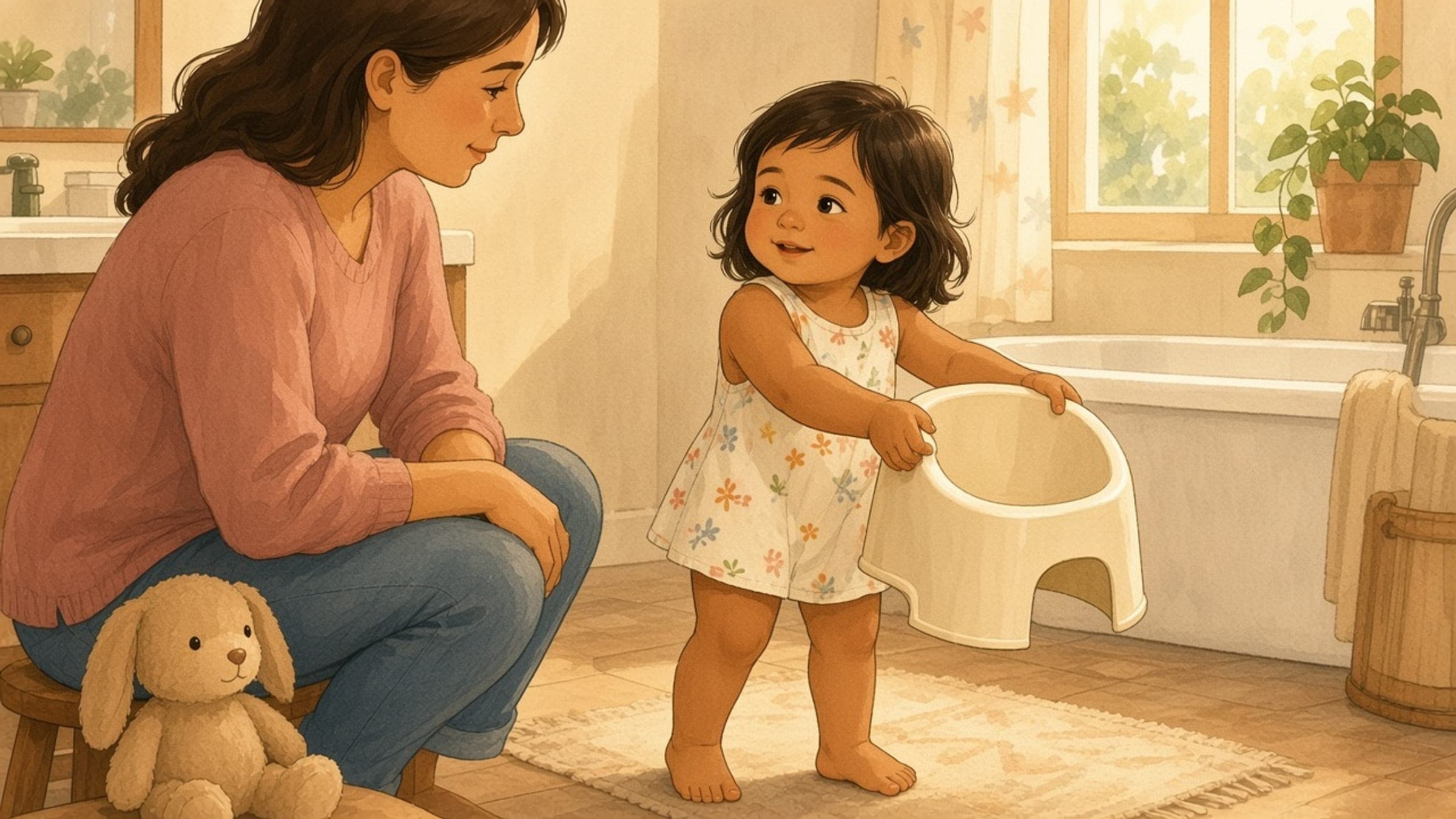
In the story, Elena is two and a half. She has a small cream potty-chair in the bathroom. Her feet reach the floor. The book does not put her on it against her will. She says the loud water scares her. Her grown-up sits at her height. Elena flushes after she is off the potty, from the doorway if she wants. The last page is not "and then she loved the potty." It is Elena putting the potty-chair back, still in charge of it.
After reading, have them point to their real potty and say which fear was theirs. If the book used a big toilet and they use a floor chair, fix the book. Wrong hardware is not a small detail.
How the studio keeps the rehearsal on this child's potty
On the Plot Outline step, the studio asks what should happen in the story and notes that a few sentences is enough. Write the real fear, the real potty (chair on the floor, or a seat plus a stool), and who flushes, in your child's words. Do not write "and then she wasn't scared." On the Voice step you set the tone. A calm, matter-of-fact tone fits. Once the book is finished, the review screen's edit mode lets you change page text if a forced sit, a prize-for-sitting ending, or "never scared again" slipped in.
For other everyday moments that can hold a small rehearsal like this, see personalized story ideas in everyday family moments.
Keep reading: if daytime training is done and nights are the leftover job, start with bedwetting. If the leftover job is dark, see afraid of the dark.
More related guidance:
- Moving From a Crib to a Big-Kid Bed: A Transition Story
- First Sleepover: Preview Scripts, Packing, and When to Wait
- Getting Dressed by Themselves: A Story That Ends the Morning Battle
- How to Build a Bedtime Storytelling Routine
- Personalized Story Ideas Hidden in Everyday Family Moments