Story ideas
How do you help a child who is afraid of costumed characters?
Preview the character, let them pick the distance, plan the exit, and never force a hug or photo. A story can rehearse that plan. It cannot treat a phobia.
The short answer
Keep your child in charge of distance. Preview the character before you go. Let them choose a wave, a look, or staying back. Plan the exit before anyone asks for a hug or a photo. Never force contact. Talk with sympathy, and do not pressure a child into being brave. A story can rehearse that plan. It cannot treat a phobia or replace a clinician.
Key takeaways
- Keep distance, choice, and an exit. The child decides how close is close enough.
- Preview the character before the fair, party, or game. A surprise hug is not a plan.
- Never force a wave, a hug, or a photo. Leaving early is allowed.
- A story can rehearse that script. It cannot treat a phobia or replace a clinician.
How do you help a child who is afraid of costumed characters?
Keep your child in charge of the distance. Preview the costume before you go. Plan the exit before anyone asks for a hug.
A mascot is large. The face does not change. The person inside cannot talk in their own voice. That is a lot of new information arriving at once, often in a loud room with a line of kids waiting for a photo. This page is that job: a costumed character at a fair, a birthday, a team night, or a store appearance. It is not a fear of dogs. A dog can bite. A mascot is a person in a suit. Keep the pages separate.
The American Academy of Pediatrics says occasional fears are common as children meet new experiences. Talk about the anxiety with sympathy. Do not belittle it, especially in front of peers. Do not pressure a child into being brave. It will take time for them to confront the fear and move beyond it in small steps (Fears & Phobias in Children: How Parents Can Help).
Your job tonight is smaller than "make them love the mascot." Name who will be in the costume. Pick a spot they can stand. Agree on the sentence you will use if they want to leave. A story can walk a character who looks like them through that same script. It cannot diagnose a phobia, treat anxiety, or promise they will hug the character after one book.
How do you preview a mascot so the costume is not a surprise?
Talk when they are calm. Show what the character looks like. Do not wait until the suit is walking toward them.
The AAP's anxiety page is specific about timing: when your child is calm, start a conversation about what they can do when the worry shows up. The examples it gives are deep breathing and muscle relaxation, a short line of positive self-talk such as "I can try this," thinking of a safe place, and gradually facing the feared object or activity. The goal it names is to cope, not to avoid. Praise the coping, not a performance of fearlessness (Help Your Child Manage Anxiety: Tips for Home & School).
The same AAP fears page describes gradual exposure, under a therapist's guidance, as talking about the fear, then looking at photos or videos, then watching from a safer distance, then being in the same room (Fears & Phobias in Children: How Parents Can Help). A parent preview can sit on those early rungs: talk, pictures, a look from across the room. It is not a clinical desensitization plan, and it does not have to end in a hug.
AAP Halloween guidance for young children is about costumes and pretend, not about fairs specifically, and the preview pattern is the part that transfers. Discuss what is going to happen. Books help that discussion. Practice dressing up in their own costume so they can feel that a suit is fabric on a person. Tell them the scary stuff is pretend. If they do not want to take part, let that be okay (Easing Babies & Toddlers into Halloween Fun).
- Name the character and the place. "The team fox will be near the snack table. It is a person in a suit." Use the real name and the real room if you already know them.
- Show a still picture first. A poster, a team page, or a photo from last year. The AAP's gradual-exposure order starts with talking and looking at pictures before anyone is in the same room (Fears & Phobias in Children: How Parents Can Help).
- Say the person-inside sentence once. "There is a regular person in there. They can wave. You do not have to touch them." That is a preview line, not a promise that the fear will vanish.
- Let them try on a hat, a mask, or a jacket if they want. The Halloween page's practice-dressing step is about feeling that a costume is pretend. Skip it if the mask itself is the scary part.
- Write the exit sentence the same night. "If you want to leave, we leave." A vague "we'll see how it goes" evaporates when a photographer kneels down.
If the hard part later is a boom they cannot pause, that is afraid of thunderstorms. If the hard part is a vacuum or a hand dryer, that is loud noises. This page stays with the costume.
How do you keep distance, choice, and an exit at the event?
Stand where they can see the character and still leave. Let them pick the next inch. Do not join the photo line unless they ask.
The AAP's line is not to pressure a child into being brave (Fears & Phobias in Children: How Parents Can Help). "Go give the fox a hug so we can get the picture" is pressure. "We can watch from here. A wave is enough. We can go to the snack table whenever you say" is a plan.
The Halloween page also tells parents to be ready to pack it in early if a costume is too scary, and to offer another job — answering the door and handing things out instead of walking up to every house (Easing Babies & Toddlers into Halloween Fun). At a fair or a party, the other job is watching from the side, getting a snack, or leaving. It is not circling back for one more try.
- Pick the viewing spot before you walk in. Across the room, behind a table, or just inside the door. The child should be able to see the suit and still turn around.
- Keep your body between them and the character if the mascot starts to close the gap. You manage the encounter. They manage the distance.
- Offer three choices, not a dare. Look from here. Wave. Walk away. A hug and a photo are not on that list unless they add them.
- Use the exit sentence the first time they ask. Do not bargain for one more minute. The Halloween page's "let that be okay" is the whole move (Easing Babies & Toddlers into Halloween Fun).
- If they wave, stop there. Getting closer can come later, or not at all. The AAP's goal for brave behavior is to cope, not to avoid — and coping can be a look from a safe distance (Help Your Child Manage Anxiety: Tips for Home & School).
| Move | What it is for | What it is not |
|---|---|---|
| Still picture at home | The costume has a memory before it walks | A promise they will want a hug |
| Distance they choose | They stay in charge of how close is close enough | A test of bravery in the photo line |
| Exit sentence | A clean leave the first time they ask | Circling back for one more try |
| Wave from across the room | A hello that keeps the gap | The only acceptable hello — a look counts too |
The table is editorial sorting. The AAP pages say sympathy, no pressure, gradual steps, and an okay-to-skip night. They do not publish a mascot protocol.
If the party itself is the job — feeling big at the cake, not the person in the suit — that is a birthday where they finally feel big.
Should you force a hug, a wave, or a photo?
No. A photo is not the win. Contact is not the win. Staying in charge of the distance is the win.
Nudging a scared child toward a mascot so someone can get a picture removes the gap they are using to feel safe. The AAP names that kind of push directly: do not pressure a child into being brave (Fears & Phobias in Children: How Parents Can Help). A wave is optional. A look from behind your leg is allowed. Leaving is allowed.
If a photographer or a well-meaning relative kneels and reaches, you are the one who says the plan out loud. "We're watching from here." Then move. Do not apologize to the costume for your child's distance.
When does a story help, and when does mascot fear need a clinician?
A story helps in a calm hour, as a rehearsal of distance, choice, and the exit. It does not help as a diagnosis, and it does not run the party.
Ordinary caution around a huge moving costume, a tight tummy in the parking lot, and a child who will watch from the side are the pattern a preview can hold. A book can put a child with their name and face in that room: see the character, pick a spot, wave if they want, leave when they say.
A story cannot treat a phobia. It cannot make a mascot smaller. It cannot promise that one book produces a hug. If the fear is extreme, persistent, or getting in the way of ordinary days, the next conversation is with their doctor.
The AAP's phobia line is a fear so extreme, persistent, and focused that it significantly interferes with usual daily activities — the child who will not go to the party, the game, or outdoors at all because a costume might be there (Fears & Phobias in Children: How Parents Can Help). If anxieties persist and interfere with day-to-day life, that page says they might benefit from meeting a child psychiatrist or psychologist who specializes in treating phobias, and it places the photo-then-window-then-room sequence under a therapist's guidance.
The AAP's anxiety page adds a second check: if anxiety does not go away or gets worse, get back in touch with the doctor. The doctor can help you decide whether a specialist visit may help, and it names cognitive behavioral therapy as one option a clinician may consider (Help Your Child Manage Anxiety: Tips for Home & School).
CDC's children's mental-health page draws the typical-versus-clinical line in different words. Many children have fears and worries from time to time. Persistent or extreme forms of fear could be due to anxiety. When a child does not outgrow typical fears, or when there are so many fears that they interfere with school, home, or play, the child may be diagnosed with an anxiety disorder. Under that category it lists phobia as extreme fear about a specific thing or situation. If you are concerned, the first step it names is a primary care provider or a mental-health specialist, not a picture book (Anxiety and Depression in Children). One skip of the photo line is not that pattern. A child who cannot use the party, the game, or play because a costume might appear might be. This page does not diagnose it.
The names below are invented for illustration. In a real personalized book the hero is your own child, built from your own photo.
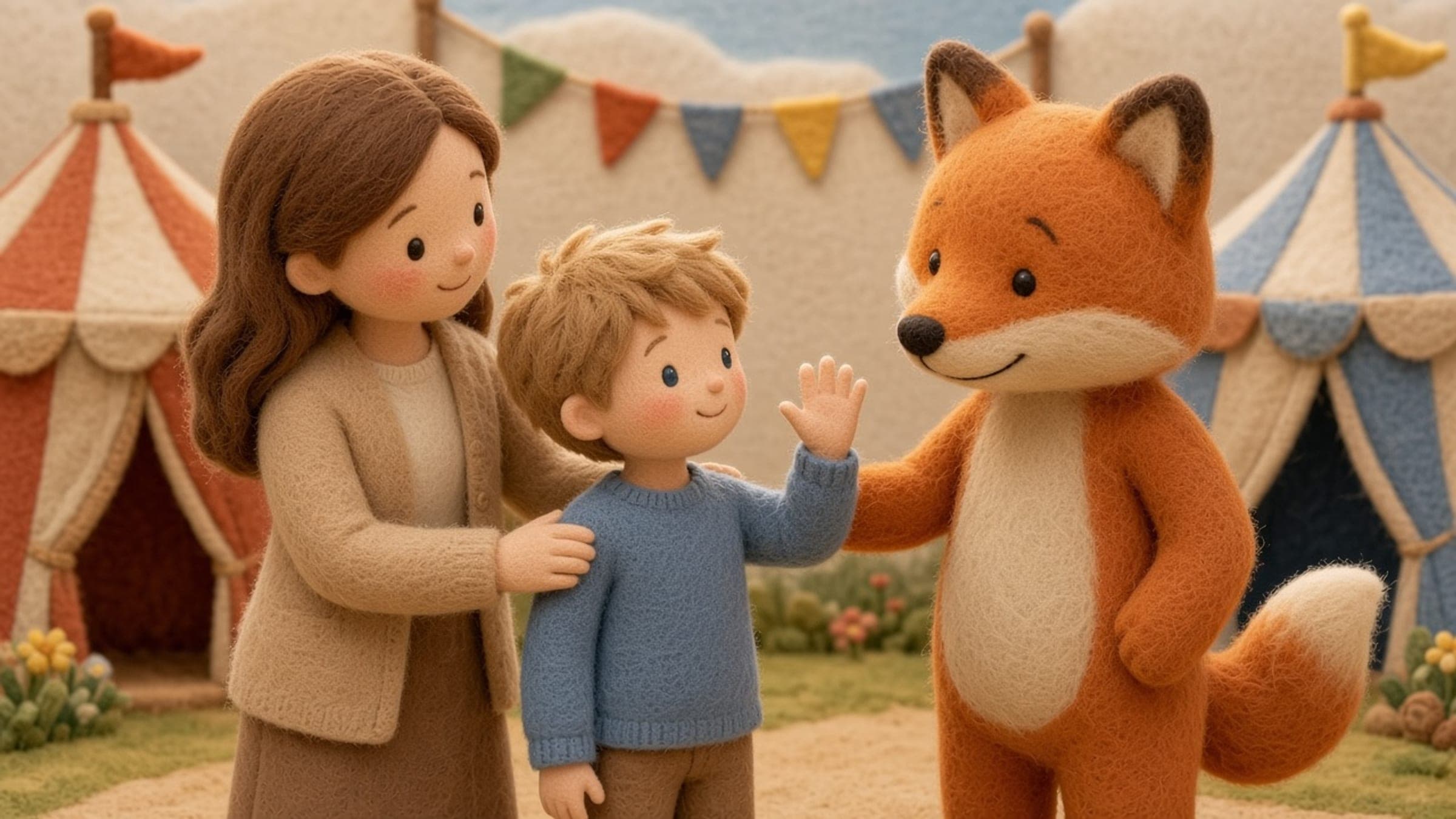
In the story, Sam's tummy still has butterflies at the fair gate. His stuffed fox, Pip, does not make the mascot smaller. Pip names the viewing spot by the snack table, the person inside the suit, and the sentence "If you want to leave, we leave." The last page is not "and then he hugged the character." It is Sam watching from the distance he chose, waving if he wants, and walking out when he says so.
Then the read-aloud has a job outside the book: say the real venue, the real spot, and the real exit sentence, and have them say the leave-line out loud once before you close the cover. A story that ends at "they hugged the mascot" is entertainment. A story that hands them tomorrow's plan is preparation.
How the studio keeps the rehearsal specific
The Plot Outline step asks a plain question — "What should happen in the story?" — as a free-text box, with the guidance that a few sentences is plenty. That is where the real character, the real viewing spot, and the real exit sentence go, in your child's words, rather than a generic "made friends with the mascot" last page. The story requires you to name one Story hero. On the Story step you review the complete written story before illustrating the opening pages, and you can use edit mode if a forced hug slipped in.
Do not write a last page where one book makes them love the costume. Write a last page where they knew the plan, they kept their distance, and leaving was allowed.
For other everyday moments that can hold a rehearsal like this, see personalized story ideas in everyday family moments.
Keep reading: if the encounter is a dog that can bite, not a person in a suit, start with a child who is afraid of dogs.
More related guidance:
- Afraid of the Bathtub Drain? A Story That Makes Bath Time Calm Again
- Afraid of the Big Slide? A Story That Turns the Drop Into a Whoosh
- Afraid of the Dark? A Story That Helps Your Child Feel Safe at Night
- Afraid of the Ocean and Waves? A Story That Makes the Beach Fun
- Personalized Story Ideas Hidden in Everyday Family Moments
Sources
-
Fears & Phobias in Children: How Parents Can Help — American Academy of Pediatrics
-
Help Your Child Manage Anxiety: Tips for Home & School — American Academy of Pediatrics
-
Easing Babies & Toddlers into Halloween Fun: 8 Tips for Parents — American Academy of Pediatrics
-
Anxiety and Depression in Children — Centers for Disease Control and Prevention