Story ideas
How do you help a child who is afraid of the dark?
Name the dark instead of dismissing it. Keep a light on if it helps. Give one lying-down tool. A story rehearses the plan; it cannot treat a phobia.
The short answer
Name the fear instead of dismissing it. Keep a light on if it helps — that is an allowed comfort, not a failure. When they are calm, give one tool they can use lying down alone: slow breaths or a short line they can say. A story can rehearse that plan before lights-out. It cannot treat a phobia or replace a clinician.
Key takeaways
- A fear of being alone in the dark is a named common childhood fear. Sympathy first; do not pressure a child to be brave.
- A light left on is an allowed comfort. So is a favorite safe object in bed.
- When they are calm, give one tool they can use lying down: slow breaths or a short line they can say.
- A story can rehearse that plan before lights-out. It cannot treat a phobia or replace a clinician.
How do you help a child who is afraid of the dark?
Name the dark. Keep a light on if it helps. Give one tool they can use lying down, alone.
The American Academy of Pediatrics names a fear of being alone in the dark as a common childhood fear, alongside animals, fires, high places, and thunderstorms. Most of those fears are mild. With reassurance and support, they generally ease on their own after a while. Talk about the anxiety with sympathy. Do not belittle it, especially in front of peers. Do not pressure a child into being brave. It will take time for them to confront the fear in small steps (Fears & Phobias in Children: How Parents Can Help).
"There's nothing there" is not a first line. The room is dark. Their imagination is doing what imaginations do. Your first job is to name that, not to argue it away. Your second job is one comfort they can keep after you leave — a light left on, a favorite object, a door left slightly open. Your third job, when they are already calm, is one tool they can reach for without you in the room.
A story can walk a child through that sequence on a quiet evening. It cannot make the dark smaller, and it cannot treat a phobia.
Is this the dark, an empty room, or a bad dream?
Stay on this page only if the hard part is lights-out in their own room.
The dark itself is one job. Leaving the bed to find you is another. Waking from the same scary dream is a third. A first night at a friend's house is a fourth. Mixing those jobs turns one fear into a pile.
| What you are seeing | What it usually means | Which page |
|---|---|---|
| They stall at lights-out, stare at shadows, and want the lamp left on | Fear of being alone in the dark | This page |
| They fall asleep, then appear in your bed at 2am because the room feels empty | Staying in their own room | Won't sleep in their own room |
| They wake from the same scary dream and dread sleep itself | Recurring nightmares | Recurring nightmares |
| The leftover fear is a friend's house, not their own dark | A first sleepover | First sleepover |
| The leftover fear is thunder after the power flickers | Weather they cannot pause | Afraid of thunderstorms |
| Thoughts keep spinning after lights-out, and the dark is not the named problem | A worried brain at bedtime | A worried brain that won't turn off |
The table is editorial sorting. The AAP and CDC pages do not publish this chart. Use it to pick one job. Do not run four scripts at once.
CDC's children's mental-health page draws a second line that matters here: fears and worries are typical in children. Persistent or extreme fear that interferes with school, home, or play is the point to talk with a health care provider (Anxiety and Depression in Children). Asking for the lamp is proportionate. Refusing to enter their room at all, night after night, is the pattern to take seriously.
What do you say before lights-out?
Talk when they are calm. Practice the plan. Do not wait until the lamp is already off.
The AAP's anxiety-at-home page is specific about timing: when your child is calm, start a conversation about what they can do when the worry shows up. The examples it gives are deep breathing and muscle relaxation, a short line of positive self-talk such as "I can try this," thinking of a safe place, and gradually facing the feared situation. The goal it names is to cope, not to avoid. Praise the coping — not a performance of fearlessness (Help Your Child Manage Anxiety: Tips for Home & School).
The same page also tells parents to set up family routines and to follow a regular bedtime, because knowing what to expect can help a child feel safe. It tells families to avoid scary or violent shows, games, and movies (Help Your Child Manage Anxiety: Tips for Home & School). The fears page adds the same media check: monitor what they see, including frightening images, and keep media age-appropriate (Fears & Phobias in Children: How Parents Can Help). A jump-scare video at 7pm is not a warm-up for lights-out.
AAP toddler-sleep guidance is written for younger children, but the comfort list is the part that transfers. Set a quiet routine before bed — a story, quiet music, or a bath — and keep bedtime the same each night. Let them take a favorite safe object to bed. Make sure they are comfortable: they may want a drink of water, a light left on, or the door left slightly open (Toddler Bedtime Trouble: 7 Tips for Parents).
- Name the fear in one sentence. "The room looks different when the lamp is off. That can feel scary." Do not add "but there's nothing there" in the same breath.
- Keep one light they can count on. AAP lists a light left on as a comfort, not as a habit to break tonight (Toddler Bedtime Trouble). A nightlight or a hall light through a cracked door is the plan. Turning every lamp off to "prove it's fine" is pressure.
- Put one safe object in the bed. AAP says a teddy, a special blanket, or a favorite toy is okay at this age, and that it often helps a child fall asleep and settle again if they wake (Toddler Bedtime Trouble). Check that it has no loose buttons or ribbons.
- Practice one lying-down tool while the lamp is still on. Slow breaths. Or a short line: "I am in my bed. The light is on." Those are the AAP's calm-hour tools — breathing and positive self-talk — used at a time they can still hear you (Help Your Child Manage Anxiety).
- Do this on a quiet evening, not on the hardest night. The AAP's rule is to start the coping conversation when they are calm (Help Your Child Manage Anxiety). A stall at the switch is not that moment.
If the leftover job after lights-out is leaving the bed to find you, that belongs with sleeping in their own room. Keep this page for the dark itself.
What do you do when they call from bed?
Name the feeling. Check that they are safe. Hand the tool only after they can hear you.
The AAP's fears page says to be sympathetic and not to belittle the fear (Fears & Phobias in Children: How Parents Can Help). The toddler-sleep page is a different job: if they are safe and well, appearing for every call teaches them you will appear, and a negative response can make a sleep problem worse. It also tells parents to give a child time and opportunity to get back to sleep on their own (Toddler Bedtime Trouble: 7 Tips for Parents). That is a sleep-habit line. It is not a rule for a child in a panic, and it is not a reason to mock the dark.
Use both pages. Check they are safe. Keep your voice low. Do not turn the visit into a second bedtime. Then leave the light and the object where they were.
- Answer the fear, not the debate. "You sound scared. I hear you." Do not start with "there's nothing in the closet."
- Check that they are safe and well. That is the AAP sleep page's first filter before you decide how much to appear (Toddler Bedtime Trouble).
- Keep the return short if you go in. Sit. Name the light. Name the object. Remind them of the one line or the breaths. Do not start a new story, a new snack, or a new argument about the closet.
- Do not pressure them to watch the dark. "You have to leave the lamp off so you get used to it" is the bravado the fears page tells you not to use (Fears & Phobias in Children). Covering their eyes, facing the wall, or keeping the nightlight is allowed.
- Save the warm praise for the coping, in the morning. The AAP's goal is to cope, not to avoid (Help Your Child Manage Anxiety). "You used your breaths" is the praise. "You weren't even scared" is a rewrite.
The names below are invented for illustration. In a real personalized book the hero is your own child, built from your own photo.
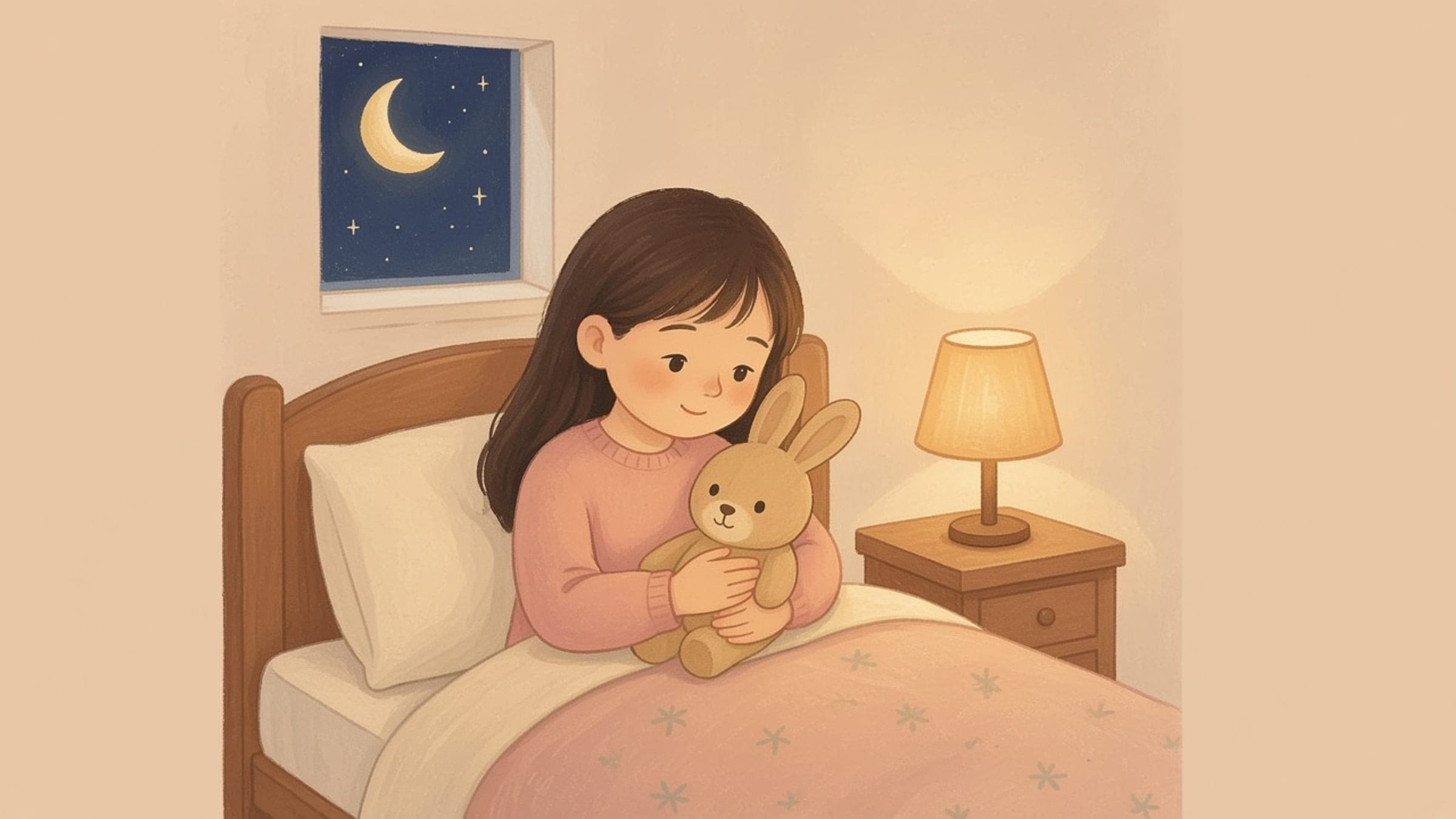
Mei stares at the closet once the big lamp is off. Her dad says, "The room looks different now. That can feel scary." The nightlight stays on. Her stuffed rabbit stays on the pillow. When Mei can hear him, they practice three slow breaths she can do lying down. The last page is not "and then she loved the dark." It is Mei in her own bed, with the light she can count on, using the same breaths after he leaves.
If they wake from the same dream rather than from the dark, leave this page for recurring nightmares. If a storm is what made the dark feel sudden, start with afraid of thunderstorms and come back here for the leftover night.
When does a story help, and when does dark fear need a clinician?
A story helps before lights-out, as rehearsal. It does not help as treatment.
The useful book names the real light, the real object, and the real line you will say. A child can watch a character with their name and face sit through lights-out and use the tool, on a calm evening, so the plan is already familiar when the lamp goes off. That is preparation. It is not desensitization therapy.
The AAP describes gradual exposure — talking about the fear, then looking at pictures, then watching from a safer distance — as a process that belongs under a therapist's guidance when a fear has become a phobia (Fears & Phobias in Children: How Parents Can Help). A read-aloud can sit on the first of those rungs: talking about the dark when everyone is calm. It cannot stand in for that clinical sequence.
The AAP's phobia line is a fear so extreme, persistent, and focused that it significantly interferes with usual daily activities (Fears & Phobias in Children: How Parents Can Help). The anxiety page adds a check that names this exact moment: if anxiety gets in the way of normal activities such as sleeping alone at night, they may need extra support, and if it does not go away or gets worse, get back in touch with the doctor. The doctor can help you decide whether a specialist visit may help, and it names cognitive behavioral therapy as one option a clinician may consider (Help Your Child Manage Anxiety: Tips for Home & School).
CDC's children's mental-health page uses different words for the same fork. Many children have fears and worries from time to time. Persistent or extreme forms of fear could be due to anxiety. When a child does not outgrow typical fears, or when there are so many fears that they interfere with school, home, or play, the child may be diagnosed with an anxiety disorder. Under that category it lists phobia as extreme fear about a specific thing or situation. If you are concerned, the first step it names is a primary care provider or a mental-health specialist, not a picture book (Anxiety and Depression in Children). One hard night with the lamp on is not that pattern. A child who cannot use their room, sleep, or ordinary evenings because of the dark might be. This page does not diagnose it.
How the studio keeps the rehearsal on this child's night
Start from one clear photo. On the Characters step, Storybook Studio builds the child from that photo so the face on the page is theirs, not a stand-in. On the Plot Outline step, a few sentences is enough: the real nightlight, the real stuffed animal, the one line or the breaths, and a last page that does not say they were never scared again. On the Voice step, a calm, matter-of-fact tone fits. After the book is finished, the review screen's edit mode lets you change page text if a magic overnight cure, a "there's nothing there" lecture, or a forced-dark ending slipped in.
Do not write a last page where one book makes them love the dark. Write a last page where they knew the plan, the light stayed on, and the tool was small enough to use lying down.
For other everyday moments that can hold a rehearsal like this, see personalized story ideas in everyday family moments.
Keep reading: if the leftover job is leaving the bed to find you, start with sleeping in their own room.
More related guidance:
- Afraid of the Ocean and Waves? A Story That Makes the Beach Fun
- Terrified of Mistakes? Trying Without Perfection
- Child Afraid of the Dentist? A Parent Script That Helps
- Afraid of Bugs and Spiders? A Story That Turns Fear Into Curiosity
- Personalized Story Ideas Hidden in Everyday Family Moments
Sources
-
Fears & Phobias in Children: How Parents Can Help — American Academy of Pediatrics
-
Help Your Child Manage Anxiety: Tips for Home & School — American Academy of Pediatrics
-
Toddler Bedtime Trouble: 7 Tips for Parents — American Academy of Pediatrics
-
Anxiety and Depression in Children — Centers for Disease Control and Prevention