Story ideas
How do you help a child who is afraid of bugs and spiders?
What to say when a bug shows up, how to watch a gentle one from a distance on a calm day, which bugs stay off-limits, and when bug fear needs a clinician.
The short answer
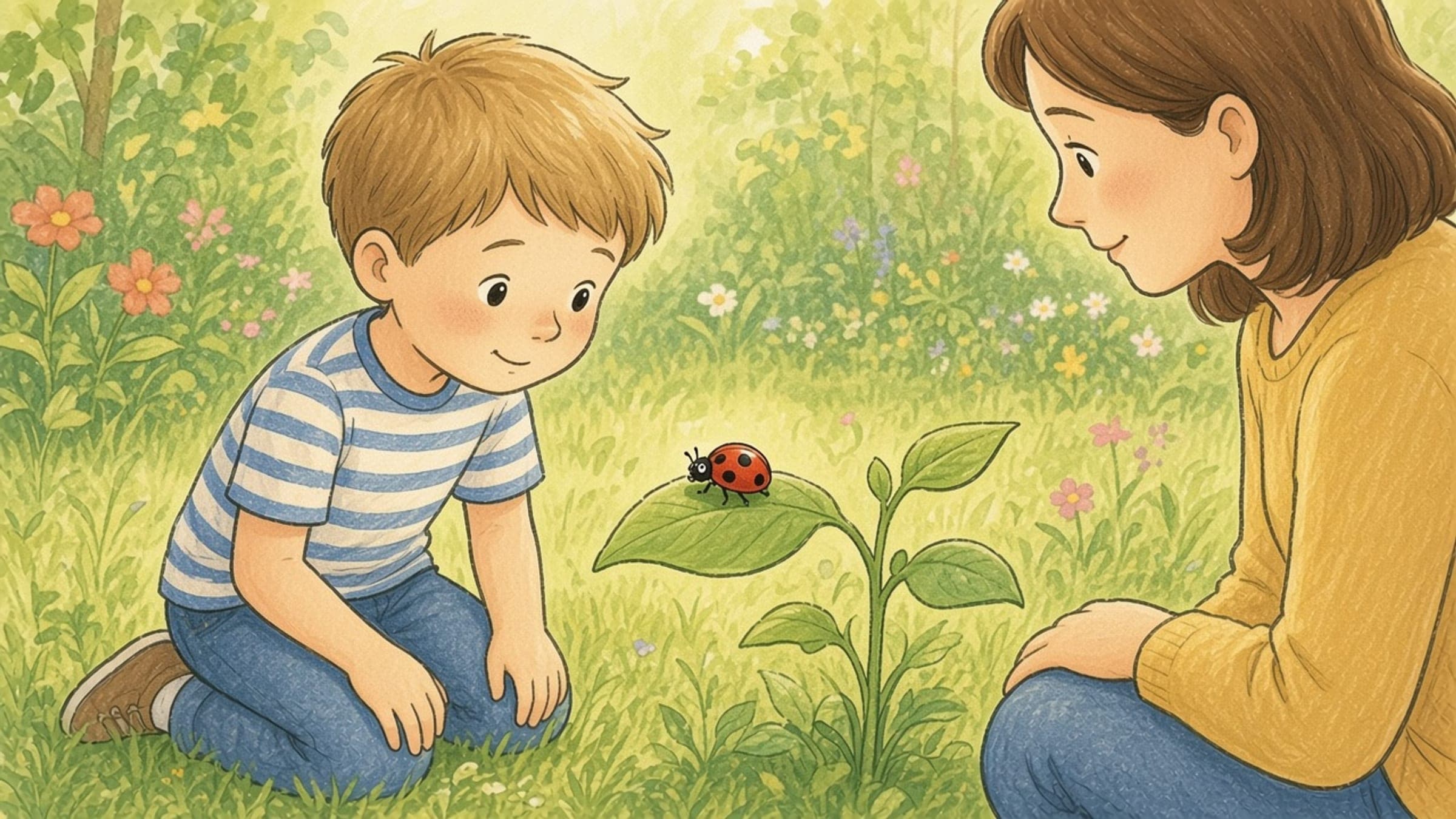
Name the fear instead of dismissing it. Do not force a touch to prove the bug is fine. When your child is already calm, watch a gentle bug from a comfortable distance — a ladybug on a leaf, not a bee on a flower. Keep real safety: leave bees and unknown spiders alone, and stay off woodpiles. A story can rehearse looking from that distance. It cannot treat a phobia or replace a clinician.
Key takeaways
- A startle at a bug is not a lecture moment. Name the fear. Do not force a touch.
- When they are already calm, watch a gentle bug from a comfortable distance. That is looking, not handling.
- Leave bees, wasp nests, and unknown spiders alone. Stay off rock piles and woodpiles.
- A story can rehearse looking from that distance. It cannot treat a phobia or replace a clinician.
How do you help a child who is afraid of bugs and spiders?
Name the fear. Do not force a touch. Watch from a distance only when they are already calm.
The American Academy of Pediatrics names a fear of animals as a common childhood fear, with large barking dogs as the example. Most childhood fears are mild. With reassurance and support, they generally ease on their own after a while. Talk about the anxiety with sympathy. Do not belittle it, especially in front of peers. Do not pressure a child into being brave. It will take time for them to confront the fear in small steps (Fears & Phobias in Children: How Parents Can Help).
That page does not name bugs or spiders on its common-fear list. The handling still applies: sympathy first, no bravado, no ridicule. A sidewalk dog is a different job — that encounter belongs on afraid of dogs. This page is the small, fast thing in the grass, on the leaf, or in the corner of the room.
"It won't hurt you" is not a first line. The bug moved. They did not expect it. Your first job is to name that, not to argue it away. Your second job is one safe distance they can keep. Your third job, when they are already calm, is one look — not a touch.
A read-aloud can walk a child through that sequence on a quiet afternoon. It cannot make a wasp harmless, and it cannot treat a phobia.
Is this a startle, a garden freeze, or a phobia?
Stay on this page only if the hard part is insects or spiders in ordinary outdoor or indoor space.
A flinch, then recovery, is one job. Refusing the backyard is another. A dog on the sidewalk is a third. Mixing those jobs turns one startle into a pile.
| What you are seeing | What it usually means | Which page |
|---|---|---|
| They jump when a beetle crosses the sidewalk, then keep walking | A startle at something fast and small | This page |
| They will not go in the grass, the garden, or the park because a bug might be there | Fear that is starting to fence off play | This page, and the CDC line about play |
| A dog is walking toward you and the job is the encounter | A dog they did not invite | Afraid of dogs |
| The leftover fear is lights-out, not a spider in the corner | Being alone in the dark | Afraid of the dark |
| The leftover fear is the boom, not the bug | Weather they cannot pause | Afraid of thunderstorms |
| A mascot or costumed character is the thing they will not approach | A person inside a suit | Afraid of costumed characters |
The table is editorial sorting. The AAP and CDC pages do not publish this chart. Use it to pick one job. Do not run four scripts at once.
CDC's children's mental-health page draws a second line that matters here: fears and worries are typical in children. Persistent or extreme fear that interferes with school, home, or play is the point to talk with a health care provider. Under anxiety, that page lists phobia as extreme fear about a specific thing or situation, and the examples it names include dogs, insects, or going to the doctor (Anxiety and Depression in Children). A flinch at a ladybug is not that pattern. A child who cannot use the yard, the park, or ordinary outdoor play because of insects might be. This page does not diagnose it.
The AAP's anxiety-at-home page names the same fork in different words: if anxiety gets in the way of normal activities such as sleeping alone at night, playing outside, or going to school, they may need extra support (Help Your Child Manage Anxiety: Tips for Home & School). Playing outside is on that list. That is why a garden freeze is worth taking seriously without turning the first ant into a clinical label.
What do you say when a bug appears right now?
Name the feeling. Put your body between them and the bug if they need that. Do not reach for their hand and press it toward the insect.
The AAP's fears page says to be sympathetic and not to belittle the fear, particularly in front of peers. It also says not to pressure a child into being brave (Fears & Phobias in Children: How Parents Can Help). "Just pick it up" is pressure. So is a sibling dare on the sidewalk. So is a grown-up who laughs and calls them a baby.
If the insect is a bee or a wasp and someone has already disturbed a hive or nest, the AAP insect page is specific: get them away from it as quickly as possible. Any disturbance makes other bees and wasps more likely to sting as well (Insect Bites & Stings in Children). That is an exit, not a curiosity lesson.
- Name the startle in one sentence. "That beetle moved fast. That can feel scary." Do not add "but it won't hurt you" in the same breath.
- Take the encounter yourself if they freeze. Step between. Keep your voice low. You are not proving the bug is a friend. You are keeping the moment small.
- Leave distance in place. An arm's length or more is looking. A forced fingertip is not looking.
- Do not narrate bravery for an audience. The fears page says not to belittle the fear in front of peers (Fears & Phobias in Children). A sidewalk audience is not a teaching aid.
- Save the calm-hour plan for later. The AAP's anxiety page says to start the coping conversation when they are already calm (Help Your Child Manage Anxiety). A scream at a wasp is not that moment.
If the leftover job after the startle is a dog walking toward you, leave this page for afraid of dogs. Keep this page for insects and spiders.
What do you do when they are already calm?
Talk then. Practice looking, not handling. Pick a gentle bug on purpose.
The AAP's anxiety-at-home page is specific about timing: when your child is calm, start a conversation about what they can do when the worry shows up. The examples it gives are deep breathing and muscle relaxation, a short line of positive self-talk such as "I can try this," thinking of a safe place, and gradually facing the feared situation. The goal it names is to cope, not to avoid. Praise the coping — not a performance of fearlessness (Help Your Child Manage Anxiety: Tips for Home & School).
The same page also tells parents to avoid scary or violent shows, games, and movies (Help Your Child Manage Anxiety: Tips for Home & School). The fears page adds the same media check: monitor what they see, including frightening images, and keep media age-appropriate (Fears & Phobias in Children: How Parents Can Help). A jump-scare spider video is not a warm-up for the garden.
AAP describes gradual exposure — talking about the fear, then looking at photos, then watching from a safer distance — as a process that belongs under a therapist's guidance when a fear has become a phobia. The worked example on that page is dogs: talk, photos or videos, a neighborhood dog seen through a window, a few minutes in a room with a gentle puppy, then a pet (Fears & Phobias in Children: How Parents Can Help). That ladder is clinical. A parent read-aloud can sit on the first of those rungs: talking about a ladybug when everyone is calm, then looking from farther away than a touch. It cannot stand in for that clinical sequence, and it does not license a forced meeting with a bee.
- Pick the bug before you pick the moment. A ladybug on a leaf, a roly-poly on a step, an ant carrying a crumb. Not a bee on a flower. Not a spider you cannot name.
- Stay far enough that nobody has to be brave. Looking from a comfortable distance is the plan. A magnifying glass can keep that gap if they want a tool. It is optional. The distance is not.
- Practice one short line they can say without you. "I can look from here." That is the AAP's positive self-talk example, used at a time they can still hear you (Help Your Child Manage Anxiety).
- Praise the looking, not a rewrite of the fear. "You stayed and looked" is the praise. "You weren't even scared" is a correction they did not ask for. The anxiety page's goal is to cope, not to avoid (Help Your Child Manage Anxiety).
- Stop while it is still small. One calm look beats a tour of every bug in the yard. The fears page says it will take time (Fears & Phobias in Children). Do not spend the whole afternoon proving a point.
The names below are invented for illustration. In a real personalized book the hero is your own child, built from your own photo.
Owen stops at the edge of the garden when a ladybug lands on a leaf. His dad does not pick it up and hold it out. He says, "It moved fast. We can look from here." They stay on the path. The last page is not "and then Owen loved every bug." It is Owen still on the path, still looking, with the same distance he can use when no one is reading.
If the leftover job is a worried loop that is not about insects, leave this page for a worried brain that will not turn off.
Which bugs stay off-limits on purpose?
Safety is a boundary, not a bravery test. Some insects are not the practice bug.
The AAP insect page places bees and wasps near flowers, shrubs, picnic areas, and beaches. Stings cause immediate pain and rapid swelling. A few children have severe reactions, such as difficulty breathing and hives or swelling all over their body. If a hive or nest has been disturbed, get the child away from it as quickly as possible (Insect Bites & Stings in Children). That is not a "watch from a distance" scene. That is an exit.
The same page lists when to seek emergency care after a bite or sting: sudden difficulty in breathing, weakness or unconsciousness, hives or itching all over the body, or extreme swelling near the eyes, lips, or penis that makes it difficult for the child to see, eat, or urinate. If there is throat swelling or trouble breathing, it says to administer self-injectable epinephrine and call 911 (Insect Bites & Stings in Children). A story does not carry that plan. If your child has a known sting allergy, that plan belongs with their clinician.
The AAP spider page is equally specific about places, not about forcing a meeting. Most spiders in the U.S. are mostly harmless, are not interested in biting humans, and are unlikely to bite unless they feel trapped or threatened. Two types — the black widow and the brown recluse — can be dangerous. They like warm, dark, and quiet places such as closets, under sinks, behind furniture, and in woodpiles. Prevention on that page includes: do not let children play around rock piles or wood piles; wear gloves in big piles of logs or leaves; shake out shoes kept in a mudroom or garage; shake out stored blankets and clothing; look carefully behind furniture before reaching (Spider Bites: Information for Families). If you suspect a black widow or brown recluse bite, that page says to call 911 immediately or go to the nearest emergency department. General care for other spider bites is wash with soap and water, cover, and apply ice or a cold pack wrapped in a thin cloth (Spider Bites: Information for Families).
This page does not identify spiders for you, name a region's venomous species beyond what the AAP page already names, or treat a bite.
When does a story help, and when does bug fear need a clinician?
A story helps before the next garden walk, as rehearsal. It does not help as treatment.
The useful book names the real bug they will look at, the real distance they will keep, and the real line you will say. A child can watch a character with their name and face stay on the path and look, on a calm afternoon, so the plan is already familiar when a beetle crosses the sidewalk. That is preparation. It is not desensitization therapy.
The AAP's phobia line is a fear so extreme, persistent, and focused that it significantly interferes with usual daily activities. The worked example is a six-year-old whose dog phobia makes them refuse to go outdoors at all because there could be a dog there (Fears & Phobias in Children: How Parents Can Help). Swap the dog for insects and the same interference test applies: a child who cannot use the yard or the park is in a different category from a child who startles and recovers. Treatment for phobias, on that page, belongs with a child psychiatrist or psychologist who specializes in treating phobias. Gradual exposure is described under a therapist's guidance. Behavior therapy is the first line; medication, if used at all, is in addition to that therapy and only in rare cases where behavioral therapy is not helping enough (Fears & Phobias in Children: How Parents Can Help).
The AAP anxiety page adds: if anxiety does not go away or gets worse, get back in touch with the doctor. The doctor can help you decide whether a specialist visit may help, and it names cognitive behavioral therapy as one option a clinician may consider (Help Your Child Manage Anxiety: Tips for Home & School).
CDC uses different words for the same fork. Many children have fears and worries from time to time. Persistent or extreme forms of fear could be due to anxiety. When a child does not outgrow typical fears, or when there are so many fears that they interfere with school, home, or play, the child may be diagnosed with an anxiety disorder. Under that category it lists phobia as extreme fear about a specific thing or situation, and insects are one of the examples it names. If you are concerned, the first step it names is a primary care provider or a mental-health specialist, not a picture book (Anxiety and Depression in Children). One flinch at a beetle is not that pattern. A child who cannot play outside because of insects might be. This page does not diagnose it.
How the studio keeps the rehearsal on this child's garden
Start from one clear photo. On the Characters step, Storybook Studio builds the child from that photo so the face on the page is theirs, not a stand-in. The same photo-to-character path is walked in how Storybook Studio turns a photo into an illustrated character; how many photos you need if you are choosing among family pictures. On the Plot Outline step, a few sentences is enough: the real garden path, the real ladybug or beetle, the grown-up who does not force a touch, and a last page that does not say they loved every bug. On the Voice step, a calm, matter-of-fact tone fits. After the book is finished, the review screen's edit mode lets you change page text if a magic overnight cure, a "just pick it up" dare, or a forced-touch ending slipped in — the same edit window described in can I edit a personalized storybook after I make it.
Do not write a last page where one book makes them love insects. Write a last page where they knew the plan, the distance stayed in place, and looking was small enough to do from the path.
For other everyday moments that can hold a rehearsal like this, see personalized story ideas in everyday family moments.
Keep reading: if the leftover job is a dog walking toward you, start with afraid of dogs.
More related guidance:
- Why Is My Child Scared of Loud Noises? What Actually Helps
- Afraid of the Bathtub Drain? A Story That Makes Bath Time Calm Again
- Afraid of the Big Slide? A Story That Turns the Drop Into a Whoosh
- Afraid of the Ocean and Waves? A Story That Makes the Beach Fun
- Personalized Story Ideas Hidden in Everyday Family Moments
Sources
-
Fears & Phobias in Children: How Parents Can Help — American Academy of Pediatrics
-
Help Your Child Manage Anxiety: Tips for Home & School — American Academy of Pediatrics
-
Insect Bites & Stings in Children — American Academy of Pediatrics
-
Spider Bites: Information for Families — American Academy of Pediatrics
-
Anxiety and Depression in Children — Centers for Disease Control and Prevention