Story ideas
Why is my child scared of loud noises?
Why sudden sounds overwhelm young kids, what to say instead of "it's not that loud," the three levers that lower the volume, and when to ask for help.
The short answer
Sudden loud sounds arrive without warning, and a young child cannot predict or stop them, so the reaction is a startle response rather than misbehavior. Most childhood fears like this are mild and ease with sympathy rather than pressure. What helps is warning your child before a predictable sound, adding distance, shortening the exposure, and offering soft ear protection they control themselves. What does not help is telling them it is not that loud.
Key takeaways
- A sudden sound your child cannot predict or stop sets off a startle response — it is not defiance and not something they chose.
- Occasional fears like this are common in childhood, and most are mild and ease with sympathy rather than pressure.
- Three levers actually change the experience: warning, distance, and duration. Ear protection is a fourth.
- "It's not that loud" is the one line to drop, because to your child it genuinely is.
- Talk to your pediatrician if the fear is intense, persistent, and getting in the way of ordinary daily life.
Why is my child scared of loud noises?
Because the sound arrives without warning and your child has no way to predict it, stop it, or know when it will end. The vacuum, the hand dryer, the blender, the toilet that flushes itself — each one starts at full volume with no run-up. What looks like an overreaction is closer to a startle response, and a young child has fewer tools than you do for talking themselves down afterward.
Occasional fears are a normal part of growing up. The American Academy of Pediatrics describes childhood fears as common as children explore the world, notes that they tend to come and go, and says most are mild and generally ease on their own with reassurance and support (Fears & Phobias in Children: How Parents Can Help).
There is also a plain physical fact underneath this. Some of the sounds kids meet really are loud. A fireworks show runs roughly 140–160 A-weighted decibels, and long or repeated exposure at or above 85 dBA can damage hearing, according to the National Institute on Deafness and Other Communication Disorders (Noise-Induced Hearing Loss). When your child flinches at the fireworks, they are not wrong about the volume.
Is it normal for a 4-year-old to be scared of loud noises?
Generally, yes. A fear that shows up at three or four, flares for a season, and fades as your child gets more predictable experience with the sound fits the pattern the AAP describes: mild, changeable, and responsive to support rather than pressure.
What matters more than your child's age is the shape of the fear. Ask yourself:
- Is it easing over months, or entrenching? Fears that slowly loosen are following the ordinary path.
- Does it stay in proportion? Covering ears at the hand dryer is proportionate. Refusing to enter any public restroom, anywhere, is not.
- Is it shrinking your child's world? The AAP draws the line at fears that become extreme, persistent, and focused enough to interfere significantly with everyday activities.
What should I say instead of "it's not that loud"?
Telling a noise-sensitive child the sound is not that loud tells them their own body is lying to them. It also ends the conversation. The AAP is direct about this: do not belittle or ridicule a child's fears, and do not pressure a child into being brave.
Try these instead:
- Name it, don't rank it. "That was really loud. It surprised me too."
- Give the ending. "The dryer runs about ten seconds. I'll count with you."
- Hand over a choice. "Do you want your ear muffs, or do you want to wait in the hall?"
- Announce before you start. "I'm turning the vacuum on after I count to three."
- Credit the coping, not the calm. "You used your plan" beats "See? That wasn't so bad."
That last one matters. Praising a child for not being scared teaches them the goal is to stop feeling it. Praising the plan teaches them they have one.
What actually makes a loud sound easier to handle?
The NIDCD's rule of thumb for protecting hearing is to avoid sounds that are too loud, too close, or that last too long — and distance and exposure time are both named as factors you control (Noise-Induced Hearing Loss). Those same three levers happen to be the ones that make a sound feel manageable to a scared child:
- Warning. A countdown converts an ambush into an appointment. This is the cheapest lever and usually the most effective.
- Distance. Let your child be in the next room while you vacuum, or watch fireworks from farther back. Stepping away is a legitimate strategy, not a retreat.
- Duration. Break the noisy job into two short bursts instead of one long one, and say how many there will be.
Soft ear protection sits alongside these. Let your child put the muffs on and take them off themselves — the control is doing as much work as the foam. For genuinely damaging sound levels like a fireworks show, hearing protection is worth using regardless of whether your child is frightened.
When should I talk to a doctor about noise sensitivity?
Bring it up with your pediatrician when the fear is intense, persistent, and interfering with home, school, or play. The AAP notes that fears reaching this level may benefit from a child psychiatrist or psychologist, and that behavioral approaches — including gradual, guided exposure in small, non-threatening steps — are the first line of treatment. The CDC similarly frames typical worries as different from fear that is extreme, lasting, and disruptive enough to warrant a conversation with a health care provider (Anxiety and Depression in Children).
Two things worth raising specifically:
- If your child seems to hear things you don't, or covers their ears at ordinary volumes, ask about a hearing evaluation. Sound tolerance and hearing are assessed by an audiologist, and it is a reasonable question rather than an alarming one.
- If the sensitivity is broader than noise — crowds, lights, tags in clothing, textures — the picture may be less about one frightening sound and more about overall sensory load. That is a different reader job, and we cover it separately in Too Much Noise or Sensory Overload? A Story to Rehearse Accommodations.
A story is not a substitute for any of this. It can prepare a child, normalize the feeling, and open a conversation. It cannot diagnose a sound-tolerance problem, treat a phobia, or replace advice from your pediatrician or an audiologist.
Does a personalized story really help?
The gap between knowing the plan and using the plan is where a story earns its place. A child can hear "you'll have your ear muffs" and still freeze when the vacuum starts, because the plan was never rehearsed anywhere calm. A book read at bedtime is that rehearsal — and when the child on the page has your child's name and face, the plan gets filed under things I do rather than things Mom says.
What a good loud-noise story looks like
The names and characters below are invented for this example. In a real personalized book, the hero is your own child.
A hero who notices everything. Lily noticed every sound. Most days that was a gift. But the vacuum, the hand dryer, and the fireworks on summer nights were too big and too sudden, and they turned a good day upside down in an instant.
A worry she can name. When a loud sound hit without warning, Lily's hands flew to her ears and her heart raced. The worst part was never knowing when the next big one was coming. The world felt full of ambushes.
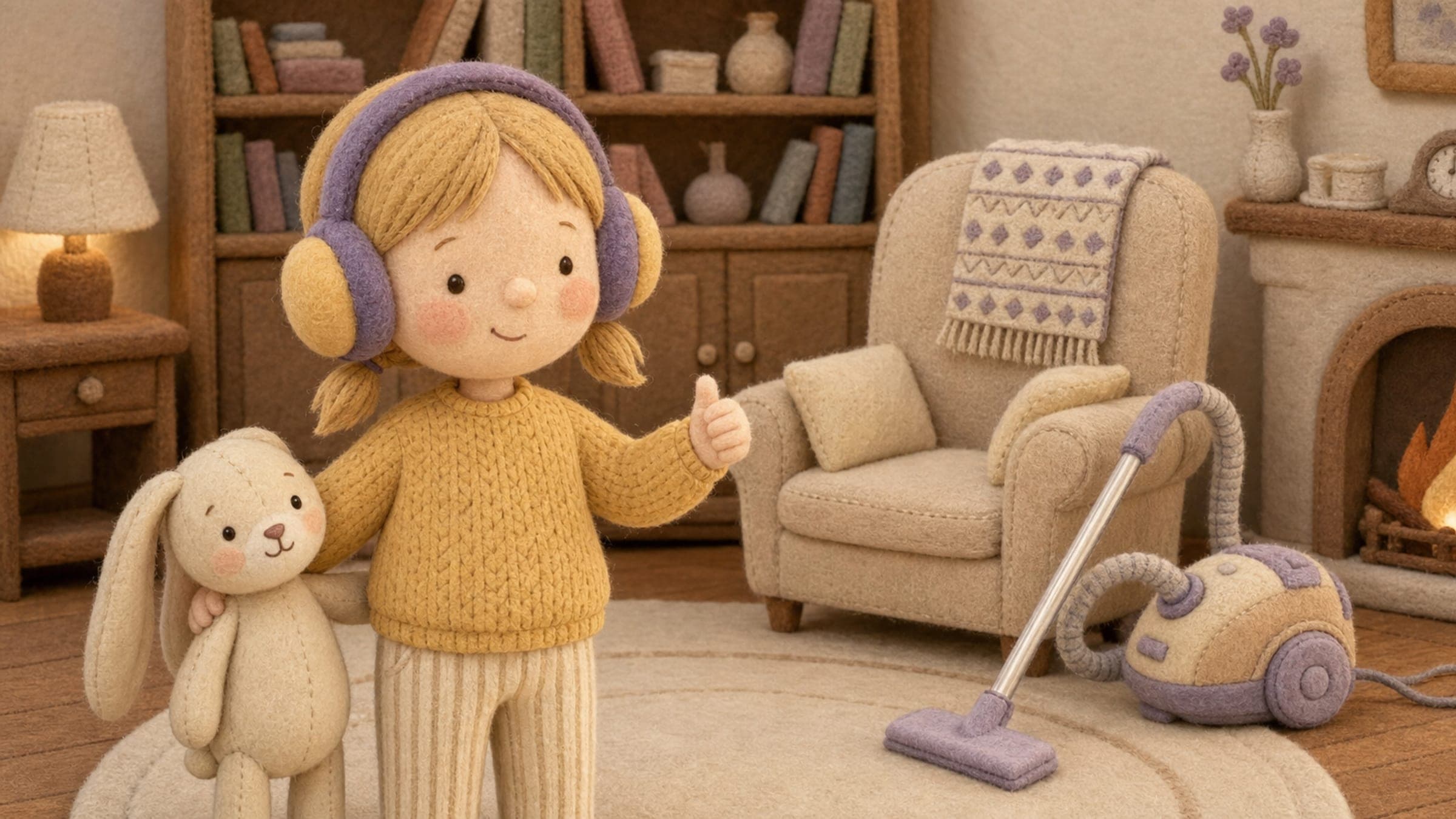
A plan she is given, not lectured about. In her book, a plush rabbit named Bramble — who had the biggest ears around — taught her the Big-Ear Plan: get a warning when you can, put on your soft ear muffs, and remember every loud sound has an ending you can count toward.
A rehearsal that transfers. Before Mom vacuumed the next morning, she gave Lily a countdown. Lily put her muffs on herself, hugged the rabbit, and said, "It has an ending." The vacuum roared, Lily counted, and then it stopped. "I had a plan and it worked."
Notice what the story does not do: it never tells Lily the vacuum is quiet, and it never ends with her deciding she likes the noise. She still finds it loud. She just isn't ambushed by it anymore.
How do you use the story at read-aloud time?
- Read it on a calm day, not in the ten minutes before you vacuum.
- Let your child say the plan's steps back to you in their own words.
- Give the countdown every time, even once it seems unnecessary.
- Afterward, name what they did: "You used your plan," not "That wasn't so bad."
- Keep the ear muffs somewhere your child can reach without asking.
Keep reading: thunder is the loudest, least predictable sound of all, and the same three levers apply — see afraid of thunderstorms.
More related guidance:
- Afraid of the Bathtub Drain? A Story That Makes Bath Time Calm Again
- Afraid of the Big Slide? A Story That Turns the Drop Into a Whoosh
- Afraid of the Dark? A Story That Helps Your Child Feel Safe at Night
- Afraid of the Ocean and Waves? A Story That Makes the Beach Fun
- Personalized Story Ideas Hidden in Everyday Family Moments