Story ideas
How do you help a child who is afraid of thunderstorms?
Name the fear, explain thunder when they are calm, then give one indoor job for the boom. A story can rehearse that plan. It cannot treat a storm phobia.
The short answer
Explain thunder when your child is calm, not during the boom. Name the fear instead of dismissing it. Once you are already inside, give one job they can do with the sound — counting the gap between flash and boom to hear the storm moving away. A story can rehearse that plan. It cannot treat a phobia or replace a clinician.
Key takeaways
- Thunderstorms are a named common childhood fear. Sympathy first; do not pressure a child to be brave.
- Explain thunder when they are calm. During the boom, name the feeling, then give one indoor job.
- Once you are already inside a safe shelter, counting the gap between flash and boom is a job. It is not outdoor lightning safety.
- A story can rehearse that plan before the next storm. It cannot treat a phobia or replace a clinician.
How do you help a child who is afraid of thunderstorms?
Do not start with "it's just thunder." Start with the fear, then one job.
Thunder is loud, sudden, and outside anyone's control. The American Academy of Pediatrics lists thunderstorms with the dark, animals, fires, and high places as common childhood fears. Most of those fears are mild and, with reassurance and support, generally ease on their own (Fears & Phobias in Children).
Your first job is to get everyone inside a safe shelter if you are not already there. Your second job is to name the fear instead of dismissing it. Your third job — once they can hear you — is one concrete thing they can do with the sound. A story can rehearse that sequence before the clouds gather. It cannot make thunder quiet, and it cannot treat a phobia.
Why do thunderstorms scare children more than other loud sounds?
Because the boom arrives without a warning they can use, and they cannot turn it off.
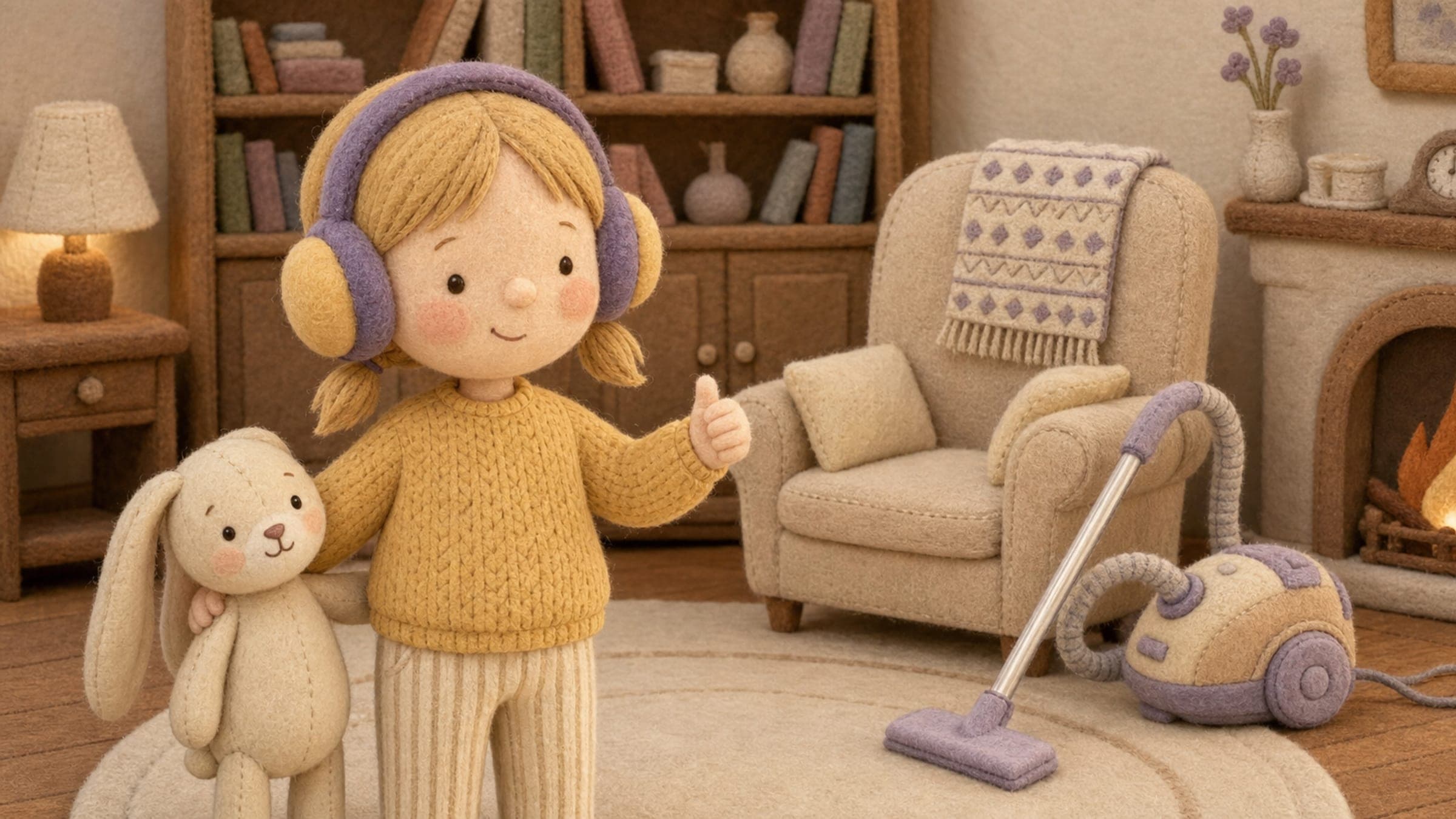
A vacuum has a switch. A hand dryer ends. Thunder does not ask first, and the next crack can be closer or farther. That unpredictability is the part a young child cannot manage alone. The AAP's fears page treats thunderstorms as an ordinary childhood fear, not as misbehavior, and it tells parents to be sympathetic rather than to belittle the fear, especially in front of peers (Fears & Phobias in Children).
The CDC's children's mental-health page draws a second line that matters here: fears and worries are typical in children. Persistent or extreme fear that interferes with school, home, or play is the point to talk with a health care provider (Anxiety and Depression in Children). Covering ears at a close boom is proportionate. Refusing to leave the house whenever clouds gather is the pattern to take seriously.
If the hard part is a vacuum, a blender, or a restroom dryer — a sound someone in the room can warn about, move away from, or shorten — that is a different job. Use the loud-noises script. This page stays with weather the child cannot pause.
What do you say before the next storm?
Talk when they are calm. Practice the indoor plan. Do not wait for the first flash.
The AAP's anxiety-at-home page is specific about timing: when your child is calm, start a conversation about what they can do when the worry shows up. The examples it gives are deep breathing and muscle relaxation, a short line of positive self-talk such as "I can try this," thinking of a safe place, and gradually facing the feared situation. The goal it names is to cope, not to avoid. It also tells parents to praise and reward brave behavior — coping, not a performance of fearlessness (Help Your Child Manage Anxiety).
The same AAP fears page says not to pressure a child into being brave. It will take time for them to confront the fear in small steps (Fears & Phobias in Children). "You have to watch the lightning with me" is pressure. "When you are ready, we can sit farther from the closed window and count" is a step.
- Explain the sound in one honest sentence. Thunder is the noise lightning makes. It is loud. It cannot come through the walls of a safe indoor shelter. Do not add a joke or a dare.
- Name the indoor plan. AAP lightning guidance is blunt: if you can hear thunder, the storm is close enough for lightning to strike, and the move is to go indoors. Trees, tents, bleachers, and open garages are not safe shelters. A building with four solid walls, or a hardtop vehicle, is (Lightning & Sports Safety).
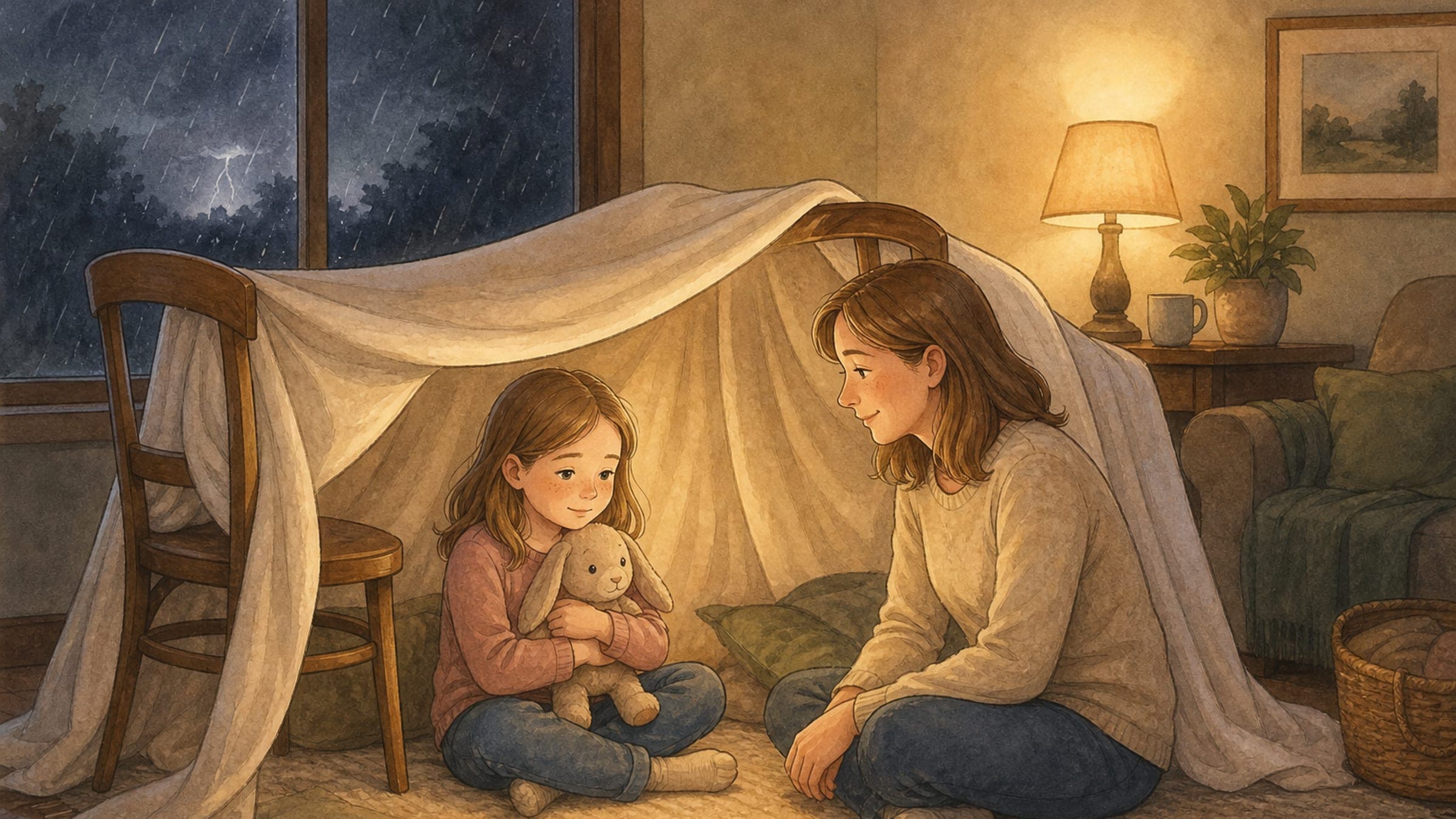
- Pick a storm spot away from open windows and plumbing. The same AAP page says that even indoors, stay away from open windows, sinks, toilets, tubs, showers, and electrical outlets, and never swim during a lightning storm (Lightning & Sports Safety). A blanket fort in the middle of the room is a plan. A fort against an open window is not.
- Practice one job they can do with the sound. Once you are already inside, counting slowly after a flash until the boom is a job: a bigger number means the storm is farther away. That count is an editorial coping tool for a child who is already sheltered. It is not the AAP's outdoor 30/30 rule, which is a safety countdown to get inside before a count of 30 (Lightning & Sports Safety).
- Do this on a clear evening. The CDC's emotion-coaching page says to wait until both you and your child are calm before the coaching conversation, and to notice feelings when they are still low-intensity (Tips for Noticing and Naming Emotions). A boom is not that moment.
If rain cancelled the picnic and the hard part is the missing afternoon, not the boom, that disappointment belongs with a cancelled plan. Keep this page for the fear of the storm itself.
What do you do in the moment, when the sky is already loud?
Name the feeling. Stay close. Give the job only after they can hear you.
The CDC's fifth emotion-coaching step is "find good solutions" — after you notice, connect, listen, and name. Rushing into problem-solving too soon can dismiss the emotion and make the moment worse. All emotions are acceptable; not all behaviors are (Tips for Noticing and Naming Emotions). "You may be scared on the couch. You may not run out the door."
- Get inside if you are not already. That is the AAP lightning rule, not a calming trick. If you can hear thunder, go to a safe shelter. Do not stay under a tree to "finish the count" (Lightning & Sports Safety).
- Name the fear in one sentence. "That boom was loud. You look scared." The CDC says you can guess the feeling and try again if they correct you, and that sitting nearby or a quiet hold counts as paying attention even when you do not have words (Tips for Noticing and Naming Emotions).
- Pause if you are flooded too. The CDC tells parents to calm their own emotions first. A short pause — three breaths — is self-regulation, not neglect. If you try to coach before you are calm, you can dismiss the feeling without meaning to (Tips for Noticing and Naming Emotions).
- When they can hear you, give the one indoor job. "Watch for the flash. Count with me until the boom." A bigger number is the storm moving away. Do not turn it into a test. Do not tell them to stop being scared so they can count better.
- Do not pressure them to watch the sky. The AAP says not to pressure a child into being brave (Fears & Phobias in Children). Covering ears in the fort is allowed. Forcing them to the window is not.
| What you are seeing | What it usually means | What to do next |
|---|---|---|
| They startle, cover their ears, and reach for you at a close boom | A typical fear of a sudden sound they cannot stop | Name the feeling. Stay close. Offer the indoor count when they can hear you. |
| They can count with you and notice the number getting bigger | The job is usable | Keep the job small. Do not narrate how brave they are. |
| They refuse to leave the house whenever clouds gather, or the fear takes over sleep, school, or play | The AAP's phobia line: extreme, persistent, and focused enough to interfere with daily activities | Talk with their doctor. A story is not the next step. |
| You are still outdoors when you hear thunder | Lightning safety, not a coping game | Get to a safe shelter. Do not count in an open field. |
The names below are invented for illustration. In a real personalized book the hero is your own child.
Nora hears the first rumble and her shoulders jump. Her dad says, "That was loud. We are inside. You look scared." They sit in the fort in the middle of the room, away from the closed window. When Nora can hear him, they watch for the flash and count until the boom. The next number is bigger. The storm is not gone. She has a job.
If the dark after the power flickers is the part that lasts, that nighttime fear belongs with afraid of the dark. If the room itself — the noise, the crowd, the lights — is what overwhelms them on ordinary days, that is sensory overload, not a weather script.
When does a story help, and when does it not?
A story helps before the storm, as rehearsal. It does not help as treatment.
The useful book names the real indoor spot, the real count, and the real line you will say. A child can watch a character who looks like them sit through a rumble and do the job, on a clear night, so the plan is already familiar when the sky gets loud. That is preparation. It is not desensitization therapy.
The AAP describes gradual exposure — talking about the fear, then looking at pictures, then watching from a safer distance — as a process that belongs under a therapist's guidance when a fear has become a phobia (Fears & Phobias in Children). A read-aloud can sit on the first of those rungs: talking about thunderstorms when everyone is calm. It cannot stand in for that clinical sequence.
For other everyday moments that can hold a rehearsal like this, see personalized story ideas in everyday family moments.
Keep reading: if the sound is a vacuum or a hand dryer, not weather, start with why a child is scared of loud noises.
More related guidance:
- A Cancelled Plan: Sit With the Feeling, Then Name a Backup
- Afraid of the Dark? A Story That Helps Your Child Feel Safe at Night
- Too Much Noise or Sensory Overload? A Story to Rehearse Accommodations
- Recurring Nightmares? A Story That Helps Your Child Change the Ending
- Personalized Story Ideas Hidden in Everyday Family Moments
Sources
-
Fears & Phobias in Children: How Parents Can Help — American Academy of Pediatrics
-
Help Your Child Manage Anxiety: Tips for Home & School — American Academy of Pediatrics
-
Lightning & Sports Safety: When Thunder Roars Go Indoors — American Academy of Pediatrics
-
Tips for Noticing and Naming Emotions — Centers for Disease Control and Prevention
-
Anxiety and Depression in Children — Centers for Disease Control and Prevention