Story ideas
How do you prepare a child for the first day of school?
Walk through the first-day schedule, rehearse a warm brief goodbye, make pickup concrete, and know when a story helps versus when to partner with the teacher.
The short answer
Preview the whole day so nothing is a surprise — cubbies, the first gathering, snack, playground, and who comes at pickup. Rehearse a goodbye that is warm and brief. Make the trip and the pickup person concrete. Visit the classroom beforehand when you can, and send a comfort object the classroom allows. A story can walk through that day. It cannot diagnose separation anxiety, replace the teacher's plan, or promise the child will love school after one book.
Key takeaways
- Preview the whole first day — cubbies, the first gathering, snack, playground, and pickup — so the building is not a mystery.
- Keep the goodbye warm and brief. Lingering stretches the hard part.
- Name who picks them up, and how they get there, in words a child can picture.
- Visit the classroom beforehand when you can. Send only a comfort object the classroom allows.
- A story can rehearse that map. It cannot diagnose separation anxiety, replace the teacher's plan, or promise they will love school after one book.
How do you prepare a child for the first day of school?
Walk through the day before it happens. Then keep the doorway goodbye short.
This page is the preschool, kindergarten, and elementary first-day job: a new building, a new teacher, a new stretch of hours, and the question of who comes back at the end. It is not starting a new school mid-year, which is walking into a class that already has friends and a rhythm. It is not moving up to middle school, which is lockers, changing classes, and a grade-band jump. Keep those pages separate. A first-day walkthrough does not finish a mid-year transfer or a middle-school schedule.
The American Academy of Pediatrics tells families to visit the new school or classroom before the first day, to attend orientations and take a tour when they can, and to rehearse heading into the new situation, because many children get nervous about a new school, classroom, or teacher. If your child seems nervous, ask what they are worried about and problem-solve it together. Remind them that teachers know students may be nervous on the first day and will make an extra effort to help everyone feel comfortable (Back-to-School Tips for Families).
Your job tonight is smaller than "make them excited." Name what the day actually holds. Practice the goodbye you will use at the cubbies. Say who comes at pickup in words they can picture. A story can walk a character who looks like them through that same map. It cannot diagnose why the goodbye is hard, stand in for the teacher's morning plan, or promise they will love school after one book.
How do you walk through the day so nothing is a surprise?
Use the real schedule, not a pep talk. Sit down when they are calm — after dinner, not while you are packing the backpack — and walk the day in order.
The AAP's first-day list starts with familiarity: visit the classroom, tour the school, and, if you can, take them to play on the playground a few days before classes start so the yard already has a memory attached. Rehearsing the new situation is the move it names for nerves about a new building, teacher, or class (Back-to-School Tips for Families).
Turn that into a map you can say out loud.
- Start at the hook or cubby. "This is where your backpack lives. You hang it up, and it stays there until pickup." If you already visited, use the real color of the cubby wall, not a generic "your spot."
- Name the first gathering. Circle time, morning meeting, the rug, the first lesson — whatever their classroom actually does. "Then you sit with the class and the teacher tells you what comes next."
- Put snack, lunch, and the playground on the list. The AAP also asks you to point out the fun parts of school starting, such as seeing old friends and meeting new ones (Back-to-School Tips for Families). Name the real recess yard if you saw it.
- End at pickup. The last beat is not "and then you love it." The last beat is who is standing there, and how they know the day is over.
- Ask what they are worried about, then pick one thing to solve. The AAP's line is to ask what is on their mind and problem-solve the new situation together. "I don't know where the bathroom is" is a walk-through. "What if you forget me" is a pickup sentence.
Write the answers down the same night, in their words. A vague "they'll be fine" evaporates by the classroom door. A dated note — bathroom, snack, who picks up — is what you take back to the teacher if the first week is bumpier than the map.
If the hard part later in the year is a seat in the cafeteria, that is eating lunch alone. If the hard part is joining a game that already started, that is being left out at recess. This page stays with day one.
How do you rehearse a goodbye that is warm and brief?
Give the goodbye a script. Then leave.
The AAP's separation-anxiety page is blunt about the doorway: create a quick goodbye ritual — even a baseball-style handshake, triple kisses at the cubby, or a special blanket or toy as you leave — and keep it short and sweet. If you linger, the transition lasts longer, and so does the anxiety. Give full attention, be loving, then say goodbye quickly even if they ask you to stay (How to Ease Your Child’s Separation Anxiety).
Do the same drop-off, with the same ritual, at the same time, when you can. The AAP says a consistent routine helps a child trust both their independence and your return (How to Ease Your Child’s Separation Anxiety).
- Pick one ritual and keep it boring. A hug, two kisses, a silly handshake, a wave at the glass. Practice it at home on a chair that stands in for the cubby.
- Say the return in child time, not clock time. The AAP's example is specific: if you will be back by 3 p.m., say "I'll be back after nap time and before afternoon snack," or whatever their classroom actually does (How to Ease Your Child’s Separation Anxiety).
- Leave after the ritual. Do not come back for one more hug. The same page describes returning an hour later to "visit" after a hard drop-off as a well-intended mistake that restarts the goodbye. Keep the promise of pickup instead.
- Practice the ritual before the first day. The AAP asks families to practice going to school and the goodbye before they have to part for real — a playdate drop-off, an hour with a grandparent, a weekend rehearsal at the classroom door if the school allows it (How to Ease Your Child’s Separation Anxiety).
- Do not sneak out. The page's job is a real goodbye with full attention, then a clean exit. A disappearing parent makes the next morning harder to trust.
Tears at the door can still happen. The AAP describes ordinary separation distress as an expected, attachment-shaped behavior, and says children are often reported to settle shortly after a parent leaves. That is not a diagnosis, and it is not a promise that your child will stop crying on minute three (How to Ease Your Child’s Separation Anxiety).
If the hard goodbye is an everyday daycare door, not the first day of school, use crying at daycare drop-off. This page stays with the first-day map.
How do you make pickup and the trip to school concrete?
Name the grown-up and the route. "Someone will get you" is not a plan.
The AAP's travel section asks families to review the basic rules and practice any new route or mode of transportation before the first day — the bus stop, the walk, the car line. If you feel it is needed, walk or drive them on the first day and pick them up, and get there early to cut down on extra stress. Finding another child in the neighborhood to walk or ride with is on that same list (Back-to-School Tips for Families).
- Say who picks them up, and where they stand. "Dad is at the blue door after playground." If a grandparent or a carpool is the pickup, use that name.
- Walk or drive the actual route once. The AAP's instruction is to practice new routes before day one. A dry run on Sunday afternoon beats a first-try in Monday traffic.
- Get there early on the first morning. That is the AAP's first-day timing, not a personality trait.
- If they ride the bus, stand the wait out with them once. Waiting for the bus to stop before they walk up, and walking where the driver can see them, are the first-day bus rules on that page. The rest of bus safety belongs with the school, not in a bedtime story.
- Keep the pickup promise. The separation-anxiety page ties trust to returning when you said you would. A late surprise without a heads-up undoes the "after snack" sentence.
The U.S. Department of Education's family-partnership page is for the conversation with the school, not for a script at the cubby. It exists so families have prompts for productive talks with educators, including a back-to-school question set: how the teacher will get to know your child's interests, strengths, and needs; the best way to reach them with a concern; and how the family can connect to well-being supports (Family Partnership and Engagement; Let's Talk Back to School). Use those questions when you need the school's plan. Do not treat the PDF as a first-day feeling script.
If the trip itself is the scary part later, that is riding the school bus. If speaking up in class is the later fear, that is getting an answer wrong.
Should you visit the classroom first, and what comfort object can go?
Yes to a visit when the school offers one. Yes to a lovey only if the classroom says it can stay.
The AAP's first-day page puts the visit first: take your child to the new school or classroom before day one, attend orientations, tour the building, and consider a playground visit a few days before classes start (Back-to-School Tips for Families). The separation-anxiety page adds a rehearsal of the goodbye at school before the real parting (How to Ease Your Child’s Separation Anxiety).
A comfort object is a separate, allowed tool — not a test of bravery. The AAP calls blankets and soft toys transitional objects: they reassure a child when they are separated from you and help them feel at home in a strange place. They are not a sign of weakness or insecurity, and there is no reason to keep a child from using one (Transitional Objects: Security Blankets & Beyond). The goodbye page includes "a special blanket or toy as you leave" in the short ritual (How to Ease Your Child’s Separation Anxiety).
| Move | What it is for | What it is not |
|---|---|---|
| Classroom visit | The room, the cubbies, the bathroom, the playground already have a memory | A promise that day one will feel easy |
| Short goodbye ritual | A clean, repeatable exit the child can predict | A longer stay that starts the goodbye over |
| Approved comfort object | A familiar stand-in while you are gone, if the classroom allows it | Proof they are "too little" for school |
| Pickup sentence | Trust that the day ends with a known grown-up | A story ending where they never miss you |
The "approved" column is ours, not a quotation. Classrooms set the rule about what can stay in a cubby or on a hook. Ask before you pack the bear. The AAP pages say the object can help; they do not override a teacher's policy.
If the first-friend job shows up after the first week — they want someone and do not have a hello yet — that is making a first friend, not another preview of cubbies.
When does a story help, and when does first-day distress need the teacher or a pediatrician?
A story helps in a calm hour, as a rehearsal of the map. It does not help as a diagnosis, and it does not run the classroom.
Ordinary first-day nerves, a tight tummy the night before, and tears that settle after you leave are the pattern the AAP already described. A book can put a child with their name and face in that day: hang the backpack, sit on the rug, go to the playground, and see the promised grown-up at pickup.
A story cannot diagnose separation anxiety. It cannot replace the teacher's morning plan or a school family's questions about how to reach the classroom. It cannot promise that one book makes them love school. If drop-off stays hard, the next conversation is with the people who see what happens after you leave.
The AAP's anxiety page draws a school-specific line: children may find it hard to focus on school, or even to go, when they are worried. Talk with the teacher and the guidance counselor about what to do if your child asks to go home early. If the anxiety does not go away or gets worse, get back in touch with the doctor; you and the doctor can try new approaches, and the doctor can help you decide whether a specialist visit may help (Help Your Child Manage Anxiety: Tips for Home & School). The separation-anxiety page says it is rare for daily separation distress to persist after the preschool years, and that the pediatrician is the person to chat with if you are concerned your child is not adapting (How to Ease Your Child’s Separation Anxiety).
CDC's children's mental-health page draws a different line than ordinary first-day butterflies: fears and worries are typical, including toddlers who become very distressed about being away from a parent even when they are safe. Persistent or extreme fear that interferes with school, home, or play is the point to talk with a health care provider. Under anxiety, it lists separation anxiety as being very afraid when away from parents. The first step it names is a primary care provider or a mental-health specialist, not a picture book (Anxiety and Depression in Children). One teary Monday is not that pattern. A child who cannot use the school day, sleep, or play because they are apart from you might be. This page does not diagnose it.
The Department of Education's back-to-school questions are the school-side half of that partnership: how to reach the teacher with a concern, and how the family can connect to well-being resources, including mental health (Let's Talk Back to School). Bring dates and what you saw. Do not bring a book as the plan.
The names below are invented for illustration. In a real personalized book the hero is your own child, built from your own photo.
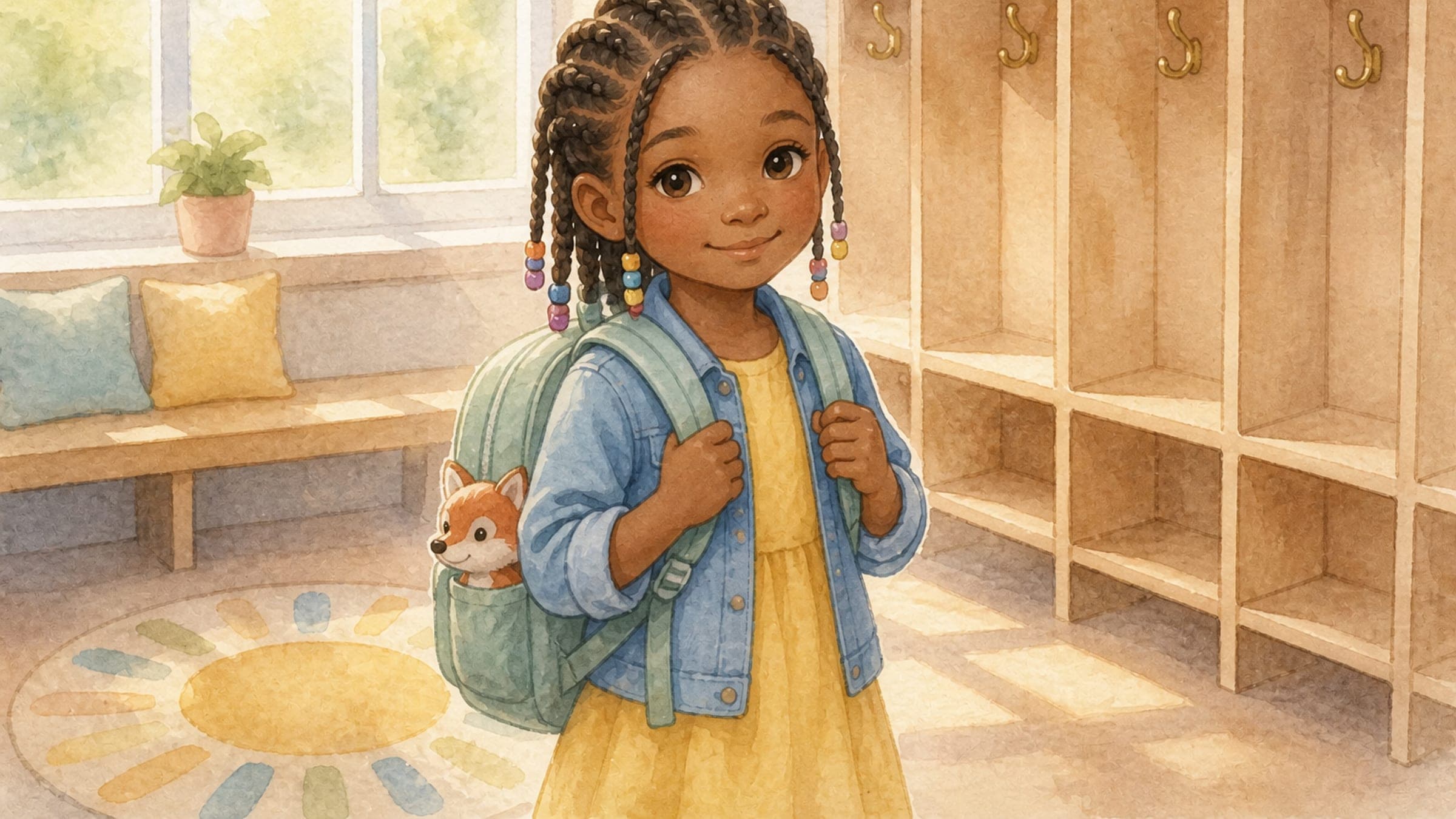
In the story, Amara's backpack is on the hook and her tummy still has butterflies. Her stuffed fox, Pip, does not make the teacher send everyone home. Pip names the cubby, the rug, the playground, and the grown-up at the blue door after snack. The last page is not "and then she loved school forever." It is Amara hanging the backpack, using the short goodbye, and knowing who comes back.
Then the read-aloud has a job outside the book: say the real cubby, the real ritual, and the real pickup person, and have them say the goodbye out loud once before you close the cover. A story that ends at "they loved it" is entertainment. A story that hands them tomorrow's map is preparation.
How the studio keeps the rehearsal specific
The Plot Outline step asks a plain question — "What should happen in the story?" — as a free-text box, with the guidance that a few sentences is plenty. That is where the real cubby, the real goodbye, and the real pickup sentence go, in your child's words, rather than a generic "had a great first day" last page. The story requires you to name one Story hero. On the Story step you review the complete written story before illustrating the opening pages, and you can use edit mode if a promised overnight love-of-school slipped in.
Do not write a last page where one book makes them adore school. Write a last page where they knew the plan, the goodbye was short, and the grown-up came back.
For other everyday moments that can hold a rehearsal like this, see personalized story ideas in everyday family moments.
Keep reading: if the hard part is walking into a class that already has a rhythm, start with starting a new school mid-year.
More related guidance:
- Going to the Resource Room: A Story About Useful Support
- Learning English as a New Language: A Bilingual Pride Story
- Learning to Read: A Story About Practice and Support
- Nervous to Raise Their Hand? A Small-Step Classroom Story
- Personalized Story Ideas Hidden in Everyday Family Moments
Sources
-
Back-to-School Tips for Families — American Academy of Pediatrics
-
How to Ease Your Child’s Separation Anxiety — American Academy of Pediatrics
-
Transitional Objects: Security Blankets & Beyond — American Academy of Pediatrics
-
Help Your Child Manage Anxiety: Tips for Home & School — American Academy of Pediatrics
-
Family Partnership and Engagement — U.S. Department of Education
-
Anxiety and Depression in Children — Centers for Disease Control and Prevention