Story ideas
How do you help a child who is eating lunch alone at school?
A parent script for telling a chosen quiet lunch from exclusion, one concrete move for tomorrow, and the exact ask to take to school.
The short answer
Sort the lunch before you try to fix it. Ask whether they want company or quiet, and whether anyone is turning them away. Protect a chosen quiet table. If they want company, coach one line — "Can I sit here?" to another kid who is also alone — not "go make friends." If the same group keeps leaving them out on purpose, treat that as social bullying and ask the school what the lunch aides actually see.
Key takeaways
- Sort the lunch before you try to fix it: chosen quiet, lonely, or left out on purpose need different next moves.
- A child who wants company needs one sentence they can use tomorrow, not the job of making friends.
- Repeated, deliberate leaving-out by the same group is social bullying, not a rough patch.
- When you go to the school, ask what the lunch aides actually see, and set a check-back date.
How do you help a child who is eating lunch alone at school?
Do not start with a seating chart or a pep talk. Start with three questions that tell you which lunch you are looking at.
A cafeteria is unstructured on purpose. A classroom assigns a seat and a task; lunch gives a child twenty loud minutes and tables that are already claimed. That is why the same empty seat can mean three different things: a break they chose, a seat they cannot find, or a seat other children are refusing them. Those need opposite responses.
The American Academy of Pediatrics notes that most children have conflicts with friends and feel pushed away at some point, and that reassurance can carry them until things settle — and that a pattern of rejection is the point to bring the school in. Your job tonight is to tell ordinary quiet from that pattern. Then coach one concrete move, or ask the school for a specific observation. Do not diagnose a social disorder, and do not treat a story as the fix.
How do you tell a quiet lunch from exclusion?
Use a short conversation, not a cross-examination. Sit down after school, before homework, and ask the questions in this order. Write down the answers in their words. You will need those specifics later if you talk to the school.
- "Do you want someone to sit with you, or do you like it quiet?" Wanting quiet is an answer, not a problem to solve. Wanting company and not finding it is a different job.
- "Does anyone say you can't sit there, or tell other kids not to sit with you?" One awkward table is a miss. The same group turning them away, or saying a table is full when it is not, is exclusion.
- "Is lunch the only hard part, or does the rest of the day feel okay?" Friends at recess, in class, or after school change what the empty seat means. Lunch as the worst part of every day is the pattern to take seriously.
The AAP's peer-problems guidance starts from a child coming home upset that "everyone is being mean to me at recess and in the cafeteria," and asks parents to stay on the child's side while they figure out what is actually happening. These three questions are how you gather that picture without turning the evening into an interrogation.
Write the answers down the same night, in their words: which table, which kids if they name them, what was said, and how many days this week it happened. A vague "lunch is hard" evaporates by the next meeting. A dated note is what you take to the school if you need to go.
| What you are seeing | What it usually means | What to do next |
|---|---|---|
| They eat, seem settled, and say they wanted the quiet | A chosen break from a loud room | Protect the break. Do not force a buddy. Build connection somewhere quieter. |
| They want company, cannot find a seat, and no one is turning them away | A lonely lunch, not yet a campaign against them | Coach one opening line for tomorrow. Practice the "no" fallback. |
| The same kids refuse them, save seats to keep them out, or tell others not to sit with them | Deliberate leaving-out | Document days and words. Ask the school what the lunch aides see. |
Do not call another child's parent from this first conversation. You do not yet know whether this is a chosen quiet, a missed seat, or a campaign, and a parent-to-parent complaint before you have dates and words usually produces heat rather than information. The AAP page that describes the cafeteria-and-recess complaint also asks you to stay on the child's side while you gather that picture (Problems With Peers).
If the cafeteria itself is the problem — the noise, the crowd, the smell of the room — a quieter table can be the accommodation, not the failure. That version of lunch belongs with too much noise or sensory overload, not with a friendship lecture.
What can your child actually try at lunch tomorrow?
Skip this section if they wanted the quiet. The move below is only for the child who asked for company.
"Go make friends" is too big a task for a twenty-minute lunch. One repeatable line is enough.
- Scan for another kid sitting alone. They are the most likely yes in the room, because they are hoping someone will ask too.
- Use one short line and keep it low-stakes. "Can I sit here?" or "Want to sit together?" Practise it at home until saying it out loud is boring.
- Have a plan for no. One no is about that table on that day. The plan is the next open seat, not a conclusion about themselves.
- Bring one object that starts a conversation. A card, a drawing, a book on the table gives another child something to point at.
- Name a fallback that is not sitting rejected. Many schools have a library, club, or homework lunch. A different room is better than a bad table.
Adults can widen the pool at the same time. CDC school-connectedness guidance reports that students feel more connected when they get to know each other well in class and enjoy working together on projects, so a teacher-arranged pairing does work a child cannot arrange in the cafeteria (Peer Connection and Support). Ask for that in the classroom, not as a replacement for watching lunch.
If the harder part is joining a game already in progress, the moves are different — see being left out at recess. If your child is new and does not know anyone yet, starting a new school mid-year covers the first-week version.
When does being left out at lunch count as bullying?
Not every empty seat is bullying. The line is whether someone is doing it on purpose, more than once, from a position of power.
StopBullying.gov defines bullying as unwanted, aggressive behavior among school-aged children that involves a real or perceived power imbalance and is repeated or could be repeated. It lists excluding someone from a group on purpose as bullying, and under social — or relational — bullying it includes leaving someone out on purpose, telling other children not to be friends with someone, and spreading rumors (What Is Bullying).
That gives you a usable test. A power imbalance at lunch is often social, not physical: the kids who already own the table can refuse a seat, and the child asking has to take the no. StopBullying.gov notes that the imbalance can be real or perceived, and that the behavior has to happen more than once or be able to happen again (What Is Bullying).
- A child who has not clicked with anyone yet is in a rough patch. Coach the one-line move and watch for a week or two.
- A child who is turned away by the same group, told there is no room at a table that has room, or kept out because someone said so, is describing behavior the school should handle. That is not a social skill they failed to learn.
What should you ask the school about lunch — and when should you wait?
Do not call the school because one lunch was quiet. Do call when the answers from tonight show a pattern, or when the exclusion is already targeted.
The AAP advises that if there seems to be a pattern of rejection, you schedule an appointment with your child's teacher and consider asking the principal or guidance counselor to attend — then asks for the step most parents skip: have them gather information from the recess and lunch aides about what is happening (Problems With Peers). Lunch aides are the adults who watch the cafeteria. Classroom teachers often cannot see it.
- Wait when the lunch is a chosen quiet, and the rest of the day is fine. Protect the break. Recheck in two weeks. You can still ask a teacher for a classroom pairing later.
- Go in when the same refusal repeats, or lunch is the worst part of every day. Bring dates, the words your child reported, and how long it has been going on.
- Ask for the aides' observations. That is the request that turns "we'll keep an eye on it" into information.
- Ask what the school can change structurally. Assigned or rotating seating, a lunch club, a buddy arrangement, or a quieter room on hard days.
- Set a check-back date. Two or three weeks, written down. An open-ended promise is not a plan.
The AAP also suggests talking with your child's pediatrician, who knows your child's developmental patterns, once you have gathered enough information (Problems With Peers). That consult is for persistent distress or a pattern you cannot sort — not a first response to one quiet Tuesday.
How does a personalized story help with a hard part of the school day?
It lets a child practise one line before the cafeteria, with a hero they recognize as themselves. It does not create friends, and it does not replace the school.
That matters most for the scan-for-the-other-lonely-kid move, because it is counterintuitive. A child's instinct is to walk toward the biggest, happiest table — the least likely yes in the room. Seeing a character do the opposite is faster than being told.
The names below are invented for illustration. In a real personalized book the hero is your own child, built from your own photo.
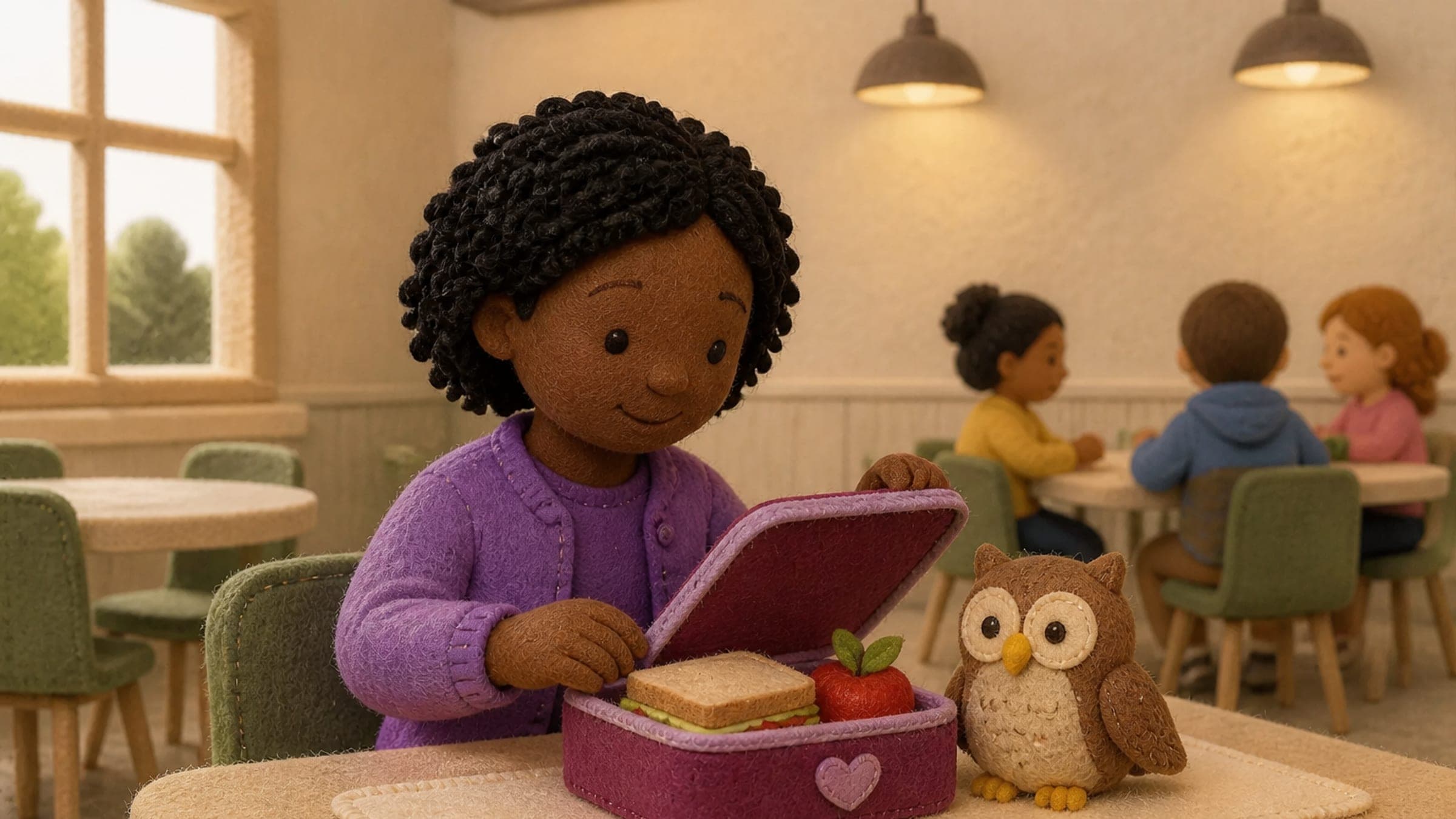
In the story, Maya wants company and keeps aiming at the loudest table. Her stuffed owl, Newton, tells her to look for the kid sitting on their own instead — because that kid is hoping someone will ask too. Maya tries one line, "Can I sit here?", and the other child says yes, relieved. If the answer had been no, the next page is the next open seat, not the conclusion that nobody likes her.
Then the read-aloud has a job outside the book: name your child's real line, and their real fallback, and have them say both out loud once before they close the cover. A story that ends at the last page is entertainment. A story that hands them one sentence for tomorrow is preparation.
Keep reading: if the goal is a first friendship rather than a seat, see how this approach helps a child make a first friend.
More related guidance:
- The First Day of School? A Story That Turns Jitters Into Excitement
- Scared of Getting an Answer Wrong? A Story That Makes Speaking Up Safe
- Going to the Resource Room: A Story About Useful Support
- Learning English as a New Language: A Bilingual Pride Story
- Personalized Story Ideas Hidden in Everyday Family Moments