Story ideas
How do you prepare a nervous child for their first school bus ride?
Prepare a nervous child for the school bus: rehearse the stop, the boarding rules, and the ride home, and ask the school what a story can't answer.
The short answer
Ask what the child is worried about, then rehearse the real stop before the first morning. NHTSA says to arrive five minutes early and wait ten feet, five giant steps, from the curb. Get the ride-home plan from the school: the bus number, the stop, and who will be there. A story can rehearse that plan. It cannot replace the school's rules or a health or IEP transportation plan.
Key takeaways
- Ask what the worry actually is: the big kids, where to sit, the driver, or getting home. Each one needs a different plan.
- Rehearse the real stop before the first morning. NHTSA says to arrive five minutes early and wait ten feet, five giant steps, from the curb.
- Get the afternoon plan from the school, not from a guess: the bus number, the stop, and who meets the child.
- A story can rehearse the stop, the steps, and the ride home. It cannot replace the school's bus rules or a health or IEP transportation plan.
How do you prepare a nervous child for their first school bus ride?
Find out what the child is actually worried about. Rehearse the real stop and the boarding steps before the first morning. Then say the ride-home plan out loud, with the real bus number and the real person who will be there.
This page is the bus itself: the stop, the steps, the seat, and the trip home. It is not the whole first day of school, where the job is the classroom, the goodbye, and pickup. If the child rides a bus for the first time on that day, use both.
The American Academy of Pediatrics notes that many children get nervous about new situations, and that it can help to rehearse heading into one. Its back-to-school list asks families to review the basic rules and practice any new route or mode of transportation, and to find another child in the neighborhood to ride the bus with (Back-to-School Tips for Families).
That is the tone to borrow. "You'll be fine" gives a nervous child nothing to hold. A plan they have already walked through does.
What is a nervous child actually worried about on the bus?
Ask before you plan. AAP suggests asking a nervous child what they are worried about and helping them problem-solve ways to handle the new situation (Back-to-School Tips for Families). The answer changes what you rehearse.
| What they say | What is usually underneath | What to rehearse |
|---|---|---|
| "The bus is too big." | The steps, the noise, the size up close | Climbing the steps with the handrail, and where to sit |
| "The big kids will be there." | Not knowing anyone | A neighbor to ride with, and a seat plan |
| "What if I get on the wrong bus?" | Losing track of the right one | The bus number, said and pointed to |
| "What if it doesn't bring me home?" | The afternoon, not the morning | The ride-home plan and who will be at the stop |
| "What if I drop something?" | Not knowing what to do near the bus | Tell the driver. Never pick it up. |
The table is editorial sorting, not a clinical tool. If the worry is really about being apart from you all day, the first day of school covers the goodbye.
How do you rehearse the bus stop before the first morning?
Go to the real stop at a quiet time and practice where to stand. NHTSA's parent tips are specific enough to rehearse word for word (School Bus Safety).
- Visit the stop ahead of time. NHTSA suggests visiting the bus stop before the new school year and showing the child where to wait.
- Count the five giant steps. NHTSA says to wait at least ten feet, five giant steps, away from the curb. Let the child count them out.
- Practice the timing. NHTSA says the child should arrive at least five minutes before the bus. Leave on time the morning of the rehearsal, too.
- Name the stop rule. NHTSA reminds children that the bus stop is not a place to run or play. Make it a calm spot, not a scolding.
- Practice crossing if they need to. AAP asks families to have the child actually practice crossing the street several times before the first day and to look both ways, just in case someone does not stop (Back-to-School Tips for Families).
What bus rules should a young child practice?
Keep it to a short list the child can say back. Most of the danger is outside the bus, so most of the rules are too.
NHTSA calls the school bus one of the safest vehicles on the road and says less than 1% of traffic fatalities involve children on school transportation vehicles. It also says children are more at risk when approaching or leaving the bus (School Bus Safety). That is why the rehearsal spends most of its time at the stop and the door.
- Wait for the stop, the door, and the driver. NHTSA says to wait until the bus comes to a complete stop, the door opens, and the driver says it is okay to get on or off (School Bus Safety).
- Use the handrail. NHTSA says to use the handrails to avoid falling (School Bus Safety).
- Stay where the driver can see you. AAP says the child should walk where they can see the driver, which means the driver can see them too (Back-to-School Tips for Families).
- Never walk behind the bus. If the child must cross in front, NHTSA says to walk at least ten feet, five giant steps, ahead of the bus and make eye contact with the driver before crossing (School Bus Safety).
- If you drop something, tell the driver. NHTSA says not to pick it up, because the driver might not see the child (School Bus Safety).
- Once you sit, stay seated. AAP says the child should not move around on the bus, and should use a lap/shoulder belt at all times if the bus has one (Back-to-School Tips for Families).
If a child asks why there is no seat belt, NHTSA's answer is plain: large school buses protect riders with strong, closely spaced seats with energy-absorbing backs, which it calls compartmentalization. Small school buses must have lap or lap/shoulder belts (School Bus Safety). Follow your district's rules about which bus your child rides.
How do you plan the ride home?
Get the afternoon plan from the school, then say it the same way every time. For a lot of young children, "Will it bring me home?" is the real question.
None of the sources on this page publishes a rule for who must meet a young child at the afternoon stop, or what happens if a child misses it. Those rules come from the school or district, so ask before you promise anything.
- Ask the school for the bus number and stop name. Write the number where the child can see it, and practice finding it.
- Ask who meets them. Name the real person: "Grandma will be at the stop." Do not promise it if it is not settled.
- Ask what happens if something goes wrong. A missed stop, a late bus, nobody at the stop. Tell the child only the part the school confirms, in one line, such as "If nobody is at the stop, stay on the bus and tell the driver."
- Find a bus buddy if you can. AAP suggests finding another child in the neighborhood to ride with (Back-to-School Tips for Families).
- Decide about day one. AAP says that if you feel it is needed, you can drive or walk your child to school and pick them up on the first day (Back-to-School Tips for Families). The bus can start on a later day.
If finding a seatmate is the bigger worry, making a first friend covers that step. If older kids on the bus start picking on your child, that is no longer first-ride nerves. AAP notes that bullying can happen on the school bus (Back-to-School Tips for Families), and being bullied covers what to do next.
What if my child has a health condition or an IEP?
Plan this with the school before the first ride, not in a bedtime story.
AAP says that if a child has a chronic condition that could lead to an emergency on the bus, families should work with the school nurse or other school health staff on a bus emergency plan, ideally before the first day. It also asks families to check the school's policy on food on the bus, because eating on the bus can be a problem for students with allergies (Back-to-School Tips for Families). For a child who carries epinephrine, living with a food allergy covers the wider school plan.
For a child with a disability, transportation can be part of special education. Under the Individuals with Disabilities Education Act regulations, "related services" include transportation, which covers travel to and from school and specialized equipment such as special or adapted buses, lifts, and ramps when required (Sec. 300.34 Related services). Whether a particular child receives it is decided by their IEP team. Ask them what the bus, the seat, and the adult support will look like, then preview only that. For a child who uses a mobility device, using a wheelchair, walker, or prosthetic covers how to talk about access.
What can a personalized story do before the first bus ride, and what can't it do?
A story helps in a calm hour as a rehearsal of the real stop, the five giant steps, the handrail, the seat, and the ride home. It does not teach traffic safety on its own, and it does not stand in for the school's rules.
The names below are invented for illustration. In a real personalized book, the hero is your own child, built from your own photo.
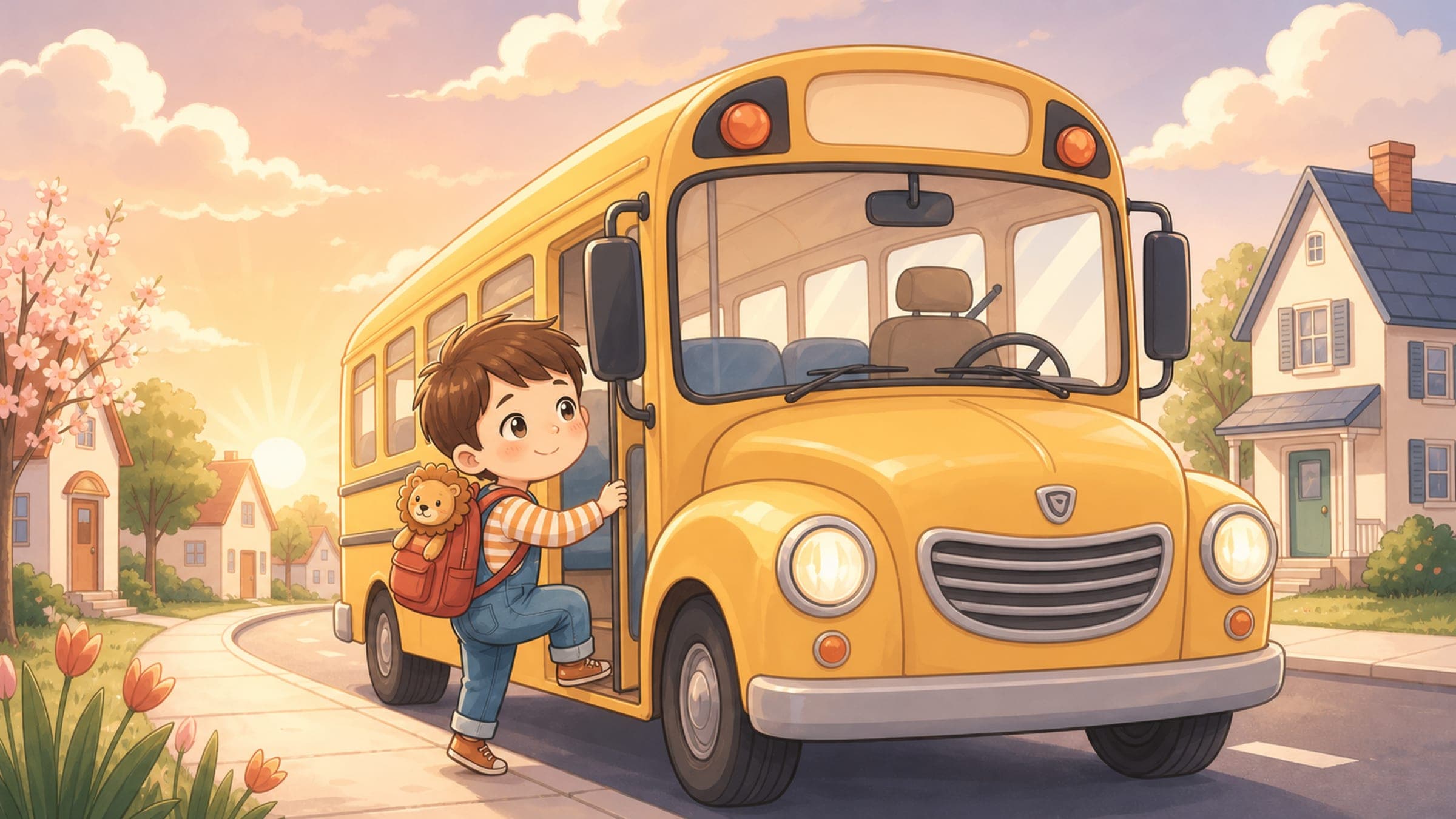
In the story, Owen and his dad count five giant steps back from the curb at the corner stop. The bus comes, stops, and opens its door. Owen waits until Ms. Green, the driver, waves him on. He holds the handrail, climbs up, and sits next to Maya from down the street. In the afternoon the bus stops at the same corner, and Dad is standing right where he said he would be. On one page Owen's mitten falls by the wheel, and he does not reach for it. He tells Ms. Green. The last page is not "and he was never scared again." It is Owen knowing where to stand, who to tell, and who will be at the stop.
After reading, go to the real stop and count the five giant steps together. Doing the plan once in real life is what makes it the child's.
How the studio keeps the story on your child's real route
On the Plot Outline step, the studio asks you to tell it what happened and notes that a few sentences is enough. Write the real stop, the bus number, the driver's name if you know it, the bus buddy, and who meets your child in the afternoon. On the Voice step you set the tone and choose whether it rhymes. Once the book is finished, the review screen's edit mode lets you change page text, so you can remove any line that shows a child running at the stop or promises that nothing ever goes wrong.
For more everyday moments that can hold a small rehearsal like this, see personalized story ideas in everyday family moments.
Keep reading: the bus is one first-time leap; the pool is another — see how the same approach helps a child scared to put their face in the water.
More related guidance:
- Starting a New School Mid-Year: A First-Week Story
- Struggling to Read? A Story That Protects a Child's Confidence
- Eating Lunch Alone: When It's Normal and When to Tell the School
- Afraid of a Wrong Answer in Class? Separate It From Worth
- Personalized Story Ideas Hidden in Everyday Family Moments