Story ideas
How do you help a child who is afraid of getting an answer wrong in class?
Help a child who won't raise a hand for fear of being wrong. Praise the try, script tonight, plan with the teacher. A story rehearses. It cannot treat anxiety.
The short answer
Separate the wrong answer from your child's worth. Praise the try, not only the right call. After a miss, take the feeling seriously, skip the teasing, and name one small next try. Make a participation plan with the teacher so they are not cold-called into panic. A story can rehearse a wrong answer staying ordinary. It cannot diagnose anxiety, treat it, or promise they will love raising a hand after one book.
Key takeaways
- A wrong spoken answer is a classroom moment, not a measure of the child.
- Praise the try. Keep home free of teasing about the miss.
- After a wrong answer, take the feeling seriously, then name one small next try.
- Ask the teacher for a small participation plan. Do not leave them to white-knuckle cold-calls.
- A story can rehearse a miss staying ordinary. It cannot diagnose or treat anxiety.
How do you help a child who is afraid of getting an answer wrong in class?
Separate the wrong answer from your child's worth. Praise the try. After a miss, take the flush of embarrassment seriously, skip the teasing, and pick one small next try. Ask the teacher for a participation plan so they are not surprised into panic.
This page is that classroom job: a child who sits on their hands because a wrong spoken answer, in front of the room, feels like proof they are not smart. It is not raising their hand, which is shyness — a wobbly voice, all those eyes — when they already know the answer. It is not terrified of making a mistake, which is broader perfectionism: crumpling a drawing, quitting a new game, refusing anything that will not come out right. Keep those pages separate. A classroom miss is not a crumpled picture. A shy first hand-raise is not the same fear as "what if I am wrong."
The American Academy of Pediatrics is blunt about mistakes. A child needs to feel comfortable, not defeated, when they get something wrong. Setbacks are a normal part of living and learning. Supportive feedback and recognition of effort can overpower a sense of failure, guilt, or shame and give renewed motivation. Praise the try, not only the finished goal, and be specific: "Good try — you're working harder" (Building Blocks for Healthy Self Esteem in Kids).
Your job tonight is smaller than "make them love speaking up." Name the miss. Name that it does not measure them. Name one next try they can survive. A story can walk a character who looks like them through that same miss. It cannot diagnose why the hand stays down, treat an anxiety disorder, or promise they will volunteer after one book.
How do you separate a wrong answer from your child's worth?
Change what the miss means before you change the child. If a wrong answer is treated as a verdict, sitting on their hands is a rational defense.
The AAP's self-esteem page puts mistake-handling on the same list as belonging and competence. Children need to feel they can meet challenges, and they need expectations that are not too low and not too high. Overprotection makes them too dependent. Goals they can never reach leave them feeling powerless. When they miss, they need to feel comfortable, not defeated, and they need to hear that they can learn from the miss. If you make a mistake yourself, share what happened so they can watch you move past it (Building Blocks for Healthy Self Esteem in Kids).
The AAP's anxiety page adds the school-pressure line. It is ordinary for a child to feel anxious before a test or when talking in front of a group. If you think they are upset by pressure to do well in school, tell them they are doing a good job and that you are proud of them. Help them set realistic goals. Goals that are too hard to meet can make them feel worse about themselves (Help Your Child Manage Anxiety: Tips for Home & School).
Child Mind Institute's academic-anxiety page is the same effort rule from a second publisher: focus on effort, not perfection, and praise persistence, not just grades (When School Stress Is Too Much: Supporting Kids With Academic Anxiety).
- Name the miss as information, not a verdict. "The answer was off. That is how we find the right one. It does not mean you are not smart."
- Praise the try in their words. The AAP's examples are specific and close to the moment: "Good try — you're working harder." "I like the way you waited." Do not wait for a perfect recitation.
- Keep home free of teasing. Child Mind's embarrassment page is plain: do not mock mistakes or poke fun at embarrassing incidents, even gently. Ridicule teaches a child to attach shame to a small miss (How to Help Kids Deal With Embarrassment).
- Share one of your own misses, then stop. The AAP asks you to model moving past a mistake. Child Mind adds: stay calm, do not obsess, and do not compare your disaster to theirs.
- Lower the goal if it is a trap. "Be right every time" is not a plan. "Raise a hand for one question you are sure of" is.
The numbered script is editorial sorting. The AAP pages name effort-praise, realistic goals, and modeling. Child Mind names no-teasing and effort over grades. None of them publish a dinner-table protocol.
If the hard part is a skill, not a spoken miss — they cannot get the words off the page — that is struggling to read or going to the resource room. This page stays with the feared wrong answer.
What do you say the night after they got one wrong?
Take the feeling seriously. Then move. Do not throw a party, and do not file a complaint with the class.
Child Mind's embarrassment page uses this exact classroom miss as the example that sounds small to a grown-up and huge to a child: giving the wrong answer in class. Do not dismiss it. Do not get angry on their behalf. Do not heap more attention on the moment. Validate, then praise a coping move — they stayed in the chair, they tried again, they told you — and offer perspective without comparing. Let them take the lead if they do not want to talk (How to Help Kids Deal With Embarrassment).
The AAP's anxiety page gives you a line you can practice when they are calm, not in the doorway: positive self-talk such as "I can try this" instead of "I can't do this," plus thinking ahead about what to do in a stressful situation. Praise and reward brave behavior. The goal it names is to cope, not avoid (Help Your Child Manage Anxiety: Tips for Home & School).
- Open with the feeling, not a fix. "That miss felt big. I believe you."
- Ask one question, then wait. "What was the worst part — the wrong words, the faces, or the quiet after?" If they do not want to talk, stop. Child Mind says not to push.
- Praise a real coping move. Staying in the chair. Telling you. Trying the next problem on paper. Not "you were so brave you did not even care."
- Give one piece of perspective, once. Child Mind's line is that most kids have moved on by the next day, even when it still feels like front-page news to them. Do not stack stories about your own worse days.
- Pick tomorrow's small try before you close the talk. One sure question. A written answer first. A signal to the teacher. Not "just raise your hand more."
Write down what they said, in their words. A vague "they're just shy" evaporates by morning meeting. A dated note — the miss, the feeling, the next try — is what you take to the teacher if the hand stays down.
If the laugh in the room was not a one-off, and the same kids keep humiliating them, that is being bullied. Child Mind draws that line: sporadic embarrassment is ordinary; regular teasing or humiliation, especially from bigger or "popular" kids, is a reason to step in (How to Help Kids Deal With Embarrassment). This page does not treat one wrong answer as bullying.
How do you make a small participation plan with the teacher?
Do not leave a terrified child to white-knuckle cold-calls. Ask for a smaller on-ramp.
The AAP's school-anxiety list starts with the adults in the building: talk with the teachers and the guidance counselor. Remind your child they can think ahead about a stressful moment. Help them set realistic goals. Reward brave behavior at school — time with you doing something fun is the reward that page names (Help Your Child Manage Anxiety: Tips for Home & School).
Child Mind's academic-anxiety page puts teachers on the same side: stay in touch so you can see how the worry shows up at school. In the classroom, even small changes help — clear instructions, safe chances to ask questions, and predictable routines. Do not reinforce avoidance. Letting a child skip the thing that scares them makes the anxiety stronger (When School Stress Is Too Much: Supporting Kids With Academic Anxiety).
| Move | What it is for | What it is not |
|---|---|---|
| One volunteered sure question | A try they can survive | A promise they will love being called on |
| Teacher holds cold-calls on hard items this week | Time to practice the sure question | A permanent pass on speaking |
| Written answer, then spoken | A ramp into the room | Proof they are "too sensitive" for class |
| "Good try — let's think together" | Effort language the AAP already named | A guarantee classmates will stay kind |
| Fun time with you after a real try | The AAP's reward for brave school behavior | A prize for staying silent |
The table is editorial sorting. The AAP names teacher talks, realistic goals, and rewarding brave school behavior. Child Mind names teacher contact, safe question-asking, and not feeding avoidance. Neither publishes a cold-call protocol or a "written first" rule. Ask the teacher what they can actually do. Write that down. Put the real plan in the story. Do not invent a private signal the classroom will not use.
If the later hard part is the first week of a new building, that is the first day of school. If it is walking into a class that already has a rhythm, that is starting a new school mid-year. This page stays with the feared miss.
What if they still sit on their hands even when they know it?
Shrink the try. Do not bargain them into a speech.
The AAP's fear-management list, used when a child is calm, is gradual: face the feared activity in small steps, practice a short coping line, and praise the coping, not a perfect performance. The goal is to cope, not avoid (Help Your Child Manage Anxiety: Tips for Home & School). Child Mind's parent list is the same shape: break the task into smaller steps, praise persistence, and do not let skipping the scary moment become the plan (When School Stress Is Too Much: Supporting Kids With Academic Anxiety).
- Confirm they know the answer. A child who does not know is not in a participation fight. They need the lesson, or reading support, not a pep talk.
- Cut the audience. Partner talk, a written card, or answering the teacher at the desk is a smaller room than the whole rug.
- Use one sure question, once. The AAP's realistic-goal line is the warrant. "Share one thing you are sure of" is a goal. "Be the kid who always knows" is not.
- Practice the coping line at home, once. The AAP's example is "I can try this." Use their words if they have better ones. Then stop drilling.
- Stop the session if fear is stacking. Three shutdowns in one morning meeting is a pile-up. Go back to the teacher plan. Do not add a fourth cold-call because a book said they would feel proud.
Child Mind describes a clinical exposure step — in group therapy, a clinician may have a child purposely give a wrong answer in front of peers until the miss feels manageable (When School Stress Is Too Much: Supporting Kids With Academic Anxiety). That is treatment. It is not a homework assignment, and it is not a plot you should write into a picture book as a dare.
When is a wrong-answer fear a story job, and when do you call the teacher or pediatrician?
A story helps in a calm hour, as a rehearsal of a miss that stays ordinary. It does not help as a diagnosis, and it does not run the classroom.
Ordinary nerves before being called on, a tight tummy the night after a miss, and a child who needs the feeling taken seriously are the pattern the AAP already called normal: anxious before a test or when talking in front of a group (Help Your Child Manage Anxiety: Tips for Home & School). Child Mind draws the same everyday line: a tough test or a presentation can bring ordinary stress that fades when the moment is over (When School Stress Is Too Much: Supporting Kids With Academic Anxiety).
A story cannot diagnose social anxiety, academic anxiety, or any other condition. Child Mind is explicit that "academic anxiety" is not itself a clinical diagnosis — it is anxiety triggered by school demands — and that when the fear centers on performance, such as speaking in class, a clinician may consider social anxiety. That is their sorting, not yours and not a book's (When School Stress Is Too Much: Supporting Kids With Academic Anxiety). CDC's children's mental-health page is the action line: fears and worries are typical; persistent or extreme fear that interferes with school, home, or play is the point to talk with a health care provider. The first step it names is a primary care provider or a mental-health specialist, not a picture book. Under anxiety, it lists social anxiety as being very afraid of going to places where there are people, such as school. Some anxious children keep the worry to themselves, so the quiet can be missed (Anxiety and Depression in Children).
Call the teacher when the hand stays down for weeks, when they ask to see the nurse during the same subject, or when you need a real participation ramp. The AAP already put the teacher and guidance counselor on that list, and it says to get back in touch with the doctor if the anxiety does not go away or gets worse — including when shyness shows up as a new behavior problem, or when you want help deciding whether a specialist visit may help. Cognitive behavioral therapy is the example that page names (Help Your Child Manage Anxiety: Tips for Home & School). Child Mind's embarrassment page adds persistent avoidance as a concern: frequently too sick for school, the nurse during one class, cutting class, or refusing school (How to Help Kids Deal With Embarrassment). One flushed Wednesday is not that pattern. A child who cannot use the school day because a wrong answer feels unsurvivable might be. This page does not diagnose it.
The names below are invented for illustration. In a real personalized book the hero is your own child, built from your own photo.
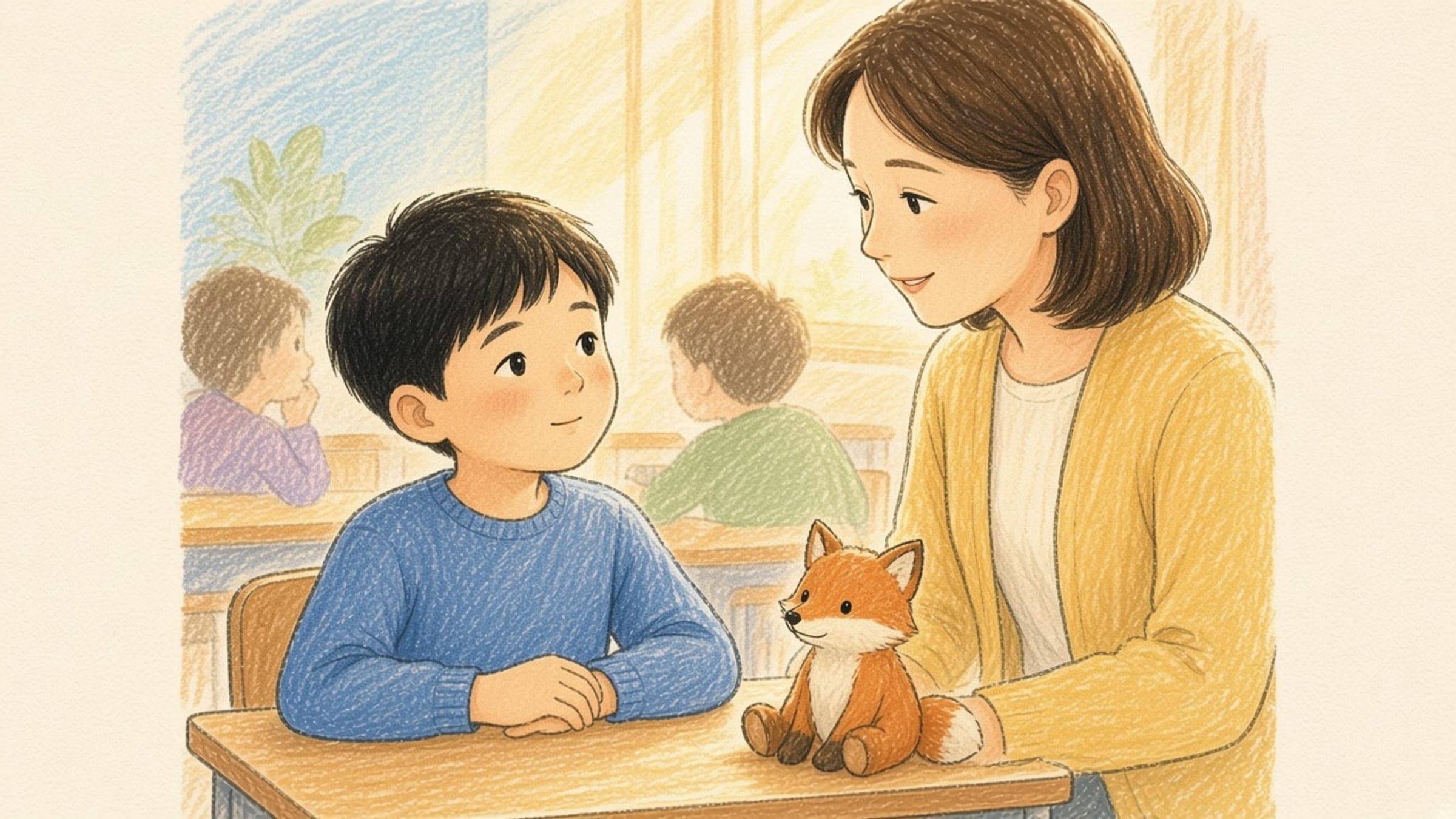
In the story, Jun knows the answer and still sits on his hands. His stuffed fox, Nori, does not make the class clap. Nori names the miss as information, the teacher's "good try — let's think together," and one sure question for tomorrow. The last page is not "and then he loved being wrong." It is Jun staying in the chair after a miss, then raising a hand for the one question he picked.
Then the read-aloud has a job outside the book: say the real class, the real teacher plan, and the real next try, and have them say the coping line out loud once before you close the cover. A story that ends at "they loved speaking up" is entertainment. A story that hands them tomorrow's one question is preparation.
How the studio keeps the rehearsal specific
The Plot Outline step asks a plain question — "What should happen in the story?" — as a free-text box, with the guidance that a few sentences is plenty. That is where the real miss, the real "good try" line, and the real next question go, in your child's words, rather than a generic "became brave in class" last page. The story requires you to name one Story hero. On the Story step you review the complete written story before illustrating the opening pages, and you can use edit mode if a promised overnight love of raising a hand slipped in.
Do not write a last page where one book makes them adore being called on. Write a last page where the miss stayed ordinary, the try was praised, and tomorrow's question was already picked.
For other everyday moments that can hold a rehearsal like this, see personalized story ideas in everyday family moments.
Keep reading: if the hard part is shyness, not a feared miss, start with raising their hand.
More related guidance:
- Learning English as a New Language: A Bilingual Pride Story
- Moving Up to Middle School? A Story That Turns Nerves Into Readiness
- Nervous to Ride the School Bus? A Story That Eases the First Ride
- Eating Lunch Alone: When It's Normal and When to Tell the School
- Personalized Story Ideas Hidden in Everyday Family Moments
Sources
-
Building Blocks for Healthy Self Esteem in Kids — American Academy of Pediatrics
-
Help Your Child Manage Anxiety: Tips for Home & School — American Academy of Pediatrics
-
Anxiety and Depression in Children — Centers for Disease Control and Prevention
-
When School Stress Is Too Much: Supporting Kids With Academic Anxiety — Child Mind Institute
-
How to Help Kids Deal With Embarrassment — Child Mind Institute