Meaningful gifts
How do I teach my child to tell time?
How to teach a child to tell time: what ages most kids learn it, the order to teach it (hour, half hour, five minutes), a homemade clock, and daily practice.
The short answer
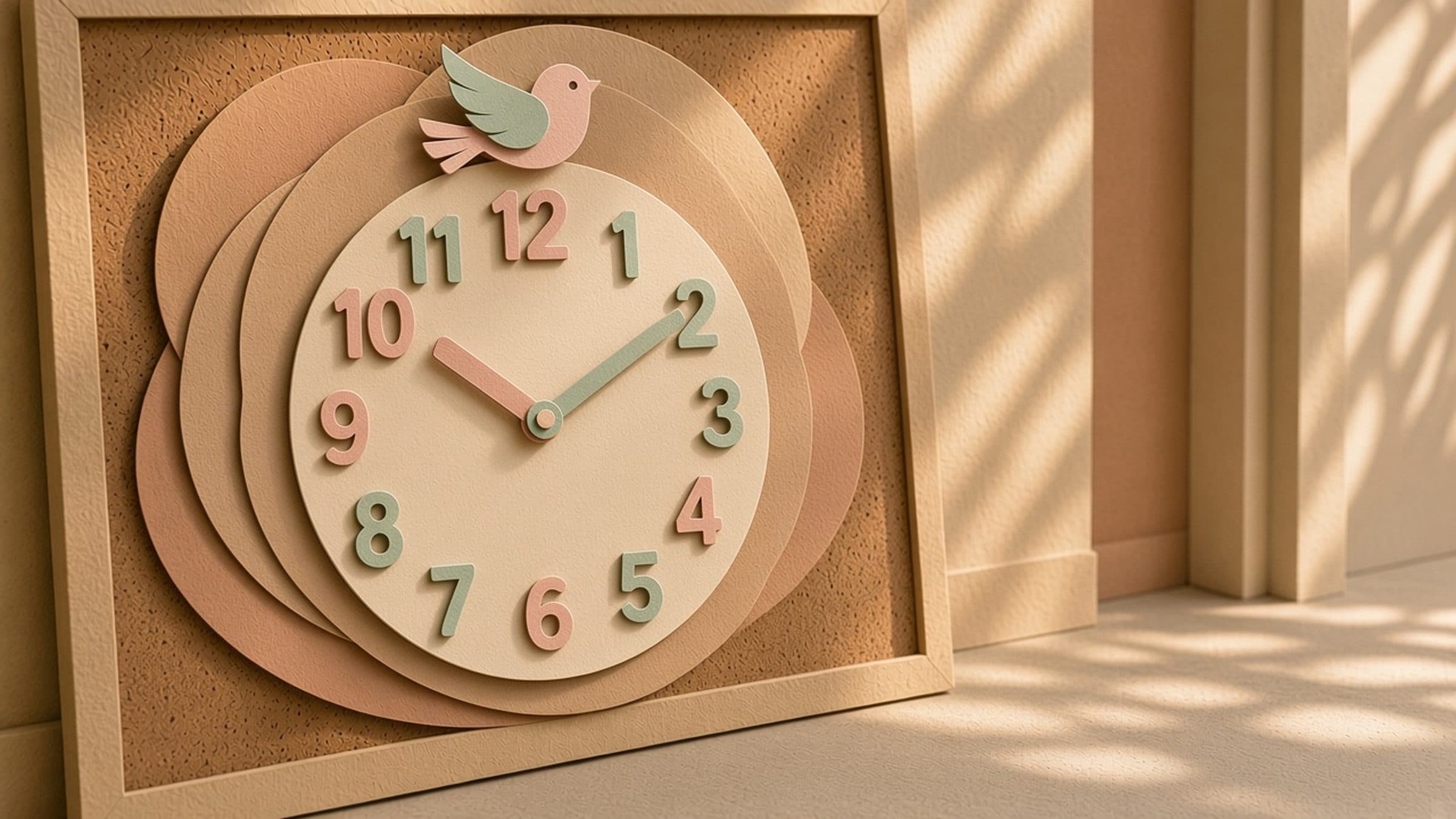
Start with time words and routines in preschool, then teach the hour hand alone, then half past, then counting by fives for the minute hand. U.S. school standards introduce hours and half hours in first grade and five-minute intervals in second grade, so most children read an analog clock around ages 6 to 7.
Teach telling time in steps: time words first, then the hour hand on its own, then half past, then the minute hand counted by fives. In U.S. schools, first grade covers hours and half hours and second grade covers five-minute intervals, so most children read an analog clock around ages 6 to 7.
Key takeaways
- Preschoolers need words like before, after, morning and night first.
- Teach the short hand alone before adding the long hand.
- Counting by fives is the key skill for minutes.
- Daily, real moments beat worksheets.
What comes before the clock
Preschoolers live by sequence, not minutes. Build the vocabulary that clocks rely on: morning, afternoon, evening, yesterday, tomorrow, before, after, soon, later. Talk through the day in order ("first breakfast, then the park, then lunch"). A picture schedule on the wall shows the sequence. Visual timers that show time shrinking as a colored wedge help a 4-year-old feel how long "five minutes" is.
The order to teach it
1. The hour hand alone. Use a clock or drawing with only the short hand. When it points at 3, it's three o'clock. When it's between 3 and 4, it's "after three." This removes the hardest part, two hands moving at different speeds.
2. O'clock with both hands. Add the long hand pointing straight up at 12. Explain that when the long hand is at the top, we say "o'clock."
3. Half past. The long hand points straight down at 6. The short hand sits halfway between two numbers. Fold a paper circle in half to show "half" of the hour.
4. Counting by fives. Before minutes make sense, children need to skip-count to 60 by fives. Practice on fingers, on stairs, or with a song. Then show that each number on the clock stands for five minutes.
5. Quarter past and quarter to. Fold the paper circle into quarters. Some families skip "quarter to" at first and say "forty-five" instead.
6. Single minutes. The small tick marks come last, usually in second or third grade.
Make a clock together
Cut a paper plate circle, write 1 to 12 around the edge, and fasten two paper hands with a brad so they turn. Make the hour hand short and one color, the minute hand long and another. Color the space between each number to show the five-minute chunks. Children remember a clock they built better than a bought one.
Practice in real life
- Call out the clock at moments that matter: "The long hand is on 6, so it's half past. Bath time."
- Ask, then check. "What time do you think it is?" Then look together.
- Set times for treats. "When the short hand is on 4 we'll go outside."
- Hang an analog clock where your child can see it at eye level.
- Use both clocks. Put a digital clock next to an analog one so your child can match them.
Digital or analog first?
Digital time is easier to read but harder to understand. "3:45" says nothing about how close 4 o'clock is. The analog face shows time passing as distance, which builds number sense. Most teachers suggest teaching both, with analog for meaning and digital for reading.
Common sticking points
- Mixing up the hands. Call them by color or by "hour hand" and "minute hand," never just "the hands."
- Reading the hour too early. At 2:50 the short hand is almost on 3, and children say "three." Show that the hour stays 2 until the long hand reaches the top.
- Saying "half past" and "thirty." Both are right; let your child know they mean the same thing.
How long it takes
Expect months, not weeks. Children who are still working on counting by fives aren't ready for minutes yet. A few minutes a day over the school year works better than a long weekend push. If your child struggles with numbers in general, ask the teacher which skills to practice first.
Games that make it fun
- What time is it, Mr. Wolf? Children call out times and take that many steps.
- Clock match. Write times on cards and have your child set the paper plate clock to match.
- Beat the timer. Set the clock hands for when a tidy-up should end and check together.
- Time detective. On a weekend, ask your child to tell you when it's 11 o'clock for a snack.
Talking about elapsed time
Once your child reads the hour, start asking "how long until?" questions. "It's 2 o'clock. The party is at 4. How many hours is that?" Count the hours forward on the clock face with a finger. This is harder than reading a time, so keep it light, and don't expect it to stick right away.
Long before reading a clock, preschoolers learn plenty of other firsts. For ages about 1 to 5, the milestones book prints a story around the ones you choose, after you approve a proof. Flip through an example, or read gift ideas for grandparents.
Also useful:
Sources
- Common Core State Standards, Grade 1 Measurement and Data (1.MD.B.3), Common Core State Standards Initiative, accessed November 3, 2026
- Common Core State Standards, Grade 2 Measurement and Data (2.MD.C.7), Common Core State Standards Initiative, accessed November 3, 2026