Meaningful gifts
How do I teach my preschooler to count?
How to teach a preschooler to count: rote counting vs counting objects, one-to-one correspondence, knowing how many, typical ages, and games for number sense.
The short answer
Counting has three parts: saying number words in order, touching one object per number, and knowing the last number tells how many. Many 3-year-olds count a few objects, and by the end of kindergarten U.S. standards expect children to count to 100 by ones and tens and to count up to 20 objects.
Counting is really three skills: reciting number words in order, touching one object for each number, and understanding that the last number said tells how many there are. Many 3-year-olds count a few objects, and by the end of kindergarten U.S. standards expect children to count to 100 and to count out up to 20 objects.
Key takeaways
- Reciting "one to ten" is not the same as counting things.
- Touching each object once is the skill to practice most.
- Ask "how many?" after counting to build the idea of quantity.
- Real objects beat flashcards for children under 5.
The three parts of counting
Rote counting. Saying the number words in order, like a song. A 2-year-old might "count" one, two, five, eight, which is normal; they know counting has a rhythm.
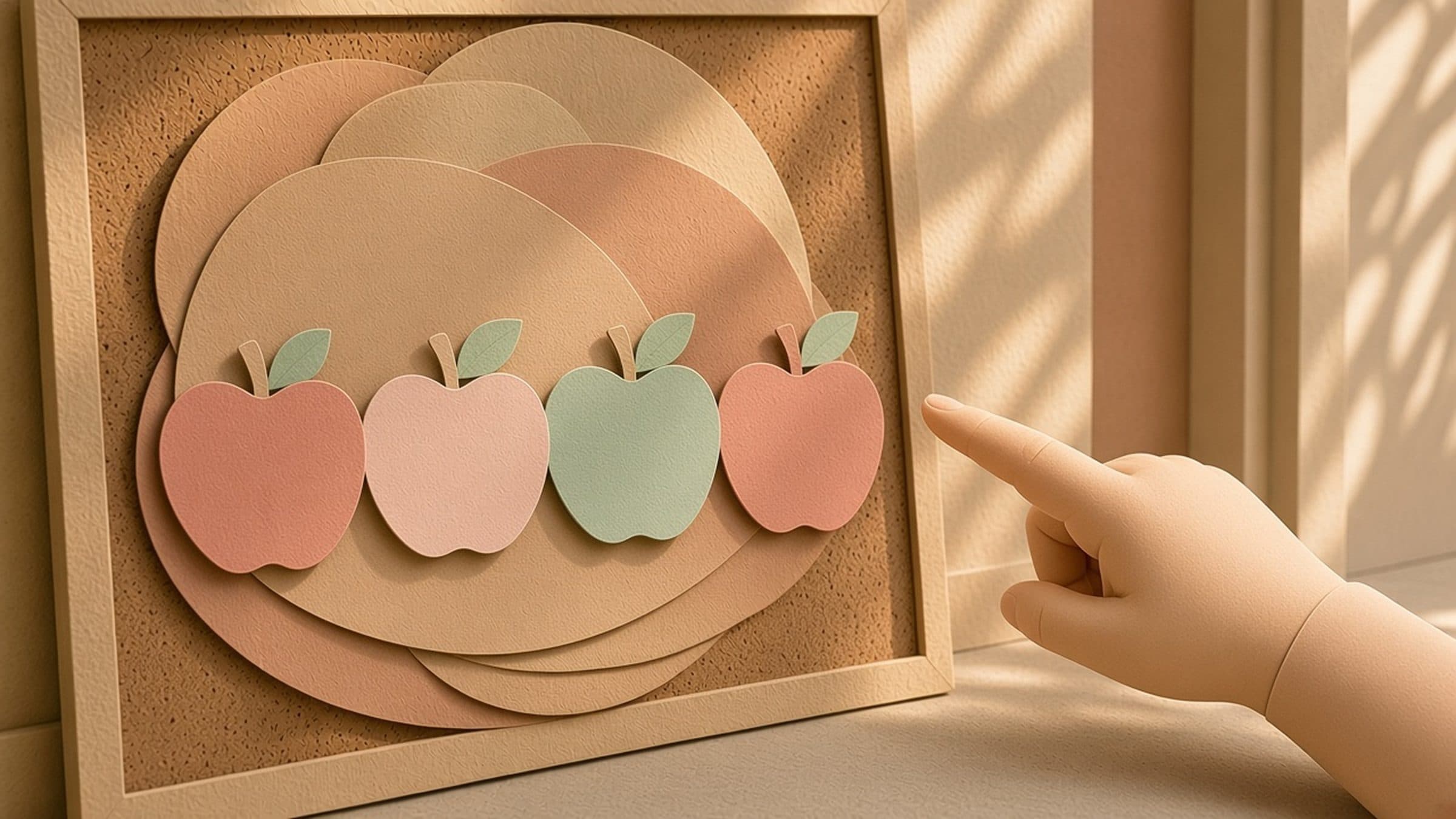
One-to-one correspondence. Pointing to or moving one object for each number word. This is the hard part. Young children skip items, count one twice, or keep talking after they run out of things.
Cardinality. Knowing that the final number answers "how many?" Ask a 3-year-old to count four blocks, then ask how many there are. Many will count again instead of saying "four." That's a sign they're still building this idea.
Typical progression
- Ages 2 to 3: Say some number words; may count two or three objects.
- Ages 3 to 4: Count up to about five objects accurately; recognize small groups of two or three without counting.
- Ages 4 to 5: Count ten or more objects; begin to write some numerals; compare which group has more.
- Kindergarten: The Common Core standards ask children to count to 100 by ones and tens, write numbers 0 to 20, count up to 20 objects, and compare groups.
Children vary a lot. Use these as a rough map, not a test.
Activities that build each skill
For one-to-one:
- Count stairs as you climb, one step per number.
- Set the table together: one spoon for each person.
- Drop pom-poms or coins into a jar, saying a number with each clink.
- Line up toy cars and touch each roof as you count.
For cardinality:
- After counting, ask "So how many cars?" and celebrate the answer.
- Ask for amounts: "Can you bring me three socks?"
- Play "hide and count": put four blocks under a cup, peek, then hide again. How many are under there?
For number words and order:
- Count down for a rocket launch.
- Sing counting songs and rhymes.
- Count claps, jumps, and spins.
Board games help
Simple path games where you roll a die and move a token build counting, number recognition, and turn-taking at the same time. They also show a child that bigger numbers mean farther along the path, which links counting to size and distance. A homemade path drawn on paper with numbered squares works just as well as a store game.
Seeing small amounts at a glance
Recognizing two or three items without counting, called subitizing, is a building block for adding. Show dot patterns on dice, dominoes, or fingers briefly and ask how many. Use the same patterns often so they become familiar.
Mistakes to welcome
When your child skips an object, don't stop the count. Count again together, slowly, touching each item. Move counted items to a new pile so nothing gets counted twice. Praise effort and strategy ("You touched each one!") more than the right answer.
Beyond ten
The teen numbers are tricky in English because "eleven" and "twelve" don't sound like "ten and one." Point out that 13 is "ten and three." A hundreds chart on the wall helps children see the pattern of tens later on.
When to ask for advice
If your 4-year-old can't count any objects, or you're worried about language, attention, or learning more broadly, mention it at the next well-child visit. Your pediatrician can check against developmental milestones and suggest next steps.
Counting in daily routines
Fold counting into what you already do:
- Count snaps as you fasten a coat.
- Count toys back into the bin at cleanup.
- Count cars of one color on a drive.
- Count claps before a song starts.
Short moments add up. Five or six chances a day matter more than one sit-down lesson.
Writing numbers
Writing numerals comes after counting objects. Start with tracing in sand, shaving cream on a tray, or chalk on the sidewalk, and focus on 1 to 5. Reversed numbers, like a backward 3, are very common until about age 6 or 7.
The first time they count the candles on their own cake can be worth keeping. For children about 1 to 5, the milestones book turns firsts you pick into a printed story you approve as a proof first. There is a sample to page through and a gift guide.
Next step:
Sources
- Common Core State Standards, Kindergarten Counting and Cardinality, Common Core State Standards Initiative, accessed November 3, 2026
- CDC's Developmental Milestones, Centers for Disease Control and Prevention, accessed November 3, 2026