Story ideas
How do you prepare a child for their first sleepover?
Sort yes from wait, pack a comfort plan, preview the night, and know what to say if homesickness hits. A story rehearses. It cannot force readiness.
The short answer
Do not start with a packing list. Start with whether this child wants the night. If they do, preview the house, pack one comfort object and a bedtime plan, and agree with the host on a pickup if homesickness hits. A story can rehearse that plan. It cannot make a child ready who is not asking to stay.
Key takeaways
- A first sleepover should be the child's idea. A long daytime playdate can be enough.
- If they want the night, preview the house, pack one comfort object, and keep a pickup plan with the host.
- Homesickness is ordinary. Name the feeling first, then use the plan. Coming home is allowed.
- A story can rehearse that sequence. It cannot diagnose anxiety or make an unready child stay.
How do you prepare a child for their first sleepover?
Do not start with a packing list. Start with whether this child wants the night.
A sleepover is not a slightly longer playdate. The games end, the house gets quiet, and they are asked to fall asleep in a bed that is not theirs. That is why the same child who begged to go can still want to come home at 10 p.m. Those are different jobs: deciding if tonight is the night, then giving them a plan they can use if missing home shows up.
Child Mind Institute psychologist Laura Kirmayer is blunt about the first gate: there is no age when a first sleepover suddenly becomes due, and it should be the child's idea, not a parent project. Long daytime playdates can be just as good (How to Help Kids With Sleepover Anxiety).
If they do want to stay, your next jobs are concrete. Preview the house. Pack one familiar comfort and a bedtime plan that can travel. Agree with the host — and with your child — that a pickup is allowed. A story can rehearse that sequence before the backpack is zipped. It cannot make an unready child ready.
When should you say yes to a first sleepover, and when should you wait?
Say yes when they are asking, they already know the house, and they have practiced a smaller night away. Wait when the invitation is doing the wanting for them.
Kirmayer's readiness check is practical, not mystical: have they ever spent a night away — a hotel, a relative, even the living-room floor? How tightly do they need their usual bedtime? Do they wake in the night, and can they settle without you? (How to Help Kids With Sleepover Anxiety).
The American Academy of Pediatrics gives the same kind of answer for a bigger overnight. On overnight camp, it says there is no hard-and-fast rule about the best age, and that most children are ready between 7 and 8 — after you have thought about their comfort being away from home and talked it through together (Choosing a Summer Camp). That is camp, not a friend's living room. Use it as a reminder that age alone is not the test. A first sleepover is the smaller step.
The AAP's separation-anxiety page tells you how to build that smaller step: practice being apart. Send them to a grandparent, schedule playdates, let a trusted adult take them for an hour on the weekend, and rehearse the goodbye before the real one (How to Ease Your Child's Separation Anxiety).
| What you are seeing | What it usually means | What to do next |
|---|---|---|
| They ask to stay, know the host, and have slept away once — even downstairs | A usable first sleepover | Preview the house. Pack the plan. Keep pickup open. |
| They want the pizza and the movie, then go quiet when you mention sleeping there | They want the evening, not the night | Offer a late pickup after the movie. Try the overnight another time. |
| They have never slept away from you, even at a grandparent's | The first night away is still too big | Practice a living-room campout, then a relative's house, then host a friend at home. |
| Missing you, or fear of the night, is taking over school, home, or play | The CDC's line for a health care conversation, not a packing list | Talk with their doctor. A story is not the next step. |
CDC's children's mental-health page draws that last line carefully: fears and worries are typical. Toddlers can become very distressed about being away from a parent even when they are safe. Persistent or extreme fear that interferes with school, home, or play is the point to talk with a health care provider (Anxiety and Depression in Children). One nervous Saturday is not that pattern. Dreading every night away, or every ordinary goodbye, might be.
If the hard part is falling asleep in their own bed at home, that is sleeping in their own room. If the hard part is a daytime goodbye with a known pickup, use the first day of school. This page stays with a night at someone else's house.
What do you say when you preview the night?
Talk when they are calm. Walk the real house, or the real plan, before the backpack is packed.
Kirmayer's preparation step is to name the specific worries and solve those, not "sleepovers." Where is the bathroom? Where do the adults sleep if they need help? What if they feel sick? What if they wet the bed? If they are used to reading in bed, say out loud that this house may not do that (How to Help Kids With Sleepover Anxiety).
The AAP's camp page asks you to talk openly about homesickness before the first night away: stay positive, and help them understand that missing home can show up even when they have been away before (Choosing a Summer Camp). A friend's house is shorter than camp. The feeling can still arrive when the lights go out.
- Confirm they still want the night. "You can go for the pizza and I can pick you up after the movie. Staying over is only if you want that part too."
- Walk the house, or describe it in order. Front door, bathroom, where they will sleep, where the grown-ups will be. A child who knows who to wake is less stranded.
- Name the missing-home feeling before it happens. "When the house gets quiet, you might miss us. That is allowed. It does not mean you made a mistake."
- Give the return in child time. The AAP tells parents to define a return in language a child can use — after breakfast, after two sleeps — and to keep that promise (How to Ease Your Child's Separation Anxiety).
- Say the pickup line once, without drama. "If you need to come home, you can. We will come get you. We will not be mad."
If the dark itself is the fear — at home, in their own bed — start with afraid of the dark and send the flashlight or nightlight along. Do not treat a first sleepover as the place to extinguish that fear.
What should you pack, and what plan goes with the bag?
Pack one comfort that already works at home, plus the information the host needs. Do not pack a new lovey for the occasion.
The AAP calls those familiar blankets and soft toys transitional objects. They are not a sign of weakness. When a child is tired, they help them sleep. When they are separated from you, they reassure. When they are in a strange place, they help the place feel like home. The same page suggests building the object into the nighttime ritual, and keeping a duplicate if you can, so one can be washed without a crisis (Transitional Objects).
AAP bedtime guidance is the same idea in a smaller frame: a quiet routine, a consistent bedtime, and a favorite thing in bed — a teddy, a special blanket, a toy that is safe to sleep with (Toddler Bedtime Trouble). You will not recreate the whole home routine at someone else's house. You can send the one object and the one quiet step that already means "sleep is coming."
- Pack the lovey they already use, not a new one. If you have a duplicate, send the one that smells like home and leave the spare on their bed.
- Add the bedtime piece that can travel. The book they always hear, a small flashlight, or the same pajamas. Ask the host whether a nightlight or a cracked door is fine.
- Pack a small family photo only if they asked for one. It is a reminder, not a test of how much they miss you.
- Tell the host the plan in one paragraph. Where they usually sleep, what they do if they wake, who they should find, and that you can come get them.
- If they worry about wetting the bed, make that plan discreet. A spare pair of pajamas in a zip bag, a pad the host already uses, and no announcement to the other kids. The shame-free version of that night lives on the bedwetting story guide.
If the invitation itself falls through — the friend gets sick, the parents cancel — that disappointment is a cancelled plan. Do not fold it into a lecture about being ready next time.
What do you say if homesickness hits?
Name the feeling. Use the plan. Be willing to drive.
Kirmayer's line for the midnight call is the one most parents skip: be ready to pick them up, even at two in the morning. Then do not just scoop them into avoidance. Engage the emotion first. Validate it. Then try to redirect to the plan you already made — the comfort object, the bathroom, the host parent, one more try at settling. If you do go get them, the next sentence is not frustration. It is "we went too fast, we will plan better next time" (How to Help Kids With Sleepover Anxiety).
CDC emotion coaching uses the same order at a younger age, and it still fits a quiet living room at 10 p.m.: notice, connect, listen, name, and only then find a solution. Rushing the fix can dismiss the feeling. All emotions are acceptable; not every next move has to be staying (Tips for Noticing and Naming Emotions).
- If they call, name what you hear. "You sound homesick. The house got quiet. That is a real feeling."
- Remind them of one piece of the plan. The stuffed animal, the flashlight, the host parent down the hall, a drink of water, one more try in the sleeping bag.
- Do not bargain with shame. "Everyone else is fine" is not a plan. Neither is "I told you that you would be okay."
- If distress is high, go get them. Tell them you are proud they tried. In the morning, write down what was hard so the next preview is more specific.
- Keep the return promise for the morning they do stay. "I will be there after breakfast" has to be true.
The AAP's goodbye advice still applies at the door: keep the goodbye short, give full attention, then leave when you say you will. Lingering makes the transition longer. Coming back "just to check" can restart the whole separation (How to Ease Your Child's Separation Anxiety). A later pickup you already agreed on is not that kind of return. A surprise visit an hour after drop-off is.
When does a story help, and when is this child not ready?
A story helps before the night, as rehearsal, for a child who already wants to try. It does not help as a push.
The useful book names the real friend's house, the real lovey, the real line they can say to the host, and the real pickup plan. A child can watch a character who looks like them feel the quiet, use the plan, and either settle or come home without shame. That is preparation. It is not exposure therapy, and it is not a diagnosis.
Kirmayer notes that if sleepovers keep failing and a child is already in care for separation worries, treatment that teaches them to manage the fear can help — and that a short consult can be enough if they are not already in care (How to Help Kids With Sleepover Anxiety). That consult belongs with their clinician. This page will not start it.
The names below are invented for illustration. In a real personalized book the hero is your own child, built from your own photo.
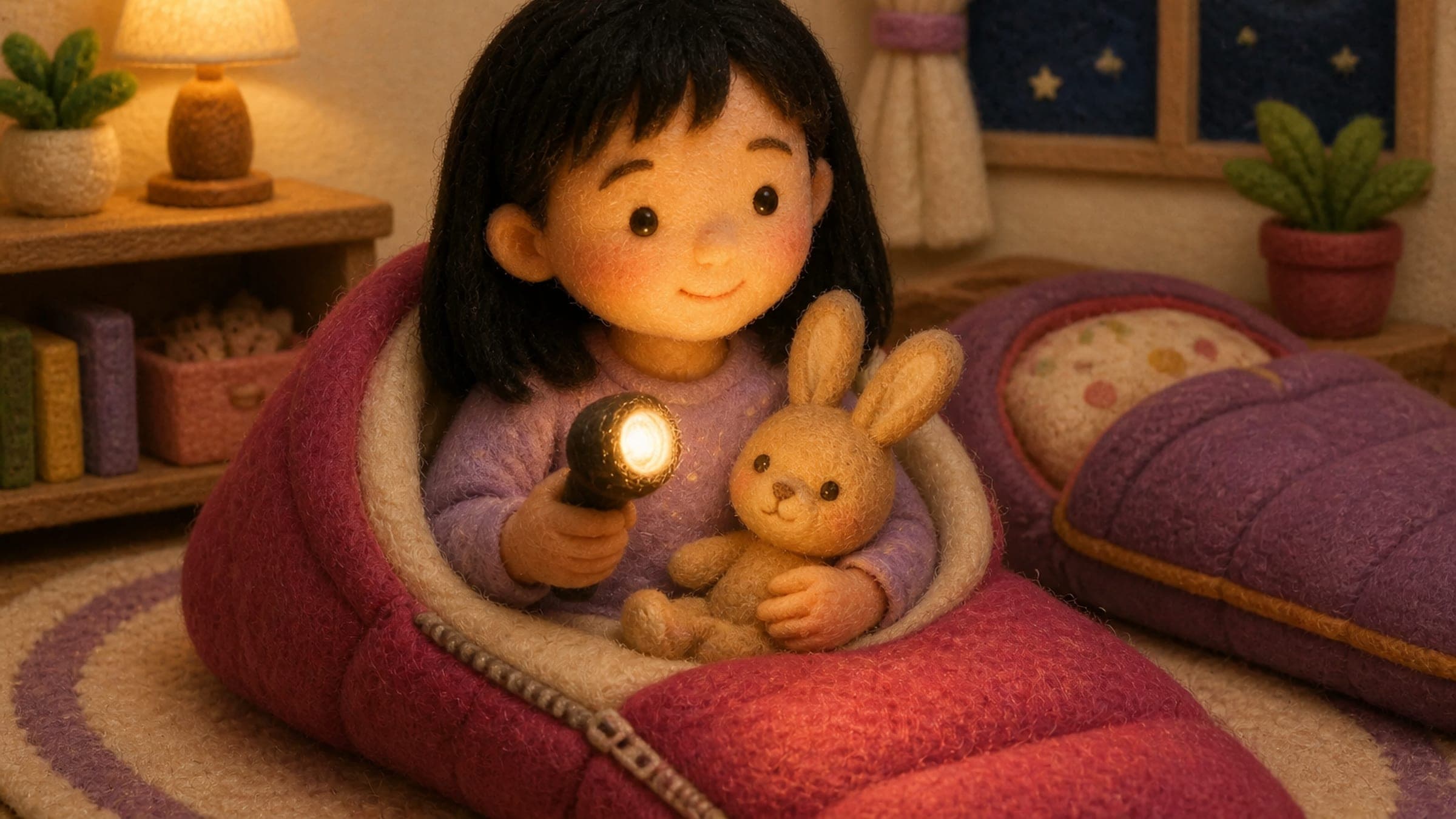
Maya wants the movie and the sleeping bags. At bedtime the house gets quiet. She looks at the photo in her backpack, holds her stuffed rabbit, and remembers the line: she can tell the host parent, and her grown-up will come if she needs them. She tries the sleeping bag. Morning is not promised on page one. The plan is.
Then the read-aloud has a job outside the book: name your child's real comfort object, their real host, and the real pickup sentence, and have them say that sentence once before they close the cover. A story that ends at the last page is entertainment. A story that hands them a plan for 10 p.m. is preparation.
For other everyday moments that can hold a rehearsal like this, see personalized story ideas in everyday family moments.
Keep reading: if the dark is the hard part even at home, start with afraid of the dark.
More related guidance:
- Getting Dressed by Themselves: A Story That Ends the Morning Battle
- Giving Up the Pacifier: When to Wait and How to Say Goodbye
- How to Build a Bedtime Storytelling Routine
- Teaching a Child to Tie Shoes: Start With the Last Step
- Personalized Story Ideas Hidden in Everyday Family Moments
Sources
-
How to Ease Your Child's Separation Anxiety — American Academy of Pediatrics
-
Choosing a Summer Camp and Preparing Your Child: AAP Safety Tips — American Academy of Pediatrics
-
Transitional Objects: Security Blankets & Beyond — American Academy of Pediatrics
-
Toddler Bedtime Trouble: 7 Tips for Parents — American Academy of Pediatrics
-
Anxiety and Depression in Children — Centers for Disease Control and Prevention
-
Tips for Noticing and Naming Emotions — Centers for Disease Control and Prevention
-
How to Help Kids With Sleepover Anxiety — Child Mind Institute