Story ideas
How do you help a child feel confident about new hearing aids?
Prepare a child for hearing aids with realistic expectations, personal choice, an adjustment plan, and a short peer-question script. The audiologist leads.
The short answer
Follow the audiologist's plan. Offer a color or accessory only when that option exists. Say what hearing aids do: they make some sounds louder. They do not restore typical hearing and they do not cure hearing loss. Adjustment takes time and regular wear. Prepare a short answer for questions, plus a way to change the subject. A story can preview the fitting, daily care, and that script. It cannot diagnose hearing loss, promise a listening result, or replace the audiologist.
Key takeaways
- Hearing aids make some sounds louder. They do not restore typical hearing and they do not cure hearing loss.
- Follow the audiologist on style, wear time, and adjustments. Offer a color only when that option exists.
- Adjustment takes time and regular wear. Discomfort, a loud own-voice, whistling, and leftover noise are reasons to go back to the clinic.
- A story can preview the fitting and a short answer for questions. It cannot diagnose hearing loss or promise what the child will hear.
How do you help a child feel confident about new hearing aids?
Follow the audiologist. Say what the device actually does. Offer a real choice only when one exists. Prepare a short answer for questions. Do not treat hearing as a measure of worth.
This page is that job: a child who is about to wear hearing aids, or just started. It is not getting glasses for the first time. Glasses change how a page or a board looks. Hearing aids change access to sound, and the fitting, wear plan, and adjustments belong to the audiologist. Keep the pages separate.
CDC is plain about the ceiling. No single treatment or intervention is the answer for every child or family. Technology does not "cure" hearing loss. It may help a child make the most of residual hearing — the hearing they already have (Treatment and Intervention for Hearing Loss). NIDCD says the same thing in device language: a hearing aid will not restore typical hearing. With practice, it can increase awareness of sounds and where they come from (Hearing Aids).
Your job tonight is smaller than "make them love the aids." Name the real device. Name the color if they get to pick one. Name the sentence they can use if someone asks. A story can walk a character who looks like them through that same script. It cannot diagnose hearing loss, promise a listening result, or replace the audiologist.
What should you say hearing aids actually do?
Say they make some sounds louder. Do not say they make every sound clear. Do not say they fix hearing.
NIDCD describes a hearing aid as a small electronic device worn in or behind the ear. It makes some sounds louder so a person with hearing loss can listen, communicate, and take part more fully. It can help in quiet and in noise. The device that will work best depends on the kind and severity of the hearing loss. If both ears have hearing loss, two aids are generally recommended because two aids give a more natural signal and help with locating sound (Hearing Aids).
CDC says hearing aids can be worn at any age, including infancy, and that they can help many types of hearing loss. A young child is usually fitted with a behind-the-ear style because that style fits growing ears better (Treatment and Intervention for Hearing Loss; Intervention Options). NIDCD notes that in-the-ear casings usually are not worn by young children because the ear grows and the case has to be replaced, and that canal aids are usually not recommended for young children (Hearing Aids). Use the style the audiologist actually fitted. Do not write a story about a tiny hidden aid if the child will wear a behind-the-ear aid.
The American Academy of Pediatrics adds a wear rule that matters more than any pep talk: a hearing aid works only while it is being worn. For a very young child, that means making sure it is on and working. Early placement can give a child awareness of sound and language. Early exposure to spoken language or to visual language, including sign, has a very positive impact on language development. Speech is only one form of communication (Hearing Loss in Children). CDC says families may need to change communication habits or learn skills such as sign language, and that those skills can be used together with hearing aids (Treatment and Intervention for Hearing Loss).
If the hard part later is a first speech-language session, that is starting speech therapy. If the hard part is a procedure day, that is tonsils out or ear tubes. This page stays with the wearable device.
How do you offer color or accessory choice without overpromising?
Offer a choice only when the audiologist or the device actually has one. A color is ownership. It is not a guarantee that the aid will feel good or that classmates will say nothing.
CDC's parent guide is specific: behind-the-ear hearing aids come in skin color and in many bright colors. The child's audiologist helps pick the type that fits that child's hearing loss (Intervention Options). If two colors are on the tray, let the child pick. If the clinic has one option, do not invent a second one in the story.
The same guide explains earmolds. A plastic earmold connects to a behind-the-ear aid and directs sound into the ear canal. Each ear is shaped differently, and a child's ear changes as they grow, so earmolds are made for that child. New earmolds can be made and attached to the same hearing aid (Intervention Options). That is a useful preview: the aid they chose can stay; the piece in the ear may be remade.
- Ask what is actually choosable. Color, stickers, a clip, or nothing. Use the audiologist's list, not a catalog you imagined.
- Let them pick from real options. "Blue or green" is a choice. "Any color you want" is a promise the clinic may not keep.
- Say the color is theirs, not a test. They do not have to love the look on day one. They do not have to show it off.
- Put the real color in the story. If the hero wears a beige aid and the child picked teal, the book is about someone else.
- Keep accessories optional. A clip or a case can help keep an aid from getting lost. It is not a personality.
The steps are editorial sorting. CDC names bright colors and an individually made earmold. It does not publish a "let them decorate the aid" protocol.
If the job is another device a child will live with — a wheelchair, a walker, or a prosthetic — that is using a wheelchair, walker, or prosthetic. This page stays with hearing aids.
How long does adjustment take, and what if they will not wear them?
There is no universal day-count. NIDCD says hearing aids take time and patience, and that wearing them regularly helps the adjustment. Ask the audiologist how long to wear the aid while they are getting used to it (Hearing Aids).
NIDCD lists problems that are common at the start, not proof the child is failing:
- The aid feels uncomfortable at first. Ask how long to wear it during the adjustment.
- Their own voice sounds too loud. That "plugged-up" feeling is the occlusion effect. It is common. Most people get used to it; the audiologist can check whether a correction is possible.
- A whistling sound can mean a poor fit, a device that is not working well, or wax or fluid in the way. See the audiologist.
- Background noise does not fully disappear. A hearing aid does not completely separate the sounds they want from the ones they do not. Sometimes the aid needs an adjustment (Hearing Aids).
CDC's parent guide adds a child-specific whistle: babies and children outgrow earmolds quickly. If the earmold is too small, sound leaks and you hear whistling. Sometimes reseating the mold stops it. If it does not, call the audiologist. The child may need a new earmold (Intervention Options).
Young children also take aids out, play with them, lose them, or put them in their mouths. CDC says that is common and frustrating, and that the audiologist can suggest ways to keep the aids on — including clips to clothing and a battery-door lock. Batteries are dangerous if swallowed. Hearing aids, earmolds, and batteries should never go in the mouth. If one is swallowed, get medical care immediately (Intervention Options).
AAP's wear rule still applies: the aid helps only while it is on (Hearing Loss in Children). "Keep it on" is the clinical job. "They will love the new sounds by Friday" is not a plan. If they will not wear the aid, take the discomfort, the whistle, the loud own-voice, or the leftover noise back to the audiologist. Do not bargain them into a full day because a book said they would feel proud.
| Move | What it is for | What it is not |
|---|---|---|
| Regular wear on the audiologist's schedule | Time and practice so the brain can use the louder sound | A promise they will like every sound by a set day |
| Color or accessory they actually get to pick | Ownership of a device they have to wear | A guarantee classmates will not notice |
| A return visit for fit, whistle, or loud own-voice | An adjustment the clinic can make | Proof the child is being difficult |
| A short answer for questions | A way to end the conversation | A speech they must give every time |
The table is editorial sorting. NIDCD and CDC describe adjustment, fit, and wear. They do not publish a classroom script.
What do you say when a classmate asks?
Prepare two or three lines. Practice them once when everyone is calm. The child chooses which line, or none.
A hearing aid is visible. A classmate may ask what it is. That question is ordinary. It is not a test of whether the child is "confident." Do not write a script that requires them to teach the room or to smile about it.
- Write a short fact line. "They're hearing aids. They help me hear some sounds." Use the child's words if they have better ones.
- Write a subject-change line. "Yeah. Want to play tag?" Not every question needs a lesson.
- Write a grown-up line. "You can ask my teacher" or "Ask my grown-up." They do not have to handle it alone.
- Say they can use none of the lines. Walking away is allowed. So is "I don't want to talk about it."
- Practice once, then stop. A story can hold the same three lines. It cannot make a classmate kind.
If the question turns into teasing or exclusion, that is a different page: being bullied. This page does not treat a curious "what's that?" as bullying, and it does not treat a story as anti-bullying work.
When does a story help, and when does the audiologist lead?
A story helps in a calm hour, as a rehearsal of the fitting, the wear plan, the color they chose, and the answer for questions. It does not help as a diagnosis, and it does not run the clinic visit.
Ordinary curiosity, a tight tummy before the fitting, and a child who wants to know what the aid will look like are the pattern a preview can hold. A book can put a child with their name and face in that room: see the audiologist, try the aid, say what feels okay and what does not, pick a color if one exists, and use a short line if someone asks.
A story cannot diagnose hearing loss. It cannot promise that one book produces comfortable wear. It cannot make every sound clear. Fitting, programming, earmold remakes, wear time, and safety — including battery locks — belong to the audiologist and the medical team.
The names below are invented for illustration. In a real personalized book the hero is your own child, built from your own photo.
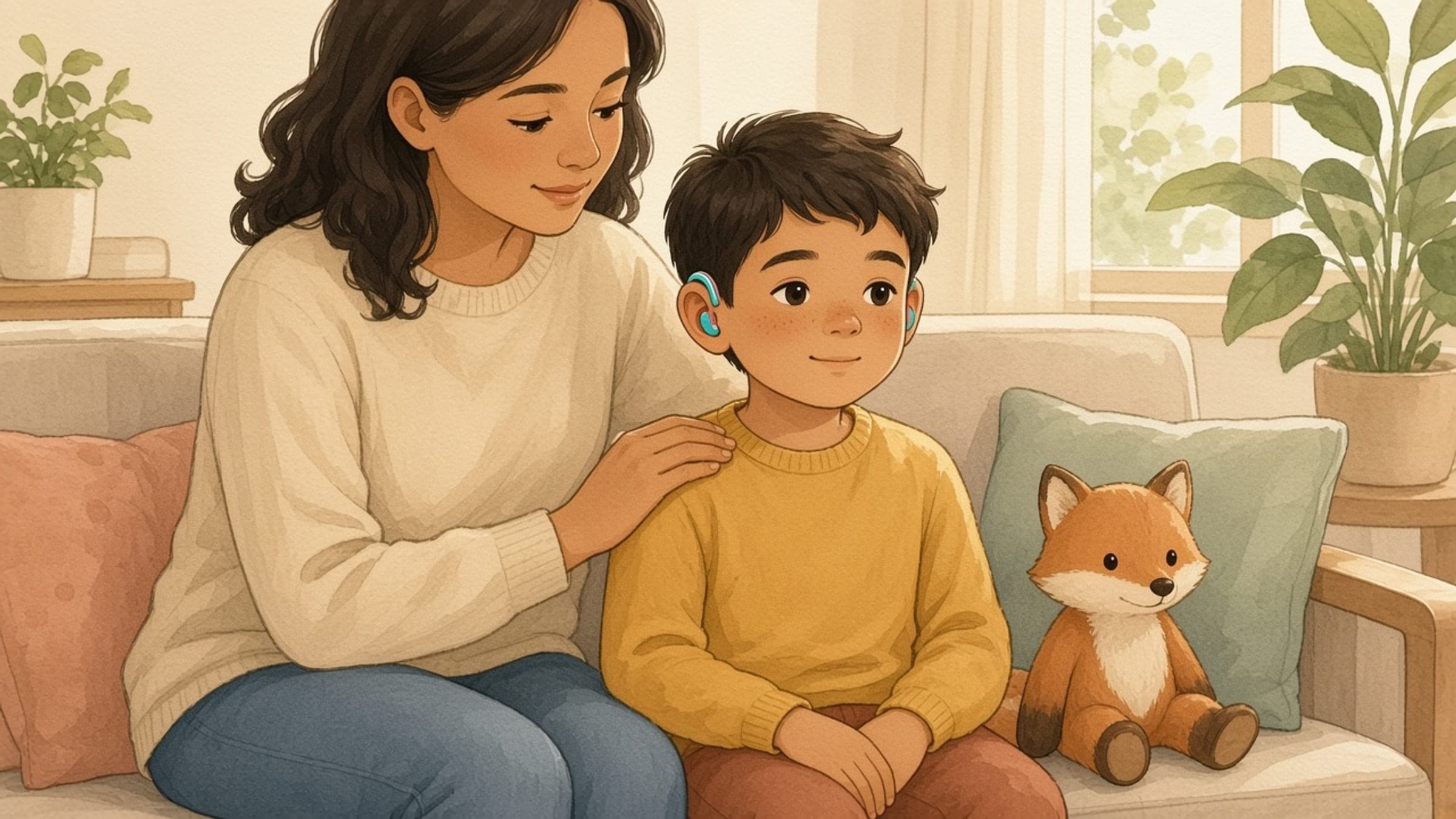
In the story, Mateo sits on the exam chair and names the teal hearing aids he picked from the two colors on the tray. His stuffed fox, Luma, does not make the room quieter. Luma names the steps: in, on, tell the audiologist what feels odd, and the sentence "They're hearing aids. They help me hear some sounds." The last page is not "and then every sound was perfect." It is Mateo wearing the aids on the schedule the clinic gave him, using the line if he wants, and asking a grown-up when the whistle or the loud own-voice shows up.
Then the read-aloud has a job outside the book: say the real clinic, the real color, the real wear plan, and have them say the fact line out loud once before you close the cover. A story that ends at "they loved their hearing aids" is entertainment. A story that hands them tomorrow's plan is preparation.
How the studio keeps the rehearsal specific
The Plot Outline step asks a plain question — "What should happen in the story?" — as a free-text box, with the guidance that a few sentences is plenty. That is where the real color, the real fitting, and the real peer-question line go, in your child's words, rather than a generic "loved their hearing aids" last page. The story requires you to name one Story hero. On the Story step you review the complete written story before illustrating the opening pages, and you can use edit mode if a cure ending or a guaranteed listening result slipped in.
Do not write a last page where one book makes them love the device or hear everything. Write a last page where they knew the plan, they had a choice that existed, and the audiologist was still in charge.
For other everyday moments that can hold a rehearsal like this, see personalized story ideas in everyday family moments.
Keep reading: if the device is glasses, not hearing aids, start with getting glasses for the first time.
More related guidance:
- Living With a Food Allergy? A Story to Practice the Safety Plan
- New Type 1 Diabetes Diagnosis? A Story That Makes the Routine Normal
- Staying Overnight in the Hospital? A Story to Preview the Night
- Too Much Noise or Sensory Overload? A Story to Rehearse Accommodations
- Personalized Story Ideas Hidden in Everyday Family Moments