Story ideas
What are a toddler's most common first words?
A toddler first words list by category: people, food, animals, sounds and social words, how to count signs and word bits, and when to ask about a speech check.
The short answer
A toddler's most common first words are people (mama, dada, a sibling or pet's name), food (milk, banana, more), animals and their sounds (dog, moo, quack), social words (hi, bye, no, uh-oh) and everyday objects (ball, shoe, car). Count signs and consistent word bits too. The CDC lists three or more words besides mama or dada by 18 months, and two words together by age 2.
A toddler's most common first words fall into a handful of groups: people (mama, dada, a sibling's or pet's name), food (milk, more, banana), animals and their sounds (dog, moo, quack), social words (hi, bye, no, uh-oh) and things they handle every day (ball, shoe, car). Signs and consistent word bits count too, and the CDC lists three or more words besides "mama" or "dada" by 18 months.
Key takeaways
- First words name what a toddler sees, wants or plays with every day.
- A "word" is any sound or sign used the same way for the same thing.
- CDC checklists: a word or two besides mama or dada by 15 months, three or more by 18 months, two words together by 2 years.
- Talk to the pediatrician if there are no words by 15 to 18 months, or if words are lost.
The list, by category
| Category | Common first words |
|---|---|
| People | mama, dada, baba, nana, a sibling's name, the dog's name |
| Food and drink | milk, more, juice, nana (banana), cracker, water, all done |
| Animals | dog, cat, duck, bird, fish |
| Animal sounds | woof, moo, baa, quack, meow |
| Social words | hi, bye-bye, no, yeah, uh-oh, thank you (often "tank") |
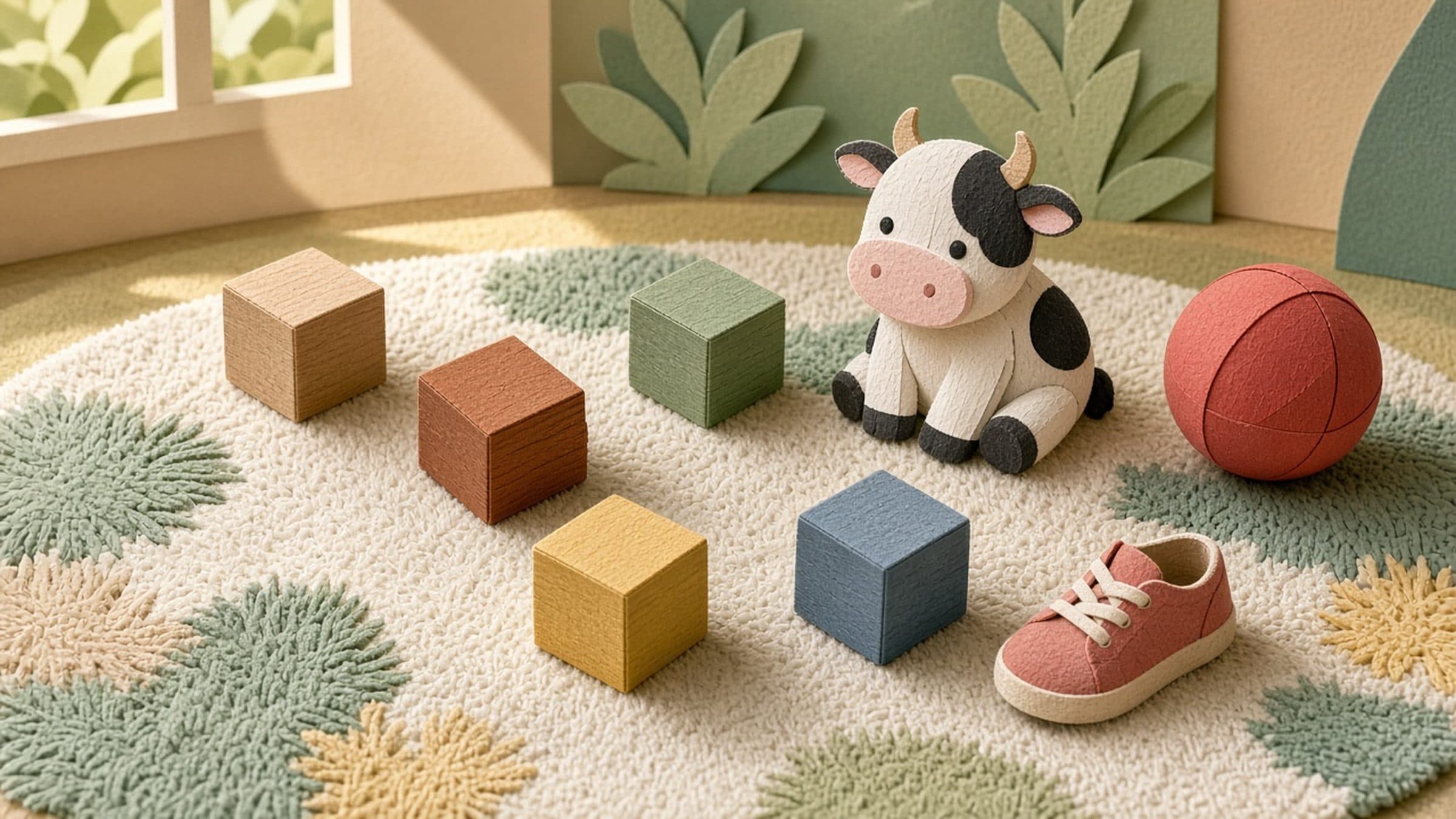
| Toys and objects | ball, car, book, shoe, hat, phone, keys |
| Actions | up, down, go, open, eat |
| Body parts | nose, eye, toes, belly |
The pattern is simple: children name what they meet most and what gets the biggest reaction. "Uh-oh" shows up early because it gets a laugh. "More" arrives fast because it gets food.
What counts as a word
Speech-language pathologists usually count a word when a child uses the same sound or sign, on purpose, for the same thing, more than once. That includes:
- Word bits: "ba" for ball, "wa" for water.
- Animal sounds used to name the animal: "moo" while pointing at a cow.
- Signs: "more," "milk" or "all done" in baby sign.
- Words in any language the family speaks. A bilingual toddler's words in both languages count together.
What doesn't count yet: babble without meaning ("dadadada" to the ceiling), or copying a word once without using it again.
A dated word list
Keep a running list on the fridge or in your phone: the word, the date, and what your toddler meant. For example, "Jan 12, 'da' = dog, at the window." Two reasons to bother:
- It answers the pediatrician's question. At the 18-month and 2-year visits you'll be asked how many words your child says. A list beats a guess.
- It's a lovely record. The first twenty words read like a portrait of your child's world.
Most families stop counting somewhere past 50 words, when new ones arrive faster than anyone can write them down.
What the checklists say
The CDC's Learn the Signs. Act Early. checklists mark ages by which most children (75% or more) have reached a skill:
- By 12 months: calls a parent "mama," "dada" or another special name.
- By 15 months: tries to say one or two words besides mama or dada.
- By 18 months: tries to say three or more words besides mama or dada and follows one-step directions without gestures.
- By 2 years: says at least two words together, like "more milk," and points to things in a book when asked.
ASHA's birth-to-5 chart lines up with these and adds a reminder that each child develops uniquely, even within one family.
When to ask about a speech check
Talk to your pediatrician if:
- Your toddler has no words by 15 to 18 months.
- Your toddler doesn't point, wave or respond to their name.
- Words they used have disappeared.
- You have a worry that won't go away.
The doctor may suggest a hearing test or a referral to a speech-language pathologist. In the U.S. you can also contact your state's early intervention program directly. Asking early never hurts, and it's never too soon to ask.
Helping words along
Talk about what your toddler is looking at. Add one word to theirs: "Dog." "Yes, big dog." Read books together and pause so they can name a picture. These habits support language, but no book, app or video speeds speech on its own, and a slow talker isn't behind because of anything a parent did.
Putting the first words in a book
Some families like to save the first words somewhere more permanent. Our milestones book, with the "toddler firsts" focus, lets you write a few of your child's real first words into the family details so they appear in the story, along with the people who said them back: parents, grandparents, siblings or the dog. It's for children about 1 to 5, and you see a proof before a softcover or hardcover prints, with a PDF included. Browse a sample milestones book, read the milestones gift guide, or see current costs on the pricing page.
Frequently asked questions
Do boys talk later than girls? On average girls start slightly earlier, but the range for both overlaps a lot. Use the same checklist for every child.
Does a second language slow first words? Bilingual toddlers may split words across two languages, but their total vocabulary is typically similar. Count both.
Is "no" a good first word? It's one of the most common. It means your toddler has figured out that words change what happens.
Related reading:
Sources
- Milestones by 18 Months, Centers for Disease Control and Prevention, accessed November 3, 2026
- Milestones by 2 Years, Centers for Disease Control and Prevention, accessed November 3, 2026
- ASHA's Developmental Milestones: Birth to 5 Years, American Speech-Language-Hearing Association, accessed November 3, 2026