Story ideas
When do children start writing their own name, and how should adults help?
Read what a name-writing attempt actually shows, using a published 9-point research rubric, then offer the next step instead of asking for the finished name.
The short answer
Name-writing arrives in an ordered sequence, not on one deadline. The CDC's five-year milestone is "writes some letters in her name" — not a neatly printed full name. ZERO TO THREE puts letter practice at ages 3 to 5, starting with the child's own name. Researchers score name writing on a 9-point scale from scattered scribble to conventional spelling, so a scribble is a rung rather than a miss. Find the rung, then offer the next one.
Key takeaways
- The CDC's five-year milestone is "writes some letters in her name" — not a neatly printed full name.
- Researchers score name writing on an ordered 9-point scale from a scattered scribble to conventional spelling. A scribble is a rung, not a miss.
- Hand skills arrive first. The AAP lists copying a circle and tracing a square at 3, and copying stars and diamonds at 4 to 5 — it does not list name writing at either age.
- Find the rung the child is on and offer the next one. Do not ask for the top of the ladder.
- A story can make practice feel purposeful. It cannot measure development, diagnose a learning difference, or guarantee neater handwriting.
When do children usually start writing their name?
There is no single age when a full, readable name should suddenly appear, and the official milestone is smaller than most parents assume. The CDC lists "writes some letters in her name" among the five-year cognitive milestones — some letters, not a legible signature (Milestones by 5 Years).
Before that, marks move through a fairly predictable sequence. ZERO TO THREE describes five stages: random scribbling from about 15 months, controlled scribbling around 2 to 3, lines and patterns around 2½ to 3½, drawing pictures of objects or people from 3 to 5, and letter and word practice from 3 to 5 — where children "usually start by experimenting with the letters in their own names" (Learning to Write and Draw).
Those two facts together change the job. You are not waiting for a name to appear one morning. You are watching a sequence, and your only real decision each time is which rung the child is on and what the next rung looks like.
This page stays with that decision. The learning-to-read guide covers keeping meaning and enjoyment visible while reading skills form, and the struggling-to-read guide covers what to do when decoding itself is the problem. Neither is the same question as what to do with the marks already on the paper in front of you.
What does this particular mark actually show?
Researchers do not treat name writing as pass-or-fail either. Puranik and Lonigan scored the name writing of 4- and 5-year-olds on an ordered 9-point scale, running from a scattered scribble at 0 to correctly spelled first name at 9 (Contributions of Emergent Literacy Skills to Name Writing, Letter Writing, and Spelling in Preschool Children).
That scale was built to measure groups of children in a study, not to grade your child at the kitchen table. Its usefulness at home is different and simpler: it shows that the messy stages are named stages, in order, and that each one has a specific next step.
| What is on the paper | Where that sits on the research scale | The next rung to offer |
|---|---|---|
| Marks scattered anywhere on the page | Level 0 — no response or scattered scribble | Nothing about letters yet. Big paper, big movements, and let them fill it. |
| A scribble organized into a horizontal or vertical line | Level 1 — a linear scribble | Notice the line out loud: "You kept it going straight across." |
| Separate circles, dots, or short lines rather than one continuous mark | Level 2 — distinguishable, separate units | Point out that writing is made of separate pieces too. Model your own name once. |
| Shapes that look a bit like letters, sometimes running left to right | Levels 3–4 — simple characters, then left-to-right orientation | Name the direction, not the accuracy: "You started over here and went that way." |
| The real first letter of their name, with stand-in shapes after it | Levels 5–6 — first letter present, rest represented by characters | Practice only that first letter. Leave the rest alone. |
| First letter correct plus some other real letters, or more than half the name | Levels 7–8 — real letters appearing through the name | Offer one more letter at a time, in the order they already write them. |
| The whole first name, spelled conventionally | Level 9 | Move on. Practice is done; use the name for real things. |
Two rules make the table usable. First, look for the child's intention before judging the shape — ZERO TO THREE is explicit that if a child scribbles something and then tells you what they "wrote," you should take it seriously. Second, do not erase or trace over an attempt to make it look adult-made. The mark is the evidence you are reading.
What has to be true about the hand first?
A wobbly name is often a hand problem wearing a letter problem's clothes, and the letter practice will not fix it.
The AAP's preschool hand-and-finger guidance gives a useful checkpoint. Around 3, a child's grasp shifts from a whole-fist grip to holding the crayon "like an adult, with thumb on one side and fingers on the other," and they can trace a square, copy a circle, or scribble freely. By 4 to 5, they hold the paper with one hand and the crayon with the other, and can trace and copy geometric patterns such as stars and diamonds (Hand and Finger Skills of Your Preschooler).
Worth noticing what that page does not say: it lists no letter writing and no name writing at either age. The hand skills are described on their own terms, and letters ride on top of them later.
So before adding another name-practice session, check the layer underneath:
- Can they copy a circle? A circle is a closed, controlled loop. Several letters need that same movement.
- Can they trace a square? Corners mean stopping a line and starting a new direction on purpose — the movement behind every letter with a straight edge.
- Does the other hand hold the paper? If the page slides while they write, the shapes will wander regardless of effort.
- Does the hand tire within a minute or two? Fatigue changes what you should ask for next, not how hard you should push.
If the circle and the square are not there yet, the honest answer is that name practice is early. Shapes, chalk, and big movements are the useful work, and they are not a consolation prize. Fine-motor control is the same underlying skill the scissors guide deals with from the other direction.
What does a low-pressure practice session look like?
Use a sequence that can end successfully after one mark:
- Invite: "Would you like to add your mark or one letter?" A no is a legitimate answer.
- Model: Write the name once in plain print where the child can see it. Once — not as a line to copy across the page.
- Choose: Let them pick the crayon, marker, chalk, or tool they can control safely.
- Try one movement: Describe direction plainly — "down, then across" — without asking for a perfect copy.
- Reflect: Ask which part they want to keep, circle, decorate, or show someone.
- Stop early: End while they still have energy. Repetition across days beats one long session.
ZERO TO THREE's guidance for adults is aimed at process rather than product — comments like "Look at the lines you are making — there are so many of them!" or "Tell me about your picture" — and it suggests displaying the work so the child sees it treated as valuable. Displaying a level-2 attempt is not lowering the bar. It is showing the child that the rung they are on counts.
What can a parent say when the letters look wobbly?
The temptation is to say "That's perfect" when the child already knows it is not. Trade the verdict for a question and three legitimate exits:
"You made marks for your name. I can see where you started. Would you like to tell me about this one, try one more movement, or be finished for today?"
| Instead of saying | Say | Why it works |
|---|---|---|
| "That's perfect!" | "You kept that line going all the way across." | Names something real. A child who can see the wobble stops trusting praise that ignores it. |
| "Let me fix that one." | "Do you want to add one more, or keep it how it is?" | Leaves the attempt as evidence instead of replacing it with adult handwriting. |
| "Try to make it neater." | "Want to try the first letter one more time, bigger?" | Turns a vague standard into a single, finishable movement. |
| "You did that yesterday, remember?" | "Tell me about this one." | Invites the child's meaning rather than testing recall. |
| "Just finish your name." | "That's a good place to stop." | Ending with energy left is what makes tomorrow's session possible. |
Children who are frightened of getting things wrong may need the pressure taken off before the crayon helps at all. The mistake-fear guide and the answering-in-class guide both deal with separating a wrong answer from the child's sense of themselves.
When should you raise it with someone?
Milestones are conversation prompts, not a scorecard. Development varies, and the CDC frames its lists as something to discuss rather than a threshold to clear.
Bring specific observations — not a single sample — to your child's teacher or health professional if you have concerns about their overall development, hand use, communication, or progress. "He is still at scribbles at five, tires after about thirty seconds, and holds the crayon in a fist" is a useful sentence. A photo of one bad afternoon is not.
How can a personalized story support practice?
Build the story around a repeatable routine rather than a sudden transformation. A workable sequence shows the hero choosing a crayon, making one meaningful mark, explaining what it represents, taking a break, and coming back another day. The ending can celebrate participation or communication — not a flawless signature.
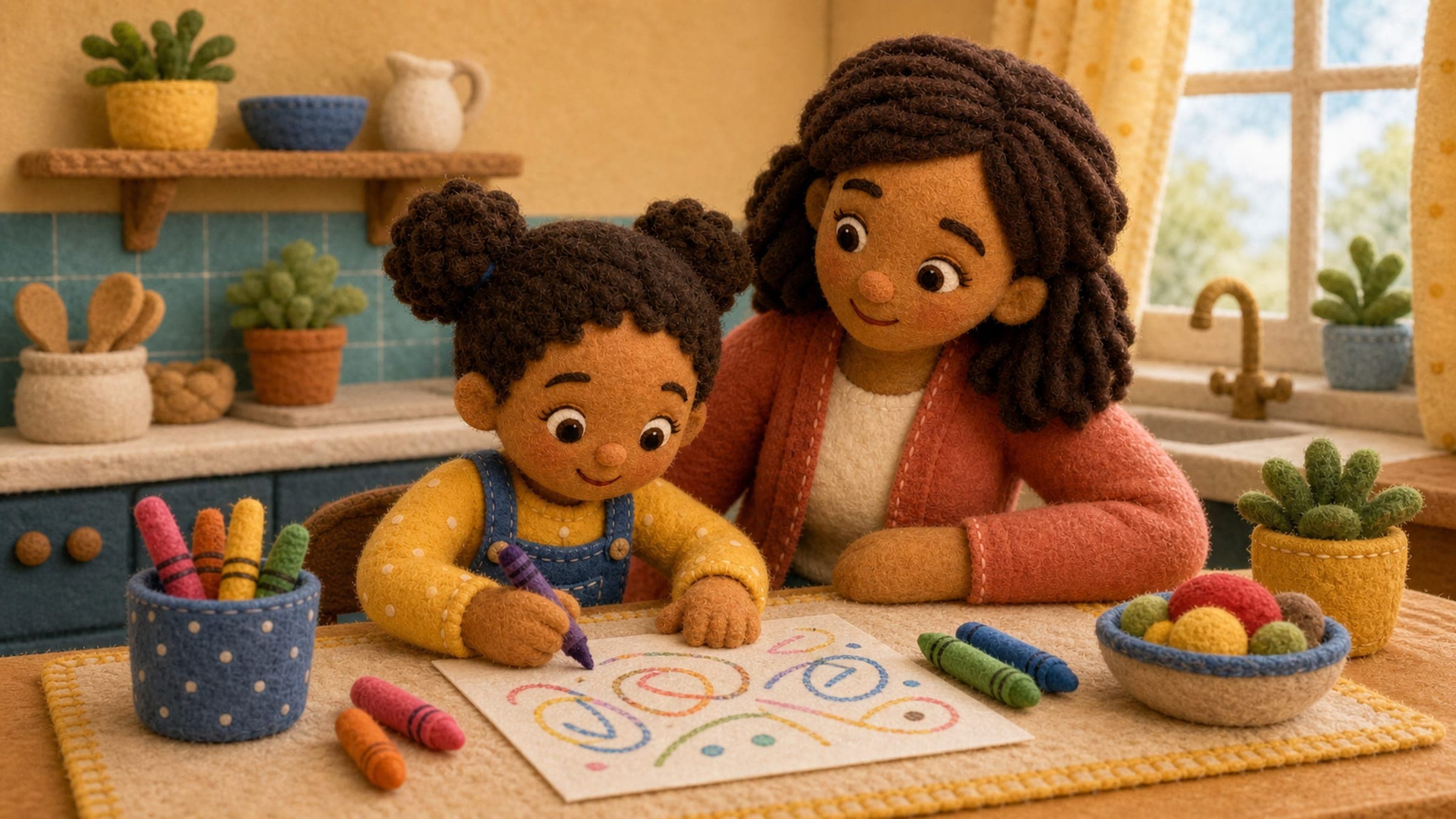
One production detail matters more than it sounds. Keep any illustrated paper free of readable generated letters. The story text can name the goal while the image shows colorful non-symbolic marks and a calm adult nearby. That avoids displaying an incorrect version of the child's name in an illustration, and it keeps the same scene reusable for a child at level 2 and a child at level 7 — who need very different practice but the same story.
For more ideas that turn a small family moment into a specific child-centered story, see the everyday personalized-story guide.
More related guidance:
- What to Do With Anger: A Story About Safe Choices
- Losing a Game: A Story About Handling Disappointment
- Standing Up for Someone: A Safe Upstander Story
- Telling the Truth After a Lie? A Story That Makes Honesty Feel Safe
- Personalized Story Ideas Hidden in Everyday Family Moments
Sources
- Milestones by 5 Years — Centers for Disease Control and Prevention
- Learning to Write and Draw — ZERO TO THREE
- Hand and Finger Skills of Your Preschooler — American Academy of Pediatrics
- Contributions of Emergent Literacy Skills to Name Writing, Letter Writing, and Spelling in Preschool Children — Puranik & Lonigan, Early Childhood Research Quarterly 26(4), 2011