Story ideas
How do you help a child with two moms or two dads answer questions about their family?
Help a child with two moms or two dads answer questions about their family: age-by-age lines, how to tell curious from unkind, and school moments to plan for.
The short answer
Give them one short, true sentence they own, and teach a second skill alongside it: telling a curious question from an unkind one. A curious question gets the sentence, then everyone moves on. A repeated, targeted comment is a different problem, and AAP's sequence for that is stop, walk away, tell an adult. Rehearse both at home. A story can run the rehearsal; it cannot stop targeting at school.
Key takeaways
- Your child needs one short, true sentence about their family that they can say without thinking about it.
- They need a second skill too: telling a curious question from an unkind one. Those get different answers.
- For the unkind kind, AAP's plain sequence is stop, walk away, tell an adult.
- School has a few predictable moments — the family tree, the Mother's Day craft, the form with one "Mother" line. Those are worth getting ahead of.
- A story can rehearse the words at a calm time. It cannot stop a pattern of targeting at school.
How do you help a child with two moms or two dads answer questions about their family?
Give them one short sentence they own, and rehearse it before they need it.
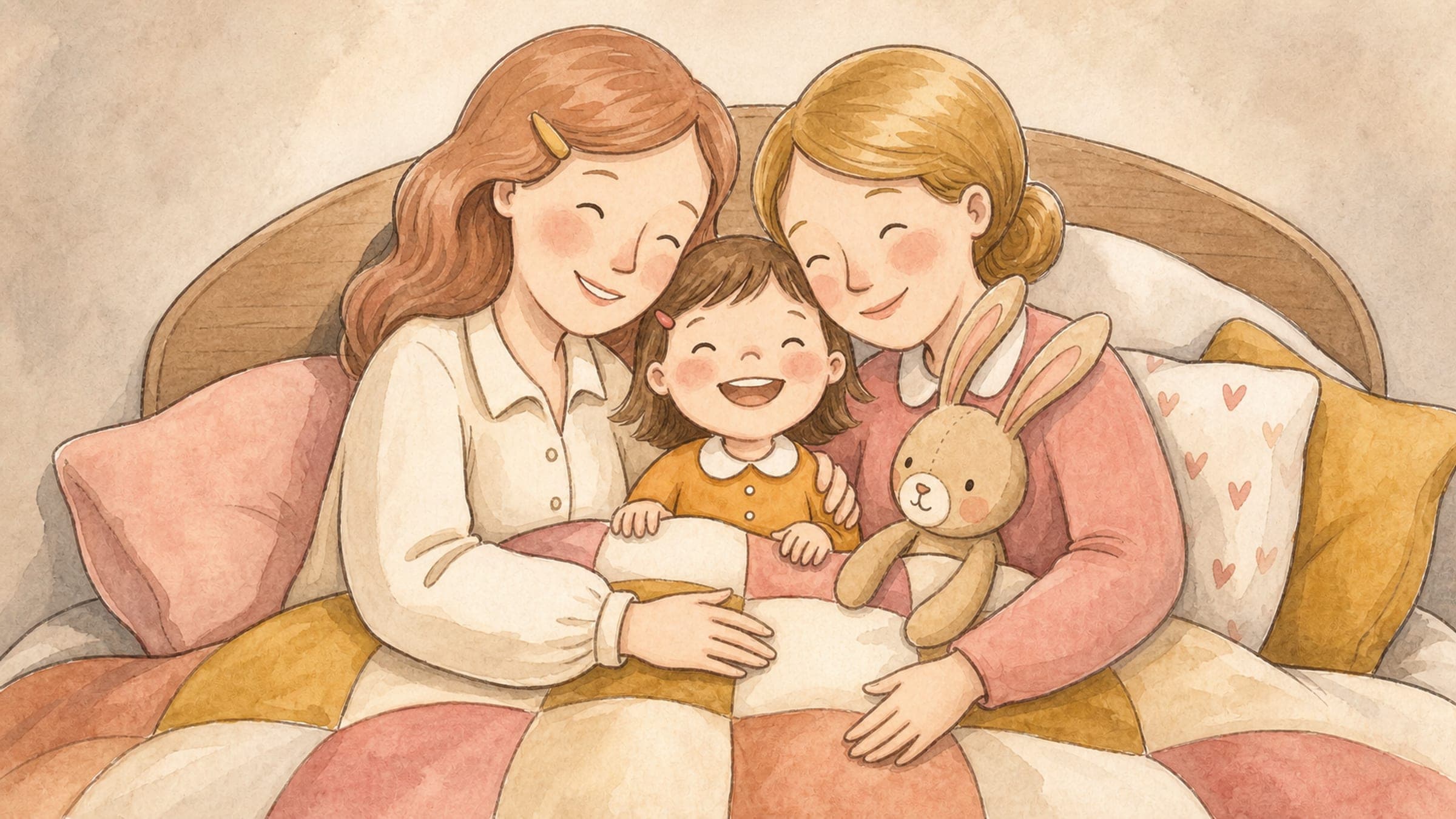
Something like "I have two moms" or "I have a dad and a papa." That is the whole answer. It is not a speech, it does not need a reason attached, and it works best when your child has said it out loud enough times that it comes out flat and ordinary instead of careful.
Then teach the second half, which most advice skips: not every question is the same kind of question. A five-year-old asking "Why do you have two moms?" is doing the same thing they do with a friend's accent or a classmate's wheelchair — sorting the world. The sentence answers it and the conversation moves on. A kid who keeps saying it, with an edge, after your child has answered, is doing something else, and your child needs a different move for that.
Both are rehearsals. Both are easier at your kitchen table than on a playground.
Is our family unusual?
Less than the question implies. The U.S. Census Bureau counted about 1.4 million same-sex couple households in the United States in 2024, close to double the number in 2005, making up roughly 1.0% of all households (More Female Than Male Same-Sex Couple Households in the United States in 2024). Those are household counts from the American Community Survey, not a count of children, so treat the figure as scale rather than a headcount of kids in your child's position.
The wider point is that "different from the family next door" describes most families now. The American Academy of Pediatrics puts it bluntly: fully half of all families do not meet the definition of a nuclear family, and the list it gives includes stepfamilies, single-parent families, households headed by two unmarried partners of the same or opposite sex, multigenerational households, adoptive and foster families, and children raised by grandparents or other relatives (Types of Families).
Worth saying to your child in those terms, because it is more useful than "every family is special." Half the class is in a family that does not look like the one on the worksheet. Some of them are also getting questions. A child being raised by their grandparents or living in two houses is fielding a version of the same playground question.
What do kids tend to ask at different ages?
The questions change shape as children get older. Roughly:
| Around this age | What tends to come up | A line that fits |
|---|---|---|
| 3–5 | "Why do you have two moms?" — plain sorting, no edge | "That's my family. I have Mom and Mama." |
| 5–7 | "Where's your dad?" — they've noticed a missing slot | "I don't have a dad. I have two moms." |
| 5–7 | "Which one is your real mom?" | "They're both my real moms." |
| 7–9 | "But how were you born?" — the mechanics question | "Our family had some help to have me. Want to hear about my family instead?" |
| 9–12 | A comment with an edge, or the same question on repeat | Stop, walk away, tell an adult. |
That table is editorial sorting from the patterns these questions follow, not a developmental schedule from a clinical source. Your child will get them out of order.
Two notes on the harder rows. "Which one is your real mom?" usually is not an attack; it is a kid applying a rule they have been taught about families. "They're both my real moms" ends it without your child having to argue the point.
The birth question is the one parents most want to script and the one your child least needs to answer at school. Your child can hold a version of their own origin story for home and give the deflection at recess — that is not hiding, it is the same boundary any child gets around private family details. How much of the full story you tell, and when, is your call and nobody else's, and it is a separate conversation from this one. A child working out questions about being adopted runs into the same split between the home version and the playground version.
How do you tell a curious question from an unkind comment?
By what happens after your child answers.
- Your child gives the sentence. "I have two dads."
- Watch what the other kid does next. Says "okay" and moves on, or asks one more thing and moves on — that was curiosity. It is done.
- If it keeps going, it changed. The same question on repeat, a nickname, a group of kids doing it together, or a kid who now brings it up every day — that is not curiosity wearing out.
- Switch to the other move. AAP's "stop–walk–talk" sequence: say stop in a firm voice — "Not cool," or "Enough" — walk away calmly, then tell a trusted adult who can help (Why Bullying Hurts All Children—and What Parents Can Do About It).
- Rehearse step 4 physically. AAP suggests practicing the response — look the other child in the eye, stand still, then calmly walk away — and offering to rehearse it until it feels natural, because it takes real courage in the moment.
AAP names this pattern directly: bullying is often about power, and children who "seem different" get picked for it, with verbal bullying including repeated insults based on personal traits such as gender, race, and sexual identity (Why Bullying Hurts All Children—and What Parents Can Do About It). Being ready for it is not pessimism about your family. It is the same preparation you would do for any trait a child cannot change.
On when to escalate, AAP's advice is to start by helping your child feel more capable in the situation, and if the behavior does not stop, to go to school leaders, counselors, teachers, coaches, and your pediatrician (Why Bullying Hurts All Children—and What Parents Can Do About It). If it has already reached that stage, being bullied and being teased for something they can't change go further into it than this page does.
What school moments are worth getting ahead of?
A handful of them are predictable enough to handle in advance, at a calm moment, rather than the night before.
- The family tree. The standard template has two slots with fixed labels. Ask the teacher early whether your child can draw their own shape. Most will say yes without it being a thing.
- The Mother's Day or Father's Day craft. For two dads, the Mother's Day week is the one to raise; for two moms, Father's Day week. Not to cancel it — to agree ahead of time who your child is making one for, so the decision is not made at a table full of classmates.
- Forms with one "Mother" line and one "Father" line. Cross them out and write what is true. Worth doing on the emergency contact and pickup list first, since that is the one that matters when someone is sick.
- "All About Me" week. Usually a good week, not a hard one. Sending in a family photo makes your child's family ordinary in the room before anyone asks about it.
- The classroom bookshelf. If you are already buying books with families like yours, offering one to the class is a low-effort way to make the question less novel.
Teacher conversations go better as logistics than as a position. "Here's our family, here's what we'd like on the forms, here's what we'd want to hear about" is a two-minute conversation at the start of a year.
What can a personalized story do here, and what can't it do?
It can run the rehearsal. A book your child asks for repeatedly is a script they hear repeatedly, at bedtime, with no playground attached — which is a better place to practice a sentence than the moment it is needed.
The names below are invented for illustration. In a real personalized book the hero is your own child, built from your own photo.
In the story, Harper has two moms. At school a kid asks where her dad is, and Harper says the line she already knows: "I don't have a dad. I have two moms." The kid says "okay" and they go back to the game. Later a different kid keeps saying it, over and over, in a voice that is not asking. Harper says "Enough," walks away, and tells Ms. Reyes. The book does not say the second kid became her friend. It says Harper knew what to do both times.
How the studio keeps the story about your actual family
On the Characters step you choose the people and pets you want in the book, so both parents go in as characters from the start rather than being worked around. On the Plot Outline step the studio asks you to tell it what happened and says a few sentences is enough — write the real thing: the names your child uses for each parent, the sentence you want them to own, and which of the two situations above you want the story to rehearse. The Voice step sets the tone and whether it rhymes. When the book is written, the review screen's edit mode lets you change page text, which is where to cut any line that makes your family sound like it needs explaining.
For more everyday moments that can carry a small rehearsal like this, see personalized story ideas in everyday family moments, or how to turn family photos into a children's story.
Keep reading: the "why don't I match?" version of this question comes up differently for a child who is the only kid in class who looks like them.
More related guidance:
- Jealous of the New Baby: Welcome Feelings, Keep Special Time
- Joining a Foster Family? A Gentle Story for the First Days
- A New Stepparent? Help a Child Warm Up Without Forcing It
- A Parent Is Deploying: A Story for Staying Connected
- Personalized Story Ideas Hidden in Everyday Family Moments