Story ideas
What puzzles are right for my toddler's age?
Puzzles for toddlers by age: knob puzzles from about 18 months, 6 to 12 pieces by 3, 20 to 30 at 4, how to pick safe pieces, and how to help without doing it.
The short answer
Start with 2- to 3-piece pre-puzzles, then 3 to 5 knobbed pieces from about 18 months, 4 to 5 pieces from 2 to 2½, and 6 to 12 pieces from 2½ to 3. Seattle Children's then suggests up to 20 pieces from 3, 20 to 30 from 4, and up to 50 from 5. Pick pieces bigger than your child's mouth, stay close with hints, and let them try a few ways before you step in.
Most toddlers can start with very simple puzzles in their second year: 2- to 3-piece pre-puzzles first, then 3 to 5 pieces with knobs from about 18 months. Seattle Children's toy guides then step up to 4 to 5 pieces from 2 to 2½, 6 to 12 pieces from 2½ to 3, up to 20 pieces from 3, 20 to 30 from 4, and up to 50 from 5 (Toys and Play: 1- and 2-Year-Olds and Toys and Play: 3- to 5-Year-Olds, both accessed November 12, 2026). Treat those numbers as a starting point, not a test.
Puzzles by age
| Age | Piece count (Seattle Children's) | What it usually looks like |
|---|---|---|
| First puzzles | 2 to 3 pieces | Pre-puzzles: big shapes that drop into a board |
| From about 1½ | 3 to 5 pieces with knobs | Peg puzzles with a picture under each piece |
| 2 to 2½ | 4 to 5 pieces | Inset puzzles or very simple jigsaws |
| 2½ to 3 | 6 to 12 pieces | First interlocking jigsaws with large pieces |
| From 3 | Up to 20 pieces | Floor puzzles, scenes, shaped puzzles |
| From 4 | 20 to 30 pieces | Jigsaws with clear edges and bold colors |
| From 5 | Up to 50 pieces | Busier pictures, pattern blocks |
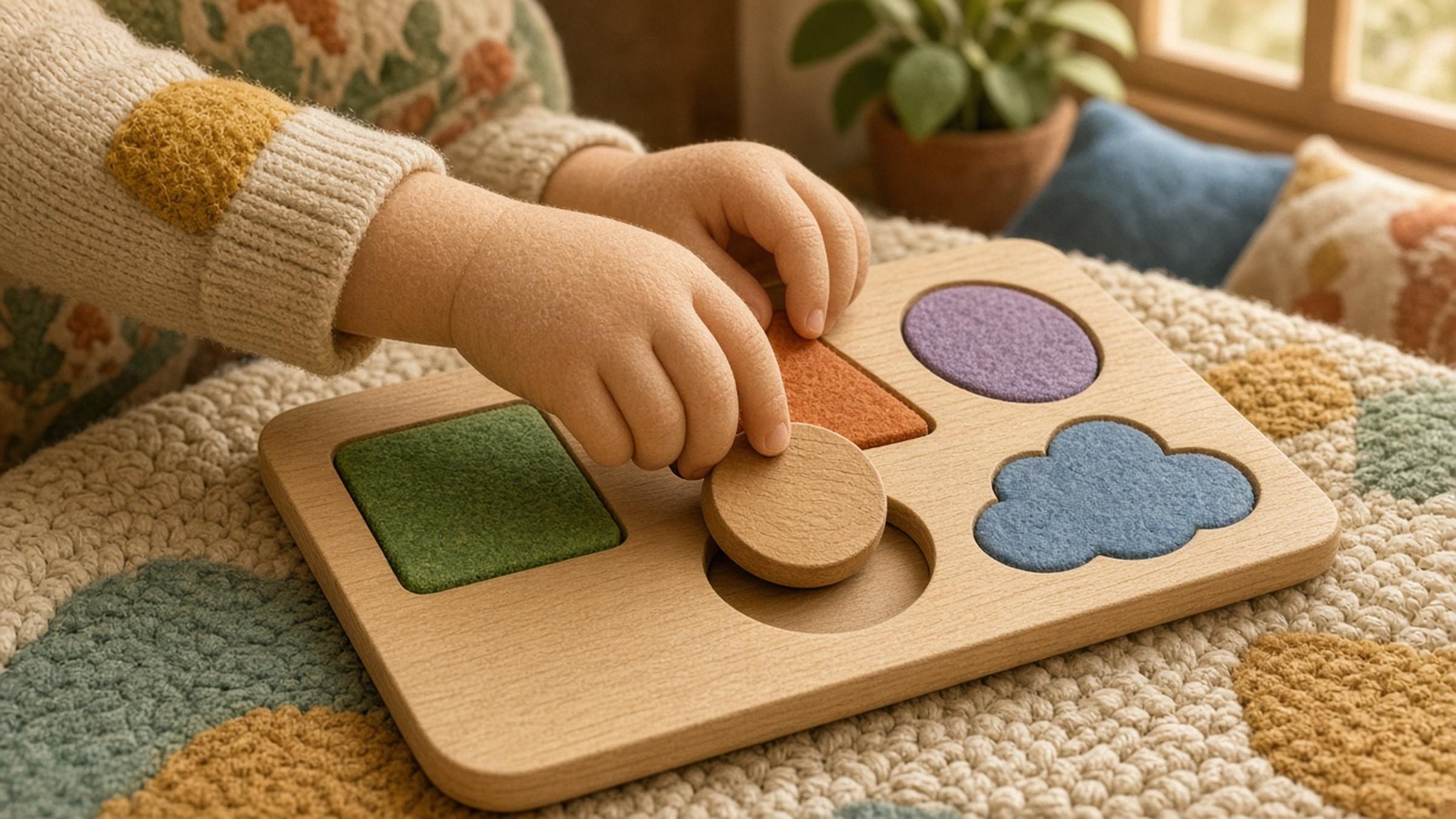
Knob and peg puzzles. Circle first, then square and triangle. Shape sorters and stacking cups fit this stage too. Expect banging and dumping; that's exploring.
Inset puzzles. Each piece has its own spot, and the matching picture underneath gives a hint. Familiar themes help: animals, vehicles, fruit.
First jigsaws. Boxed sets that go from 2 pieces up to 6 or more let a child move up when ready. Giant floor puzzles let them use their whole body.
Bigger jigsaws. By 4 and 5, many children like puzzles with a story in the picture, or a shaped outline like a dinosaur or fire truck.
What puzzles build
- Hand skills. Gripping knobs, turning pieces and pressing them in.
- Seeing shapes and space. Kids learn to turn a piece in their mind before they turn it in their hand.
- Focus. The American Academy of Pediatrics notes that for 1- and 2-year-olds, simple puzzles, latch boards or simple pretend routines can hold a child's attention for 15 or more minutes, often with a parent giving hints about what to try next (3 Ways Your Child Builds Important Life Skills Through Play, accessed November 12, 2026).
- Problem solving. Trial and error: "That didn't fit. Try another way."
- Words. "Corner," "edge," "upside down," "next to."
The same AAP article says attention spans start to stretch at 3 to 4, when more complicated puzzles and simple turn-taking board games are a good fit.
Choosing a good, safe puzzle
- Pieces bigger than your child's mouth. The AAP's toy-buying guide says to make sure all toys and parts are larger than a child's mouth, and to read the label for the ages a toy is safe for (How to Buy Safe Toys, accessed November 12, 2026).
- Thick pieces of wood or heavy cardboard last longer and are easier to grip.
- Nontoxic finishes. The same guide says to check that the label reads "nontoxic."
- A picture under the piece helps beginners.
- Clear images, not busy patterns.
- Themes your child loves. A truck fan will try longer with a truck puzzle.
How to help without doing it for them
- Show once, slowly, then hand it over.
- Point, don't place. "Look at this corner. What's missing?"
- Turn the piece a little if they're close but stuck.
- Start with edges for jigsaws, or sort by color.
- Leave a few pieces out for a first try, then add more.
- Praise effort: "You kept trying different ways!"
A little struggle before help is how the skill grows. If they're about to give up, step in with one small hint, which is the kind of scaffolding the AAP describes.
When frustration hits
- Go back one step to an easier puzzle they can finish.
- Do it together, taking turns placing pieces.
- Take a break and come back.
- Keep puzzle time short and fun.
Some children love puzzles; others prefer building or moving. Both are fine.
Puzzle play ideas
- Hide pieces around the room for a treasure hunt.
- Make your own by cutting a cereal box front into a few big pieces.
- Family photo puzzle: print a photo, glue it to cardboard, and cut it into large pieces.
- Beat the timer for older kids, just for fun.
Puzzles and other milestones
Puzzles grow alongside other skills, like learning to use scissors, teaching colors counting and hopping, skipping and jumping. If something about your child's hand skills or play worries you, bring it up at the next well visit. Pediatricians would rather hear a small concern early.
Books and puzzles together
Look-and-find books are another favorite for puzzle lovers. A personalized milestone book can celebrate the new things your child is learning to do, from first puzzles to first bike rides. See the milestones book and milestone gift ideas.
Puzzles on the go
Puzzles don't have to stay on the playroom floor. A small zip bag with a four-piece puzzle fits in a diaper bag for restaurant waits. Magnetic puzzle books work in the car without pieces sliding under seats. Some families keep one "waiting room puzzle" that only comes out at doctor visits, so it stays special.
Storing puzzles so pieces don't get lost
- Keep each puzzle in its own zip bag or a labeled box.
- Draw a small shape or number on the back of every piece in the same marker, so a stray piece finds its way home.
- Store only a few puzzles within reach and rotate the rest.
- Count the pieces together at clean-up. It's also counting practice.
FAQ
Are puzzle apps as good as real puzzles?
Real puzzles give hands more to do; apps can be an occasional extra.
How many puzzles does a toddler need?
A few, rotated every week or two, keep them interesting.
My 3-year-old can't do jigsaws yet. Should I worry?
Not on its own. Go back to inset puzzles, keep it fun, and mention it at a well visit if other skills worry you too.